本文へジャンプ

【地元道産木材が魅せる空間美〜 i-works参観8】


 深掘り的に1軒の公開住宅を見て来たシリーズ・i-works参観ですが、本日でブログの記述としては一応の最終。今後もし機会があれば、いろいろ知りたかった点について確認したいと希望してはいます。さてそういう機会はあり得るでしょうか。
 あ、住宅性能的なポイントについては辻野建設さんのHPで記載がありましたので、そちらを参照ください。住性能について徹底探究されてきた同社らしく、北海道で独自技術として発達してきた「パッシブ換気」を活用した温熱環境が詳述されています。この公開時にはそういった点についての詳細情報は受けていませんでしたので、記述は避けました。他意はありませんのでよろしく。
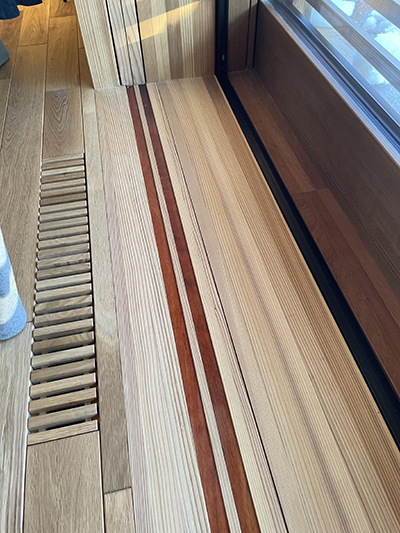
 で、参観していて驚かされ続けていたのは、写真のような住宅の細部に至るまで、徹底的に「地元木材」にこだわって空間構成されていること。材料や手間を考えればまことに究極的な仕上げ。しかし、こうした水回り空間は、住まう人がそのハダカの人間に帰る時空間でもある。そういう空間で「呼吸レベル」で自然素材と直にふれあってその心理的「再生」営為ができるというのは、すばらしい体験感。地域に根ざした作り手としての辻野建設さんの姿勢もわかりやすく伝わってくる。住宅って、その立地する地域の中で、できれば「ながく生き続けたい」と絶対に志向する存在。このような作り手としての徹底ぶりには、共感する部分が大きい。

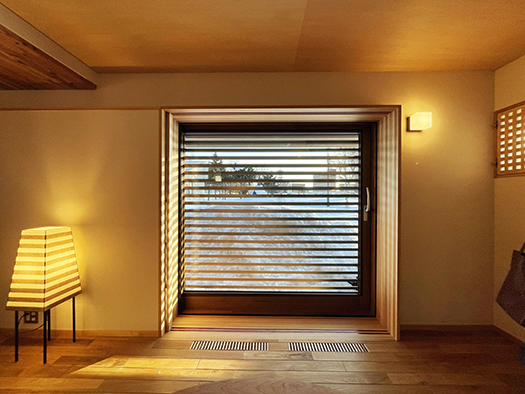
 そんな企業姿勢は大屋根の三角屋根の「軒天」部分にまで地元産材使用ということで真情を見せてくれているではありませんか。驚いた。空間デザインということでは沖縄出身で、東京芸大の住宅思潮を継承されている伊礼智さんが主旋律を奏でているけれど、この徹底した地元産木材使用へのこだわりは、その部位ごとでの取捨選択眼、仕上げという部分も含めて、ストレートに訴求してくる。
 今回公開住宅ということで、深掘り的に住宅探訪できて非常に楽しかった(笑)。機会をお知らせいただいたのは新住協の札幌支部からのお誘い。地域の作り手たちが相互に「切磋琢磨」していくためにはこうした情報交流が必須だと思います。深く感謝するとともに、情報摂取は今後とも機会をつねに探っていきたいと考えております。ぜひ今後ともこうした「公開住宅」についての情報をお知らせいただきたいと思います。どうぞよろしく。

English version⬇

The beauty of the space created by local timber from Hokkaido – i-works visit 8
Fostering a sense of atmosphere with ‘local timber’ in every detail of the water area. The sense of happiness that the real thing communicates with you in a space where you can go back to being naked and regain your energy. …

 Today is the final blog entry in the series of i-works visits, in which we have looked at one open house in depth. If there is an opportunity in the future, we hope to confirm the points we wanted to know more about. I wonder if there will be such an opportunity.
 Oh, please refer to Tsujino Kensetsu’s website for more information on home performance points. As a company that has thoroughly explored housing performance, the thermal environment that utilises ‘passive ventilation’, a technology developed uniquely in Hokkaido, is described in detail. At the time of publication, we had not received detailed information on these points, so we have avoided describing them. Please note that we have no other intention.
 What kept surprising us during our visit was the fact that even down to the details of the house, as shown in the photos, the space was constructed with a thorough focus on ‘local wood’. Considering the materials and labour involved, this is truly the ultimate finish. However, such a water space is also a space where the inhabitants return to their naked selves. It is a wonderful experience to be able to directly interact with natural materials on a ‘breathing level’ in such a space and to be able to engage in the psychological ‘regeneration’ activities. Tsujino Kensetsu’s attitude as a builder rooted in the local community is also clearly conveyed. A house is an existence that people want to live in for a long time in the area where it is located, if possible. This thoroughness as a builder is something I feel a great deal of empathy with.

 Such a corporate attitude is shown in the use of local timber even in the ‘eaves’ part of the triangular roof of the main roof, which shows the true spirit of the company. I was surprised. The main melody of the spatial design is played by Satoshi Irei, a native of Okinawa and heir to the Tokyo National University of Fine Arts and Music’s housing philosophy, but this thorough commitment to the use of local timber, including the selection and selection of each part and the finishing touches, appeals to us straight away.
 As the house was open to the public this time, it was very enjoyable to explore the house in depth (laughs). The Sapporo branch of the Shinjyukyo invited us to take part in this event. I think this kind of information exchange is essential for local builders to engage in mutual ‘friendly competition’. We are deeply grateful and will continue to seek opportunities for information intake. We would be very grateful if you could keep us informed about these ‘open houses’ in the future. Thank you very much.

【吹き抜け2階に室内「縁側」的空間〜 i-works参観7】


 札幌はここ数日ようやく積雪が続いて帳尻合わせのように冬が帰ってきていますが、ずっと少雪が続いておりました。しかし札幌から少し30kmくらい北の、この家が建つ「当別町」では十分な積雪があって、ほぼ例年並みの環境に触れられました。雪面の反射がまぶしくて楽しい。
 真冬の積雪という環境もそこで暮らす人びとにとっては、貴重な「季節感」をDNA的に染み込ませてくれる大きな要素。そういった外部環境との「同心」というのが日本住宅建築の非常に重要な、優越的な要素であることは普遍の真実だろうと思います。そういう生活文化伝統 in北海道ということですが、これまでの北海道の家づくりでは、それはあくまでも「外光の導入」という無機的な機能性だったように思える。冬の外部景観への気遣いはむしろ遮断させて室内の温熱環境保全が優先されてきた。
 ところがこのi-works住宅・伊礼智建築では、居間の吹き抜け空間に面して2階にまるで「室内バルコニー」的な、あるいは「縁側」的な空間が仕掛けられていた。「あれ、ちょっと変わった空間だなぁ」と目に飛び込んでくるのですね。
 ふつうは居間1階から周辺への眺望が企図されるものだと思うのですが、この住宅では重厚な建具収納が室内側に露出していて、開口部が比較的に閉鎖的に仕掛けられている。外部との「交歓」的な空間としてはその開口部から外に出たデッキ空間に集約・想定されていた。
 一方、この2階では開口部は左右方向に幅広く取られていて、ちょうど和風住宅建築での室内の縁側のような空間が仕掛けられている。ここからはさらに外部に出て縁側的なベランダが配置されていた。これはわたしの参観しての実感ですが、日本の伝統的住宅が大事にしてきた「ウチとソト」の融通無碍な暮らし感覚が再構築されていると感じられた。
 そしてこの空間に大きな軒の出を掛けて風雪から守っている。1階では当然その屋根から落雪してくるのであえて開口部を小さめにして、外部景観との「対話」は2階のこの空間とする企図かと思った。

 こういう空間でしたが屋根は「降りていく」方向なので、天井高は低くなっていく。この写真は2階の縁側への出入りの結界。ちょうど「立った」高さ目線で写真にして見た。ごらんのようにそのままではアタマが通らないので、やや屈まなければならない。家に慣れれば人間はその空間での「作法」を身に付けるけれど、トリセツ的注意は必要かと思った(笑)。そうです、わたし、アタマぶつかっておりました。あ、そういう人はわたしだけでしたが。

English version⬇

The indoor ‘veranda’ space on the second floor of the stairwell – i-works visit 7.
Is the eaves of the large roof a device that ‘cuts off’ the external landscape and allows the visitor to perceive ‘home and countryside’ from the edge? A challenge to the sense of flexible and impervious living in a northern country. …

 Winter has finally returned to Sapporo, as if it had finally been written off after a few days of snowfall, but there had been little snowfall for a long time. However, in the town of Tobetsu, where this house is built, a little more than 30 km north of Sapporo, there was enough snow to make the environment almost as good as usual. The reflections on the snow surface are dazzling and enjoyable.
 For the people who live there, the midwinter snowfall is also a major element that imbues them with a precious sense of the season in their DNA. I think it is a universal truth that such ‘concentricity’ with the external environment is an extremely important and superior element of Japanese residential architecture. It is that kind of lifestyle and cultural tradition in Hokkaido, but it seems to me that in Hokkaido house building to date, this has only been an inorganic functionality of ‘introduction of outside light’. The concern for the external landscape in winter has rather been blocked out and priority has been given to the preservation of the indoor thermal environment.
 However, in this i-works residence by Satoshi Irei, an ‘indoor balcony’ or ‘veranda’ like space was set up on the second floor facing the living room atrium. The building is a bit like an ‘indoor balcony’ or ‘veranda’ on the second floor.
 Normally, a view from the first floor of the living room to the surrounding area would be planned, but in this house, the heavy fixture storage is exposed on the interior side and the opening is set up in a relatively closed manner. As a ‘communal’ space with the outside, it was concentrated and assumed to be a deck space outside through that opening.
 On the second floor, on the other hand, the openings are wide in both directions, creating a space similar to an indoor veranda in a Japanese-style residential building. From here, a veranda was placed further outside. This is my impression from my visit to the house, but I felt that the sense of flexible and impervious living between home and country, which has been valued in traditional Japanese housing, has been reconstructed.
 The large eaves are hung in this space to protect it from the wind and snow, and as snow naturally falls from the roof on the ground floor, I thought the opening was deliberately kept small, so that the ‘dialogue’ with the external landscape would be in this space on the second floor.

 It was this kind of space, but the roof was oriented ‘down’, so the ceiling height became lower. This photo shows the boundary of the access to the second floor porch. The photo was taken from the perspective of just ‘standing’ height. As you can see, you have to bend down a little because you can’t pass your head as it is. Once you get used to the house, you learn the ‘manners’ of the space, but I thought it was necessary to pay attention to the ‘tricks’ (laughs). Yes, I had a head-bump. I was the only one who did that.


【おお、リバウンド大雪 in さっぽろ】


 記録的な高温・少雪という1月を過ごさせていただいた札幌市民でありますが、やはり冬将軍さま、このまま平穏に退場ということにはなりませんでした(泣)。上の図は札幌管区気象台HPからの転載で、わが家周辺(札幌市西区)のことしの冬の雪の状況を表しています。上が「降雪量」で下が「積雪深」。
 降雪量で見ても今年になってずっと折れ線グラフが平行状態で、30日になって急上昇。積雪深でも、ずっと下降していたものが一気に急上昇であります。ということで、昨日朝は20cm超になっていた積雪に対して、超久しぶりの除雪作業。合計50坪ほどの面積平面を除雪しておりました。会社事業としては離れたわけですが、事務所兼用不動産管理者としては、賃貸している事務所の機能性を担保すべき「大家」さんの職責の実行。
 カミさんと早朝散歩習慣を共有するようになっているのですが、昨日はこの除雪作業で早朝散歩に代替しておりました。体力的にはむしろ軽めで、スマホの「歩数計」ではいつもの半分程度の運動量。また通常のこの時期の「大雪」では朝だけではなく、日中にも除雪作業するケースがあるのですが、昨日はそこまでの「ドカ雪」ではなくて模様眺めでスルーしておりました。

 ということでしたが、予報ではごらんのように金土日と3日間は20〜30cmの降雪が続くという警告。その後いったん休止してくれるようですが、来週も大雪が続くとされていた。まさに「リバウンド大雪」。柔和な表情を見せていた冬将軍が突然表情を一変させて、凶暴な本性を遺憾なく発揮してくれている。
 ここのところ、ブログ記事ではすっかり伊礼智さんのi-works住宅参観記が続いていましたが、しばし冬将軍様への応接に専念したいと思います。
 一方で、新設個人会社としての業務というか、継続して取り組んできた各案件が、それぞれ一斉に目に見えるカタチになってきています。まぁ高齢期での個人企業なので、じっくりと腰を落ち着けて取り組んでいきたいと思います。発表できる段階になったら、それぞれ公開して参りますのでよろしく。
 さて外は、本日もきのう以上の積雪深のようです。北海道人はあんまり「庭仕事」趣味はやらない傾向にありますが、考えて見るとこの「雪かき」作業って、庭仕事以上のものだと気付いてきています。よしやるぞ。

English version⬇

Oh, rebound heavy snow in Sapporo.
Hokkaido people don’t have a habit of doing ‘yard work’ for themselves, but they are serious about semi-public snow removal. We’re not going to give up!

 The citizens of Sapporo had a record high temperature and low snowfall in January, but General Winter did not leave the city peacefully (tears). The figure above, reproduced from the website of the Sapporo District Meteorological Office, shows the winter snowfall in the area around my house (Nishi Ward, Sapporo) this year. The upper figure shows the amount of snowfall and the lower figure shows the depth of snow cover.
 The line graph for snowfall has been in a parallel state all this year, but it rose sharply on the 30th. The snow depth, which had been falling for a long time, also rose sharply at once. So, yesterday morning, we had to remove snow for the first time in a very long time, as the snow had accumulated to over 20 cm. In total, we had to remove snow from an area of about 50 square metres. As a company business, we have left the office, but as the office and property manager, I am responsible for ensuring the functionality of the leased office.
 I have come to share the habit of taking early morning walks with my wife, and yesterday this snow removal work replaced my early morning walks. Physically, it was rather light, and the ‘pedometer’ on my phone showed half the usual amount of exercise. Also, in the case of heavy snowfalls at this time of year, there are cases where snow removal work is carried out not only in the morning but also during the day, but yesterday it was not that heavy a snowfall, so we just went through with a view of the scenery.

 This was the case, but as you can see, the forecast warned that 20-30 cm of snowfall would continue for three days on Friday, Saturday and Sunday. It seemed to pause once after that, but the heavy snow was supposed to continue next week. A true ‘rebound heavy snow’. General Winter, who had been showing his meek face, has suddenly changed his expression and is now showing his ferocious nature without regret.
 In recent days, my blog posts have been completely devoted to Satoshi Irei’s i-works housing visits, but I would like to focus on responding to General Winter for a while.
 On the other hand, our work as a newly established private company, or rather, the projects we have been continuously working on, are all taking visible form at once. Well, since we are a private company in our old age, we would like to take our time and sit down to work on these projects. When we get to the stage where we can make an announcement, we will publish each of them.
 Outside, it looks like there is more snow today than yesterday. Hokkaido people tend not to do much ‘gardening’ as a hobby, but when I think about it, I am beginning to realise that this ‘snow shoveling’ work is more than just gardening. Okay, let’s do it.

【家族の求心力醸成が「住」最大の役割か?〜 i-works参観6】


 この住宅では北海道産の表情豊かな木材が、それこそ軒天部分に至るまでたっぷりと使われて、その醸し出される素材感が素晴らしい。また、住宅性能的には北海道でもきわめて先進的なビルダーである辻野建設さんらしく、パッシブ換気が導入され、また屋根上にはPVも設置されて技術的にはまさに最先端的。
 そういったポイントについてはHPなどで明示されています。
 わたしとしてはよりユーザー視線に立って、i-worksのコンセプトの部分にフォーカスしてみたいと思った次第。そういう視点からの気付きとしてこのモデル住宅ではテレビ画面の設置箇所が想定されていなかった。実は内心で「おお」と大いに同意させていただいた次第。ちょうどタイムリーにフジテレビと芸能人「中居氏」問題が世間を賑わせているタイミングで、家づくりでも「そろそろ、テレビの情報取得最優先」の暮らしプランニングやめませんか、と提起されたと感じたのです。
 テレビって、家の中でこれまでは「家族団欒」の中心的なメディア装置と無意識に想定され、その画面視野確保が、もっとも重要なインテリア要件だったと思えます。ところがこのi-works住宅では食卓テーブルからも居間空間からも、そういった視線確保が見られる壁面が想定できなかった。あえて言えば、先日触れた室内側の外光コントロールの建具のための収納箇所壁面が想定できるだろうけれど、そこには2階の「室内縁側」的な廊下空間を成立させるための美しく磨き上げられた柱が象徴的に立っている。なので、大型テレビ画面を設置するにはやや不似合いかと思えた。

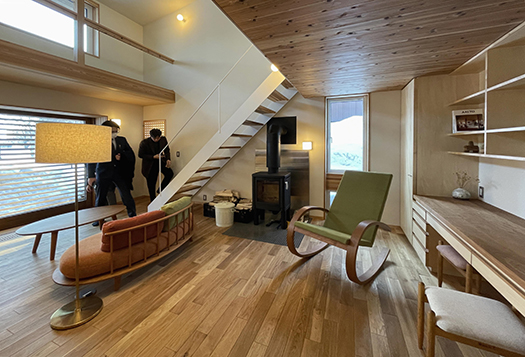
 一方で、そういった家族団欒コミュニケーションには「薪ストーブ」がそのメインの雰囲気醸成装置として1階空間全体の中で機能していると感じられた。暖房機能としてはパッシブ換気に伴う加熱装置が基本性能を提供しているので、この薪ストーブはいかにも「見せる装置」とも思える。たぶんイマドキからさらに将来的に家族の共有時間というものは「時短」傾向に向かうだろうなかで、薪ストーブというのはある種、家族の一体感にとって象徴的な意味合いを持つのではないか。人類初源的な炎のパワー。
 そしてこれからの住宅にとって、このような家族関係の「求心力」こそが核心部分になっていくのではないだろうか、と考えさせられた次第です。考えすぎかなぁ(笑)。

English version⬇

[Is fostering family centripetal power the greatest role of ‘housing’? ~ i-works visit 6]
Stop living a TV-centred life and enhance family love. In the end, the ‘role of the home’ is to protect and nurture warm family ties. …

 The house is made from a wealth of expressive timber from Hokkaido, right down to the eaves, which gives the house a wonderful sense of materiality. In terms of house performance, Tsujino Construction is an extremely advanced builder in Hokkaido, and has introduced passive ventilation and PV on the roof, which is truly cutting-edge in terms of technology.
 These points are clearly explained on the website.
 For my part, I wanted to focus on the concept of i-works from the user’s point of view. From this perspective, I noticed that this model house did not have a TV screen installed. In fact, I was inwardly very much in agreement with the idea. I felt that the timing of the Fuji TV and the celebrity ‘Mr Nakai’ issue was timely, and that it was suggested to me that it was time to stop planning a lifestyle where the TV was the top priority in terms of information acquisition.
 Televisions used to be unconsciously assumed to be the central media device for family reunions, and the most important interior requirement was to secure the field of view of the screen. However, in this i-works house, it was not possible to envisage a wall surface where such a secure line of sight could be seen from either the dining table or the living room space. If I had to venture a guess, I would say that the storage wall for the exterior light control fittings on the interior side, which I mentioned earlier, could be assumed, but there is a beautifully polished pillar symbolically standing there to establish the ‘indoor porch’ corridor space on the second floor. Therefore, it seems somewhat unsuitable for a large TV screen.

 On the other hand, it was felt that the wood-burning stove functions as the main atmosphere-building device for such family reunion communication in the entire ground floor space. As the basic heating function is provided by the heating system with passive ventilation, the wood stove can be seen as a ‘show device’. In the future, when family time is likely to become shorter, the wood-burning stove may have a symbolic meaning for the sense of family togetherness. The power of the flame is primordial to mankind.
 It made me think that this kind of ‘centripetal force’ in family relationships will be at the heart of the future of the house. Maybe I’m thinking too much (laughs).

【天井高が低めのパターンメイド住宅〜 i-works参観5】


 伊礼智氏がはじめて北海道で建てられた「i-works」シリーズ住宅探訪記、いろいろな時事テーマが飛び込んでしまって中断していたら「続きを書け」という激励文をいただきました(汗)。
 まったくその通り。人間が他の人に役に立てられるのはその「本願」の場所でこそ、でしょうね。
 ということで、短時間の住宅探訪時間でしたが、気付いていたポイントについて復帰。それは「天井高」についてであります。こちらの住宅の室内に入って一番最初に気付いたのもこのポイント。「あ、なんか低めだ」と。実はブロック造のわが家でも天井高を低めにして、一方で上下階の「吹き抜け」を対置して、そのコンビネーションを生活現場的にそれぞれの空間特性を交互に楽しむという暮らし方を選択してきています。このi-works住宅でも低い天井空間と吹き抜けの開放感とが、まるでシンフォニーのように「共鳴」し合っているように感じられた。
 現場での住宅説明ではこの点は触れられていませんでしたが、写真の「居間」にある階段を上ってみたら、段数は12段と通常とは少なめになっていたので確認できた。で、そこから2階に上がってみたのですが2階の天井高もほぼ同様だと推認できた。いや、三角屋根の形状に沿ってその端部では、当然ながらもっと低くなっていた。こういった住宅仕様が、建築家の提案する住宅シリーズ〜パターンメイド住宅と激励文をお寄せいただいた方は名付けられていましたが、このポイントは大きな特徴になるのでしょう。(オーダー住宅と規格型住宅の中間解のひとつと定義して、この用語を当てて見たい)
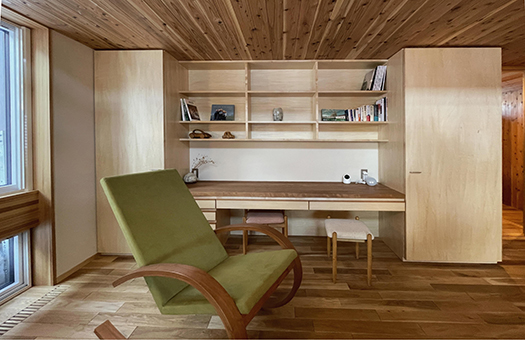
 いろいろな建材サイズは左右方向ではなかなか変えられないけれど、天地方向では変えやすい。2枚目の写真は居間の1コーナーの「書斎」的な空間。左手には薪ストーブもしつらえられていて、こんな場所で読書したり文章を練り上げたりするのには魅力的ないごこち空間と感じておりました。たぶん意識下の部分で、サイズ的に天地左右の寸法感覚から人間の「意識集中」に効果的なのではないかと思えた。・・・いいねこれ。
 低めの天井高なので、本棚として活用するときにも最上段までも一覧的で、いわば精神的な「一挙把握」的集中が可能だという空間認識が働いた。たぶん人間の「空間の好み」感情に、こういうあたりは深く関係してくるのかも知れない。

English version⬇

[Pattern-made house with low ceiling height – i-works visit 5].
Daily life is lived in the contrast between the low ceiling height and the vaulted ceiling. The musical effect, so to speak, of the production of a sense of rhythm of life is interesting. …

 I received a letter of encouragement to ‘continue writing’ when I had interrupted my exploration of the ‘i-works’ series of houses built by Satoshi Irei in Hokkaido for the first time, due to various current themes that had jumped into my mind (sweat).
 It’s absolutely right. It is only in the place of that ‘true desire’ that humans can be of use to others, isn’t it?
 So, although it was a short time to explore the house, I returned to the points I had noticed. It was about the ‘ceiling height’. This was also the first point I noticed when I entered the house. ‘Oh, it’s kind of low’. In fact, in our block-built houses, we have chosen a way of living in which the ceiling height is low, and on the other hand, the combination of the upper and lower floors is juxtaposed with a ‘stairwell’, so that the characteristics of each space can be enjoyed alternately in the living environment. In this i-works house, too, the low ceiling space and the openness of the atrium seemed to ‘resonate’ with each other like a symphony.
 This was not mentioned in the explanation of the house on site, but I was able to confirm this when I went up the stairs in the ‘living room’ in the photo, which had 12 fewer steps than usual. And from there, I went up to the second floor and was able to deduce that the ceiling height on the second floor was almost the same. No, it was naturally much lower at that end, in line with the shape of the triangular roof. This kind of housing specification was named by the person who sent us a letter of encouragement as the architect’s proposed housing series – pattern-made housing, and this point will be a major feature. (I would like to see the term applied to this, defined as one of the intermediate solutions between custom-built and standardised housing)
 The second photo shows a ‘study’ space in one corner of the living room. There is a wood-burning stove on the left hand side, and I felt it was an attractive and comfortable space for reading and writing. I thought that it might be effective for human ‘concentration’ in the subconscious part of the mind, because of its size and the sense of the dimensions of heaven, earth, left and right. … I like this.
 The low ceiling height made it possible to use it as a bookshelf, and even the topmost shelf was visible, so the space was perceived as enabling mental ‘one-step grasping’ concentration. Perhaps this is deeply related to human feelings of ‘space preference’.

【テレビ業界批判は「免許取り上げ」へ進むか?】


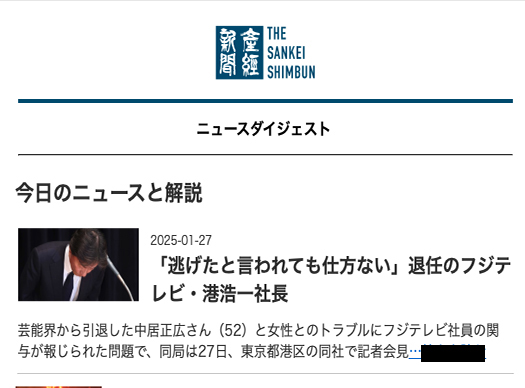
 画像は、昨日1/27 19:01受信した産経新聞のメール配信のスクショ。産経新聞は「フジサンケイグループ」であり、フジテレビとは企業経営眼的に「同系列」の立場とされるけれど、従来からフジテレビは産経新聞に対してそのような考え方はしていないとされてきた。朝日新聞とテレビ朝日、読売新聞と日テレの関係のように、こと「報道」については新聞社が主導的な役割を果たしているようではない。案の定、産経の伝え方にはむしろ突き放したような姿勢が感じられた。
 まぁ産経新聞としても「系列」的な立場からの「手心」を加えて報道すれば、そもそもの報道機関としての経営危機はさらに深まるしかないので、世の中に「合わせた」ように思われた。この報道ぶりが昨日の記者会見の状況を端的に表現しているのだろう。
 たまたま同窓生であることがわかった港浩一・前フジテレビ社長。友人たちからいろいろ断片的な「人間情報」が寄せられてくるのですが、こういう報道写真でも「鬼の首」的に象徴的に取り扱われることになる。しかしフジの問題は「天皇」とまで言われている日枝久氏こそが「企業体質」を作ってきた人物であり「巨悪」だというのがいわば共通認識だろう。その日枝久が依然として陰に隠れて、いわば「トカゲの尻尾切り」会見をさせている、という長時間のしらけた茶番劇とも思える。
 死去した読売新聞・渡辺恒雄と同様の立場にこの日枝久は立っていると言えるだろう。
 事実上「第4の権力」として情報コントロールの権能をほしいままにしてきた日本のメディア業界には、どうしてこのような「独裁的権力構造」が生成してしまうのだろうか。こうした「闇の権力」のような存在が、「世論」形成に大きな力を持ってきていたのはまぎれもない事実。
 政治についてたくさんの「腐敗追及」のようなことが行われる。そのこと自体は当然のことだろうが、しかし政治はまだしもそういう批判にさらされながら、同時に公平に「選挙」という洗礼は受け続けている。
 テレビメディアというのは本来、国民の共有財産である「電波」についてメディア企業に「許諾」されているだけの存在。メディアの意識を正常化させるためには、一度許諾されたものを返還させる条項を機能させるしかあり得ないだろう。そういった緊張感によってはじめて「情報の民主化」は為されるのではないだろうか?

English version⬇

[Will criticism of the TV industry proceed to ‘take away their licences’?
The corrupt corporate system has given birth to privileged people who are even referred to as irresponsible ‘emperors’. The people’s sovereignty should be the basis for taking away broadcasting licences. …

 The image is a scanned copy of an email distribution from Sankei Shimbun received at 19:01 yesterday, 27 January. The Sankei Shimbun is a member of the Fuji Sankei Group and is considered to be in the same family as Fuji TV in terms of corporate management, but it has traditionally been said that Fuji TV does not have such a view of the Sankei Shimbun. Newspapers do not seem to play a leading role in ‘news reporting’, as in the relationship between Asahi Shimbun and TV Asahi, or between Yomiuri Shimbun and Nittele. As expected, the Sankei’s way of reporting seemed to have a rather dismissive attitude.
 Well, it seemed that the Sankei was ‘in tune’ with the world, since if it reported the news from an ‘affiliated’ standpoint, it would only deepen its business crisis as a news organisation in the first place. This reporting style is probably a straightforward expression of the situation at yesterday’s press conference.
 Koichi Minato, former president of Fuji TV, who happened to be an alumnus. Various fragmentary ‘human information’ is received from friends, but even this kind of press photo is treated in a symbolic, ‘demon’s head’ way. However, the common perception of Fuji’s problems, so to speak, is that Hiedahisa, who is even referred to as the ‘emperor’, is the person who has created the ‘corporate structure’ and is the ‘great evil’. Hiedahisa is still hiding in the shadows and is having the press conference ‘cutting the lizard’s tail’, so to speak, which seems to be a long and tedious farce.
 It can be said that Hiedahisa stands in the same position as Tsuneo Watanabe of the Yomiuri Shimbun, who has since died.
 How is it possible for such a ‘dictatorial power structure’ to emerge in the Japanese media industry, which has effectively been the ‘fourth power’ and has been able to control information as it pleases? It is an indisputable fact that such a ‘dark power’ has been a major force in shaping ‘public opinion’.
 There is a lot of ‘corruption-chasing’ going on in politics. This in itself is natural, but politics is still subject to such criticism, while at the same time it continues to be subjected to a fair ‘electoral’ baptism.
 The television media is essentially an entity that is only ‘licensed’ by media companies to use the public’s common property, the ‘airwaves’. The only way to normalise media awareness would be to make provisions for the return of what has once been licensed work. It is only through such tensions that the ‘democratisation of information’ can be achieved.


【メディア芸能一体構造「危急存亡」の現在】


 さてきのうは法事関係の予定があったので東京から朝1番の飛行機でトンボ帰り。朝6:30という飛行機は人生でも初めてみたいな時間でした。そういうことなので、それこそ2時くらいに起床して宿泊先のサウナ施設で目を覚めさせてから早朝の都内から羽田空港へ。朝1番便というのに満席フライト。すごいですね。同乗者はビジネスの人からインバウンドの海外客、欧米系から非中国のアジア系と多種多様。わたしが過ごしてきた国内航空ツアーとは様相が変わっていると思いますね。日本社会の構造変化なのでしょうか。
 普段とはまったく違う過ごし方だったので、カラダ的にはあちこち疲労感が大きくて、きのうは夕刻に帰宅してから以降、ひたすら爆睡して疲労回復に専念であります。おかげで、今朝はやや元気回復。
 東京でいろいろな情報交換するなかで例のフジテレビの社長さんとの「遠縁」も知ったのですが、この件では本日に再度のフジテレビとしての「記者会見」が予定されているようですね。わたしは「芸能」がメインのこうしたテレビメディアにはまったく関心がなく、ときに目にする芸人さんたちによるバラエティワイドショーみたいなのにはほとほとあきれかえっていた人生行路だった。そういう場所で人生を送ってきた人が高校同窓で、いま現在の社会的関心事のスポット局面に責任者として立たされていることに驚かされておりました。
 まぁ、今回の件はテレビという商業メディアにとってまことに際どい局面、正念場でしょう。門外漢としては、遠い距離感の中で事態の推移を見るしかない。わたし個人としては、むしろテレビメディアそのものが存続するのかどうか、その「臨界点」を見定めさせてもらうような心象であります。
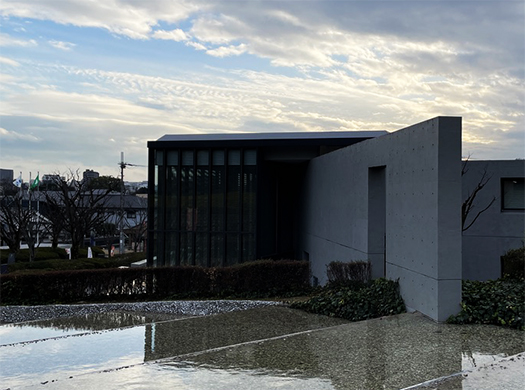
 そういう次第ですが、写真は安藤忠雄設計の姫路文学館の建築写真。自分はやはりこういう建築とか住宅空間などの領域がメインの「数寄領域」だと再認識。そういう、空間性と作家とか漫画家とかの表現者との相関関係というテーマ・場所がメインと見定めて掘り下げていきたいとあらためて念願しております。

English version⬇

Media and Entertainment Unified Structure ‘in Peril’ Today
Society’s attention is now focused on the ‘structure’ itself, which has been devoted exclusively to ‘making ratings’. This is a critical moment. How will it develop? …

 Well, yesterday I had a legal appointment, so I flew home from Tokyo first thing in the morning. It was the first time in my life that I had flown at 6:30am. So I woke up at around 2am and went to the sauna facilities at my accommodation to wake myself up, and then went from Tokyo to Haneda Airport in the early morning. The flight was full, even though it was the first flight of the morning. It was amazing. The passengers were diverse, from business people to inbound overseas passengers, from Westerners to non-Chinese Asians. I think the aspect has changed from the domestic airline tours I have been on. Is this a structural change in Japanese society?
 Since it was a completely different way of spending time than usual, my body felt very tired here and there, and since I came home in the evening yesterday, I’ve been sleeping heavily and concentrating on recovering from the fatigue. Thanks to that, I felt a little better this morning.
 In the course of exchanging various information in Tokyo, I also found out about my ‘distant relationship’ with the president of Fuji Television, and it seems that another Fuji Television ‘press conference’ is scheduled for today in relation to this matter. I have never been interested in this kind of TV media, which mainly focuses on ‘entertainment’, and have been fed up with the variety shows by comedians that I have seen from time to time in my life. I was surprised that someone who had spent his life in such a place was a high school alumnus and was now in charge of a spotlight of current social concern.
 Well, this is a critical moment for the commercial media of television. As an outsider, I can only watch the situation from a distance. For me personally, I feel as if I am being asked to judge whether the TV media itself will survive or not, and whether it is a ‘critical point’ or not.
 The photo is an architectural photograph of the Himeji Museum of Literature, designed by Tadao Ando. I have reaffirmed that I am mainly in the ‘sukiya domain’ of architecture and residential space. I would like to delve deeper into the theme and place of the correlation between such spatiality and artists, cartoonists and other forms of expression.
 

【久しぶりの東京・関東 情報収集】


 しばらく伊礼智さん設計のi-worksの北海道初の住宅探訪を続けていましたが、本日は小休止いたします。わたし自身は週末から4日間関東・東京に出張しておりました。そこでいろいろな情報収集活動をしておりました。
 そのなかでもいちばん驚かされたのが、例の問題が明るみに出てしまって既成メディア腐敗の極限とクローズアップされたフジテレビの社長さんが、どうもわたしの北海道の出身校の同窓であることがわかってしまったことでしょうか。ふつうの状態であれば、同窓生が「出世」していることと喜ばしいことであるのですが、ああいう事態ではなんとも微妙すぎる。
 わたし自身となんらかの関係性がある問題とはまったく想像もせず、ほとんど視聴もしない芸能関係・ワイドショー系のテレビ番組のことなので、批判的だけれど無関心の方がはるかに優勢でただただ報道などをみていただけだったのです。が、そういう情報に接してから急速に関心が湧いてしまった。とは言っても、同時代を生きてあのような立場、スタンスになっていった人物と、自分自身もまったく無縁ではあり得ないことに気付いたと言うところでしょうか。
 ということですが、いまちょうど札幌での用件のために朝一番の飛行機で北海道に帰還する時間が迫っていますので、本日、夕方をメドに追伸的にブログ記述したいと思います。どうぞよろしく。

追伸<20:20>:追加投稿を予告していましたが、申し訳ありません。さすがに急ぎ帰った用件もあって、疲労がMaxということで、明日続きをと思いますので、よろしくお願いします。

English version⬇

Tokyo and the Kanto region after a long time of information gathering.
Surprised at the ‘connection’ with the current situation, which we thought was unrelated. Scheduled to be added in the evening. Tokyo and the Kanto region

 I have been exploring i-works’ first house in Hokkaido, designed by Satoshi Irei, for a while, but today I am taking a short break. I myself was on a business trip to the Kanto and Tokyo regions for four days from the weekend. I was gathering a lot of information there.
 The most surprising of all was the discovery that the president of Fuji Television, which has been highlighted as a cesspool of corruption in the established media, is apparently an alumnus of my Hokkaido school.
 I had no idea that the issue had anything to do with me, and I had only been watching the news reports and the like, being critical but indifferent to it because it was an entertainment/wide show TV programme that I rarely watched. However, I have rapidly become interested in the subject.
 I am now about to return to Hokkaido by the first plane in the morning for a business matter in Sapporo, so I would like to write a follow-up blog entry by the evening today. I hope you will enjoy it.

Translated with DeepL.com (free version)

【多重な採光・環境レイヤー装置群〜 i-works参観4】


 さて i-works参観4。きのうも触れた家のメインの窓回りです。現在は三角屋根の落雪方向からの雪に閉ざされているけれど、この窓外にはウッドテラスと造作された庭がある。積雪のためそこまで取材できなかったけれど、かなり力点の置かれた庭園造作と推認された。それと木製3重ガラス入りサッシ(NORD社製とのこと)が結界を構成している。
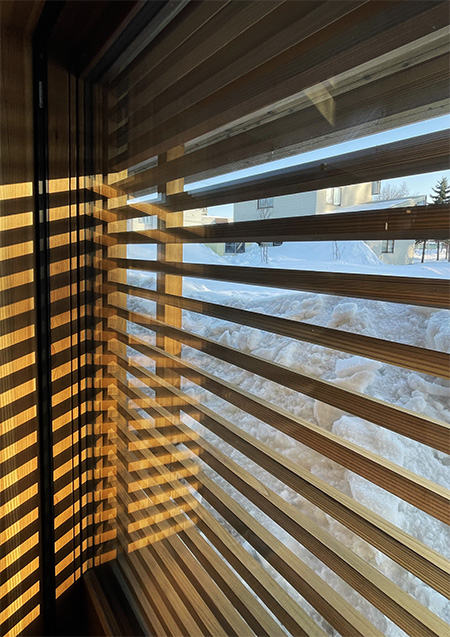
 その中間には横桟の外部建具、一種の雨戸とも思える装置が備えられていた。外部とは一定の空隙があり、折からの「暖冬」傾向もあって建具動作には支障はないようだった。また、屋根からの水分落下ラインとの間には軒天の距離が取られていた。
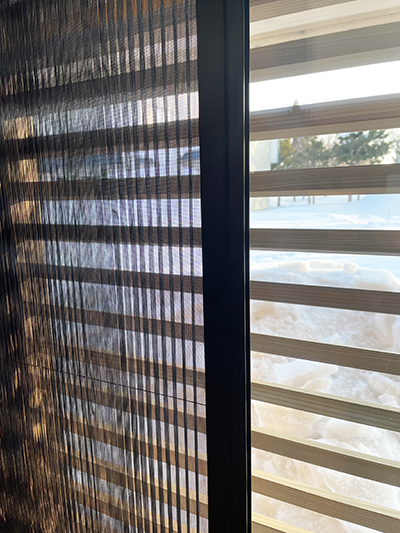
 その窓面から、内側には最外側に「網戸」が建具収納されている。木製窓にちょっとゴッツい手動用取っ手があるので、その分、後退距離が取られていた。
 そして、現場では最内側に障子が収納されていて、それが開閉されることを確認した。ただ、その網戸と障子の間にもけっこうな距離があって、なにか建具が収納されていたようだったけれど、確認できていなかった。
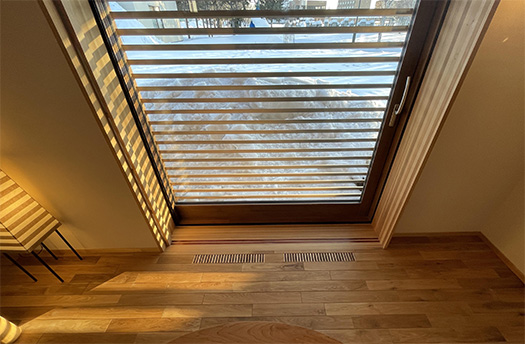
 床面を見ると、パッシブ換気と床下暖房からの暖気上昇用の開口部が仕込まれていた。この木製サッシとの距離感が内部用の建具収納スペース分、けっこう目視的には30cm程度ある。このような建具仕様がどのように環境性能的な結果に結びつくのか、あまり目にしたことがなかった挑戦かも知れない。
 建具の重層による効用としては、外部の採光に対してそれを複数のレイヤーで室内に導入させるというメリットがある。数寄屋建築が象徴する空間性とは、そういった採光レイヤーによって「やわらげられた」光環境を室内にもたらすことなのだろう。縁側や軒の出なども含めてそれが日本人的な感受性、コトバで言えば「空気を読む」みたいな人間相互の「思いやり」のような心象を育成・涵養してきたとも思える。
 考えて見るとわたしたち北海道の住宅では、そういった心象への「配慮」はひたすら空気環境の均一性・快適性のいわば「物理的」な方向一択だったかも知れない。このような挑戦が、どのように北海道民に受け入れられていくのか、興味深いと思った次第。わたし自身は1991年、いまから34年前にブロック構造の外断熱という、従前の日本建築とははるかに距離感のある選択をしたけれど、現代ではむしろこうしたチャレンジがあるのだと認識した。

English version⬇

Multiple lighting and environmental layering devices – i-works visit 4
 I myself chose a non-traditional residential architecture of non-timber-framed concrete blocks with external insulation, but times are changing. …

 Now i-works visit 4. the main window area of the house, which I mentioned yesterday. It is currently closed off by snow falling from the direction of the triangular roof, but there is a wooden terrace and a garden outside this window. We were not able to cover that much of the garden due to the snowfall, but it was considered to be a very important part of the garden construction. The wooden triple-glazed sash (made by NORD) forms the boundary between the terrace and the garden.
 In between, there was an external fittings with horizontal piers, a kind of storm door. There was a certain amount of airspace between them and the outside and, due to the occasional ‘mild winter’ trend, there seemed to be no problem with the operation of the fittings. There was also a distance between the eaves and the moisture fall line from the roof.
 From that window face, the outermost ‘screen door’ was fitted and stored on the inside. The wooden window has a rather lumpy manual handle, so a setback distance was taken from that.
 And on site, a sliding door was stored in the innermost side, which was confirmed to be opened and closed. However, there was also a considerable distance between the screen and the sliding door, and it seemed that some kind of fittings were stored there, but we were unable to confirm this.
 Looking at the floor, there was an opening for passive ventilation and warmth rising from the underfloor heating. The distance between this wooden sash and the internal fittings storage space is approximately 30 cm visually. It may have been a challenge to see how such a fittings specification could lead to environmental performance results, which we had not seen much of.
 The benefit of the multiple layers of fittings is that they allow multiple layers of light from the outside to be introduced into the room. The spatiality symbolised by sukiya architecture is probably to bring a ‘softened’ light environment into the room through such layers of lighting. It seems to me that this, including the veranda and eaves, has nurtured and cultivated a Japanese sensitivity, or in other words, a mental image of mutual consideration for each other, like ‘kuki wo yomitaku’ (reading the air).
 When you think about it, in our houses in Hokkaido, the only ‘consideration’ for such mental images may have been in the ‘physical’ direction of uniformity and comfort in the air environment. It will be interesting to see how this kind of challenge will be accepted by the people of Hokkaido. In 1991, 34 years ago, I myself chose to build a block structure with external insulation, a choice that was far removed from the traditional Japanese architecture, but I am now aware that such challenges exist in the present day.
 

【室内に重厚な建具収納〜 i-works参観3】


昨日の「雨具収納」について多くのご意見・感想をいただきました。なんとi-worksシリーズ設計者の伊礼さんご自身からもコメントいただいたのには驚いた。以下にそのコメントを転載させていただきます。〜北海道生まれのパッシブ換気をカスタマイズして取り入れています。屋根の掛け方など、北海道では変えたほうがと提案したのですが、辻野社長がこれでやってみたいと、、、チャレンジャーは辻野社長です!! 〜転載コメントは以上。
 これはまことに申し訳ありません、本来であればこれは設計者に取材をすべきだったと言われても仕方ないかと。ただわたし自身北海道で建てられる新設住宅の探訪は久しぶり。しかも公知されている話題のシリーズで、興味ワクワクで参観させていただいた感想なので、ご容赦いただければと思量いたします。なにとぞよろしく。
 で、きのう触れたようにこの住宅のひとつのテーマが、雨戸類などの「採光防犯等・複合型の暮らし環境調節装置」に対しての、現代北国人のまったくの忘却への問いかけではないかと受け止めさせていただいた。そして日本住宅文化に於いて、室内空間の雰囲気をも転換させるこうした装置が果たしてきた役割について、ひとつの気付きとして再認識させられたワケなのです。
 上の写真は昨日の建物北側2階外壁側の「外部建具収納」と対比的な建物南側の居間開口部周辺の様子。窓面の木製3重ガラス入りサッシは引き戸仕様になっていた。当然、正面左側に引き戸として仕舞い込まれる仕様。こういった場合、北海道住宅ではこれまでその片側にもフィックス型の同サイズの木製サッシが固定され、採光的には当然ダブルで日射を引き込むけれど、こちらではその片側は室内からは確認できなかった。
 その代わり、室内に重厚な「建具収納」が配置されていた。2枚目の写真のように障子なども収納されている。建具類のより詳細についてはまた明日以降触れますが、この写真でもわかるように室内側に目視では30cm超程度の「奥行き」で、多くの「採光調整」機能を果たすだろう建具類が確認できた。さらに木製サッシのすぐ外側には木製ルーバー的な「横桟」の外部建具が装置されていた。
 こういった採光調整については、たとえば34年前建築のわが家ではブラインドだけで対応してきましたが、そうした「簡素化」の結果、たしかに日本建築のある濃密な「採光」への感受性が、北海道人の暮らし方からは鈍磨してきているのかもと気付かされた次第。
 日本人の繊細な感受性の「涵養」にこうした採光調整装置群が大きな役割を果たしてきた事実は間違いなくあるでしょう。実際、こうした建具とその収納装置については北海道では職人自体すら希少化してきている。非常に示唆的で興味深いポイント。

English version⬇

[Stately fittings stored indoors – i-works visit 3].
Delicate lighting environment control devices such as storm doors, lattice doors and shoji screens were important in the ‘cultivation’ of Japanese sensibilities. We are reminded of these questions. …

We received many comments and feedback on yesterday’s ‘rain gear storage’. We were surprised to receive comments from Mr Irei himself, the designer of the i-works series. In the meantime, we reproduce their comments below. 〜The i-works series is a customised version of passive ventilation, which was born in Hokkaido. We suggested that we should change the way the roof is hung and other things in Hokkaido, but President Tsujino wanted to try it this way… The challenger is President Tsujino! 〜The above is all the comments that have been reprinted.
 I am very sorry about this, and I think it could be said that I should have originally interviewed the designer. However, it has been a long time since I have visited a new house being built in Hokkaido. Moreover, this is my impression of a well-known and talked-about series, which I visited with great interest and excitement, so I hope you will forgive me for that. I hope you will forgive me.
 As I mentioned yesterday, one of the themes of this house is that it is a question to the utter oblivion of modern northern people in regard to ‘lighting, security and other complex living environment control devices’ such as shutters. It was also a reminder of the role played by these devices in changing the atmosphere of interior spaces in Japanese housing culture.
 The photo above shows the living room opening on the south side of the building in contrast to yesterday’s ‘external fittings storage’ on the north side of the building, on the exterior wall of the second floor. The wooden triple-glazed sash on the window face was designed as a sliding door. Naturally, it is designed to be closed in as a sliding door on the left side of the front elevation. In this case, a fixed wooden sash of the same size is also fixed on one side of the window, which naturally draws in double sunlight, but this side of the window could not be seen from the room.
 Instead, a heavy ‘fittings storage’ was placed inside the room, including the shoji screens as shown in the second photo. More details of the fittings will be discussed in more detail tomorrow, but as can be seen from this photo, there are a number of fittings on the interior side of the room that are visually over 30 cm deep and would serve a ‘light control’ function. In addition, there were wooden louver-like ‘side-hinged’ external fittings just outside the wooden sash.
 In our house built 34 years ago, for example, we only used blinds to adjust the lighting, but as a result of such ‘simplification’, I realised that the sensitivity to the dense ‘lighting’ of Japanese architecture may indeed have become dulled in the way the people of Hokkaido live.
 There is no doubt that these lighting control devices have played a major role in cultivating the delicate sensitivity of the Japanese people. In fact, even craftsmen of these fittings and their storage devices are becoming scarce in Hokkaido. A very suggestive and interesting point.