本文へジャンプ

【行動抑制期の健康維持。散歩コースを考える】

本日はブログ記事、しばらくぶりに日常生活編。
毎日の全国の天気を見ていると北海道沖縄以外では記録的な大雨ということで、
当該地域のみなさん、本当にお見舞い申し上げます。
いつ大規模災害が発生するか、ギリギリの状況のようですね。
床下・床上浸水被害などが多発することも予測されます。う〜む。
きびしい行動抑制の上にこの自然災害ということで並々ならぬ年。
この未曾有の大雨で開催中の夏の高校野球では順延が相次ぎ、
昨日は、初戦を前にした宮崎商業高校が部員の感染で出場辞退とのこと。
先般のオリンピックは日本の底力を感じる無事開催でしたが、
甲子園大会はまことに厳しい状況に陥ってしまっている。
なんとか大会を終えることができるのか、胸突き八丁の局面ですね。
すでにどろんこの試合状況を見ていて「かわいそう」という声も出てきている。
ひたすら天候の回復と球児のみなさんの健康を祈っております。

札幌はオリンピック最終日マラソン当日までうだる暑さが続いていましたが、
終了とともに一気に朝は秋風を感じるほどにクールダウン。
一時は早朝12度くらいまで下がってしまってジャンパー着用まで。
ということですが、ここ数日はまた18度くらいまで上がってきて
普通の年のお盆明けといった気温状況になってきました。
普段であれば適度に出張とか移動の機会も多いので
とくに首都圏に出張するとほぼ公共交通機関利用が多く、
駅までや駅構内でも乗り継ぎでも1日1万歩くらいはよく歩けていた。
足腰を鍛える生活はむしろ現代では東京生活が適しているとされ、
事実、大相撲の力士出身地は地方よりも首都圏で増えていると聞きますね。
わたしの場合、今回の行動抑制期対応で散歩への意識が高まっています。
気の向くままというよりも習慣性重視でコースを考えてきました。
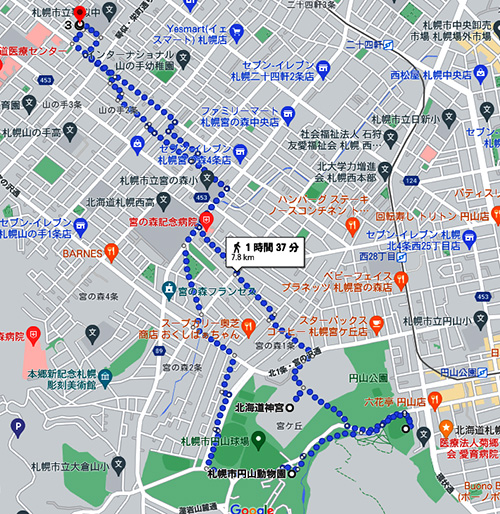
習慣では神社参拝がわたし的に行動優先基準になるので、
北海道神宮や近場では屯田兵ゆかりの琴似神社が立ち寄り目的地。
で、ごらんのような散歩コースをよく利用しています。
地図ソフトを最近Googleに変えたので、使い勝手もよく、
距離時間管理には適しているようであります。
地図ソフトからは距離と時間の平均的なデータが出てきますが、
だいたい標準的な時間に収まっているようなので、
おおむね体力的には健康状態が維持されていると確認できております。
おおむね10,000歩で1.5時間程度の散歩コース。
ソフトの使い勝手もわかってきたので、今後はもっと多様な散歩コースに
チャレンジしていこうかと考えています。

あ、ヒグマとの遭遇は遠慮したいので極力危険回避最優先であります。
みなさんもこの行動抑制期を健康維持で乗り切っていただきたいですね。
さて、きょうも頑張るぞと。

English version⬇

[Maintaining health during the behavioral restraint period. Think of a walk course]
Today is a blog post, daily life for the first time in a while.
Looking at the weather all over the country every day, it is a record heavy rain except Hokkaido and Okinawa,
We would like to express our deepest sympathies to everyone in the area.
It seems like the situation is just around the corner when a large-scale disaster will occur.
It is expected that underfloor and above-floor inundation damage will occur frequently. Hmmm.
It’s an extraordinary year because of this natural disaster on top of severe behavioral restraint.
In the summer high school baseball that is being held due to this unprecedented heavy rain, postponements have been made one after another.
Yesterday, Miyazaki Commercial Senior High School, which was before the first match, declined to participate due to an infection of a member.
The recent Olympics were held safely, feeling the strength of Japan,
The Koshien tournament has fallen into a very difficult situation.
I wonder if I can manage to finish the tournament, isn’t it?
I’ve already seen the situation of this game, and some people are saying “I’m sorry”.
We pray for the recovery of the weather and the health of all the children.

In Sapporo, the sweltering heat continued until the day of the marathon, the final day of the Olympic Games.
At the end of the day, the morning cools down to the point where you can feel the autumn breeze.
At one point, it dropped to about 12 degrees in the early morning and I had to wear a jumper.
That being said, the temperature has risen to about 18 degrees again in the last few days.
The temperature has become like the end of the Obon festival in a normal year.
Usually, there are many opportunities for business trips and travel, so
Especially when traveling to the Tokyo metropolitan area, most people use public transportation.
I could walk about 10,000 steps a day to the station, inside the station, and when connecting.
It is said that living in Tokyo is more suitable for the life of training legs in modern times.
In fact, I hear that the number of wrestlers from sumo wrestlers is increasing in the metropolitan area rather than in rural areas.
In my case, the awareness of walking has increased due to this behavioral restraint period.
I’ve been thinking about courses with an emphasis on habits rather than as I like.
In custom, visiting a shrine is a personal priority for action, so
Kotoni Shrine, which is related to Tondenhei, stops at Hokkaido Jingu Shrine and nearby destinations.
So, I often use the walking course as you can see.
I recently changed the map software to Google, so it’s easy to use.
It seems to be suitable for distance time management.
The average data of distance and time comes out from the map software,
It seems that it is within the standard time, so
It has been confirmed that the physical condition is generally maintained.
A walking course of about 1.5 hours with 10,000 steps.
Now that we know how to use the software, we will be able to take more diverse walking courses in the future.
I’m thinking of taking on the challenge.

Oh, I want to refrain from encountering brown bears, so I give top priority to avoiding danger as much as possible.
I would like everyone to survive this behavioral restraint period by maintaining good health.
Well, I’ll do my best today.

【明治開国・西洋建築との融合/日本のいい家㊳-18】


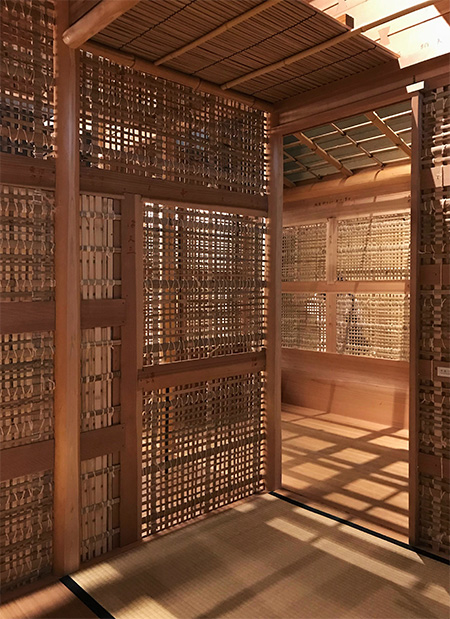
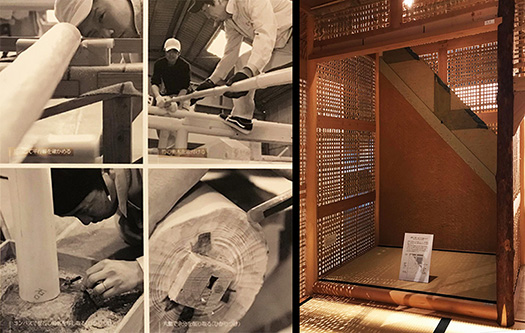
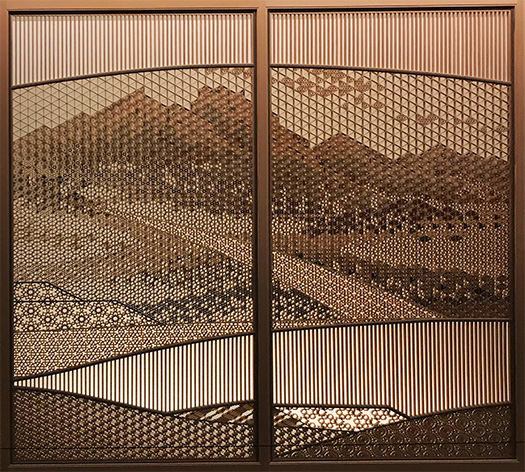
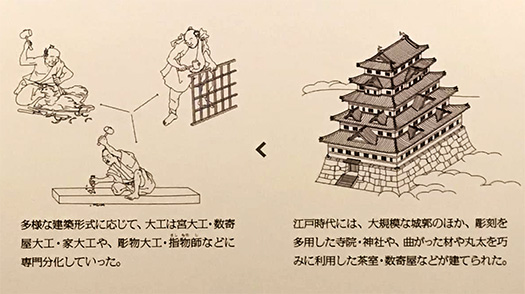
だいぶ長期間にわたって竹中大工道具館展示について触れてきました。
江戸期の技術熟成期間はいかにも日本的なディテールの深化。
鎖国という体制は国内の各地域産業発展ではそれを促進させた面があった。
一方でガラパゴス的な閉鎖性ももたらしたのかも知れない。
安土桃山期に独特の天守閣城郭を生み出したパワーは
その後はひたすら細部の完成度、その熟成に社会的関心が払われたように思う。
世界の趨勢が石炭エネルギーを利用した産業・社会変容に向かい、
産業革命によって「市場」を争奪する戦争の世紀に向かって驀進していた。
平和という意味ではたしかに国内では実現させていたけれど、
世界は日本社会にいつまでもそういう時間停止を許してはくれなかった。
しかし日本人という内面性において独自の体験を持ったのは事実でしょう。
どうしてあのような自閉性を選択したのか、よくわからない面がある。
たぶん秀吉の妄想のような海外進出路線に対して
深く「こりごりだ」という支配層の思いが共有されたのでしょう。
キリスト教のような世界宗教がバックにあればそれを拡散するという
「大義名分」はそれなりに立つのかも知れないけれど、
そういうものが見当たらないなかで、たとえば神道を拡散する名分で
日本社会の天皇制を世界に強制するというのはムリがあるのでしょう。

さて、江戸期を通して建築では目を抜くようなオリジナル発展は見られない。
たぶん「建築」の最たるものとして幕末の「黒船」があったのではないか。
もちろん黒船は建築ではないけれど、
それをみた多くの日本人にとっての衝撃性という意味では
江戸城や大阪城をはるかに越えるものとして
時代感覚を激しく揺さぶるという「建築」の要素を持っていたと思う。
たぶん安土城以降の城郭建築をはるかに越える
「動く城郭」という根底的な恐怖感を呼び覚ましたのでしょう。
たしかにたとえば品川沖から艦砲射撃を受ければ、江戸城は潰滅する。
そういう厳然たる恐怖感が日本人全員に共有された。
尊皇攘夷という熱病の結果、開国して西洋近代文明を受容することに
日本人は自然に同意したと言えるのでしょう。
テクノロジー進歩に対して率直にそれを受け入れる柔軟性は日本にあった。
他のアジア諸国に比較して、こういう柔軟性が日本の特色かも知れない。
歴史段階の終わり方において平和的だった。

竹中大工道具館展示では、明治開国時点までで
おおむねの展示構成は終了する。
明治以降は木造技術の世界から組石造、さらにRC建築へと
建築そのものの基本技術が変移していったことが基底にあるのか。
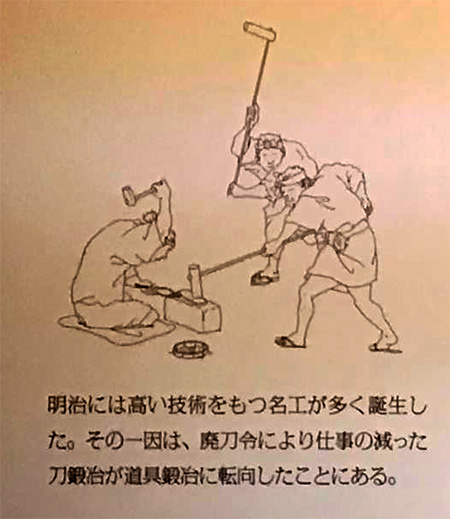
そういうなかでたとえば刀鍛冶の高度な技術が別の領域で生きたり、
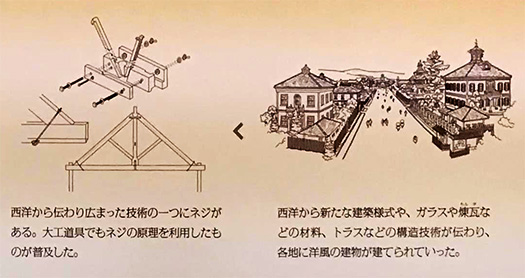
屋根の「トラス」技術、「ネジ」の導入など融合がテーマになっていく。
あるいは以前探索した北海道の初源期西洋建築へと主舞台は引き継がれたのか。
行動抑制の厳しい状況の中ですが、竹中大工道具館を再度訪れるとき、
どういった「再発見」があるのか、楽しみにしています。

English version⬇

[Meiji Opening / Fusion with Western Architecture / Good Japanese House ㊳-18]
I have touched on the Takenaka Carpentry Tools Museum exhibition for quite a long time.
During the technical aging period in the Edo period, Japanese details were deepened.
The system of seclusion has promoted it in the development of each regional industry in the country.
On the other hand, it may have brought about a Galapagos-like closure.
The power that created the unique castle tower during the Azuchi-Momoyama period
After that, I think that social attention was paid to the perfection of details and their maturity.
The world trend is heading for industrial and social transformation using coal energy,
He was on the verge of a century of war in which the Industrial Revolution was competing for the “market.”
In the sense of peace, it was certainly realized domestically,
The world has never allowed Japanese society to stop for such a time.
However, it is true that he had a unique experience in the inner nature of being Japanese.
I’m not sure why I chose that kind of autism.
Maybe for overseas expansion routes like Hideyoshi’s delusion
Perhaps the ruling class’s thoughts of being “stiff” were deeply shared.
If there is a world religion like Christianity in the background, it will spread
“The cause” may stand in its own way,
In the absence of such a thing, for example, in the name of spreading Shinto
Forcing the emperor system of Japanese society on the world would be unreasonable.

By the way, throughout the Edo period, there is no remarkable original development in architecture.
Perhaps the most important thing in “architecture” was the “Kurofune” at the end of the Edo period.
Of course, Kurofune is not an architecture, but
In terms of impact for many Japanese who saw it
As far beyond Edo Castle and Osaka Castle
I think it had an element of “architecture” that violently shakes the sense of the times.
Probably far beyond the castle architecture after Azuchi Castle
It must have awakened the underlying fear of a “moving castle.”
Certainly, for example, if a naval gunfire is received from off Shinagawa, Edo Castle will be destroyed.
Such a harsh sense of fear was shared by all Japanese.
As a result of the fever of Sonnojoi, he decided to open the country and accept modern Western civilization.
It can be said that the Japanese naturally agreed.
Japan had the flexibility to openly accept technological progress.
Compared to other Asian countries, this kind of flexibility may be a characteristic of Japan.
It was extremely peaceful at the end of the historical stage.

At the Takenaka Carpentry Tools Museum exhibition, until the opening of the Meiji era
The exhibition structure is almost finished.
After the Meiji era, from the world of wooden technology to kumite construction and then to RC construction
Is it based on the change in the basic technology of architecture itself?
Under such circumstances, for example, the advanced technology of swordsmiths lives in another area,
The theme will be fusion, such as the introduction of roof “truss” technology and “screws”.
Or it may have been taken over by the first Western architecture of Hokkaido that was explored earlier.
It is a difficult situation to restrain behavior, but when I visit Takenaka Carpentry Tools Museum again,
I am looking forward to what kind of “rediscovery” there is.

【道具を見れば腕がわかる世界/日本のいい家㊳-17】


竹中大工道具館展示を長時間、見てきていますが、
やはり日本建築、大工道具から見えてくるのは表題のような世界。
日本の在来木造技術は「木組み」という木の本性と対話する技術として
そのための手段として道具を繊細に工夫するような大工技量を生んでいった。
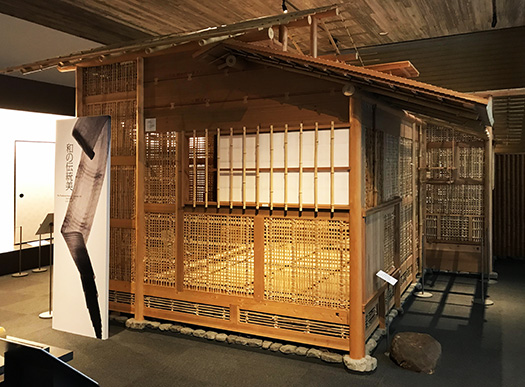
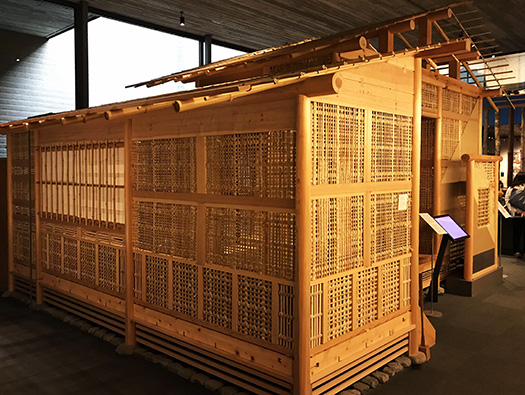
上の写真は再度スケルトン茶室だけれど、このような芸術的な木組みを
実現可能な繊細な「表現力」までが体技化されていった。
戦国期という時代は、活発な大航海時代という世界交流の時代であり
鉄砲に代表される西洋近代合理主義も導入されて日本では技術の上でも
ビッグバンのような状況があったのだと思える。
安土城を嚆矢とするオリジナル建築をも生み出したパワー。
それを引き継いだ江戸期は鎖国という条件の下で、
その西洋合理主義の実質も織り込んだような技術が追求されていった。

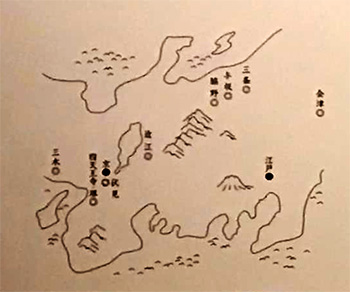
こうした大工道具類は3番目の日本地図のように
「金物生産の名産地域」の名を残すまでになっていた。
製鉄は中国地方の「おろち」伝承に見られるように国内で盛んになった産業。
ある時期まで日本社会が強く朝鮮半島に関与してきたのは
製鉄が主要部分で技術も含めて大陸・半島社会に依存していたことを証している。
それが、古墳時代か飛鳥の時代以降、具体的には白村江敗戦以降
製鉄が国内で賄われるようになって、半島への興味が薄らいでいく。
鉄の原料の調達から国内生産までが一貫して国産化した。
原料発掘は派生的に石見の銀や奥州の金発掘までもたらした。
白村江での敗戦はむしろ内製化を促進させた最大のきっかけだったのかも知れない。
そして戦国期の活発な内戦状況は武器生産技術をさらに加速し、
全国にそのような工房施設拠点が作られていった。
江戸期になってそういった鉄生産技術は大工道具の世界にも波及したのだろう。
数寄屋茶室のような繊細な建築表現を可能にする
道具の進化は、鉄器生産の高度化と共鳴していったことだろう。
図の2重◎地域がそういった地域に当たるけれど、
大工道具の心臓部である鉄の造形、品質をコントロールしてきた。
兵庫県では縁のある「三木」の地名が見えています・・・。
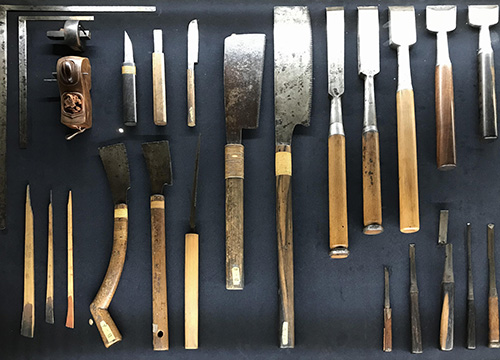
「大工の腕を見るにはその道具を見る」というのは格言化されているけれど、
木造技術のディテールで努力していけば自ずとより専用的なを求めるようになり
その入手のためには多様な人間関係を構築して
「情報ネットワーク」も不可欠になっていく。
各地を転々とした大工職人を採用する大工棟梁は
こうしたすべてを面接して技量を計っていたに違いない。

こういった繊細化が大工技術に於いても生起した江戸期鎖国体制。
このことのメリットデメリットのすべてが今日の日本社会の背景にある。
大工道具の深遠さに日本人の本然が見えてくる気がします。

English version⬇

[A world where you can understand your skills by looking at tools / A good house in Japan ㊳-17]
I’ve been watching the Takenaka Carpentry Tools Museum exhibition for a long time,
After all, what you can see from Japanese architecture and carpentry tools is the world like the title.
Japanese traditional wooden technology is a technology that interacts with the nature of wood called “wooden construction”.
As a means for that, he created a carpentry skill that delicately devised tools.
The photo above is again a skeleton tea room, but with such an artistic timber frame
Even the delicate “expressive power” that can be realized has been made into a physical skill.
The Warring States period is an era of world exchange, the age of active voyages.
Western modern rationalism represented by guns was also introduced, and in Japan, even in terms of technology
I think there was a situation like the Big Bang.
The power that created the original architecture with Azuchi Castle as the starting point.
During the Edo period, when it was taken over, under the condition of isolation,
A technique that incorporates the substance of Western rationalism was pursued.

These carpentry tools are like the third map of Japan
It had left the name of “a specialty area for hardware production”.
Ironmaking is an industry that has flourished in Japan, as seen in the tradition of “Orochi” in the Chugoku region.
Until a certain time, Japanese society was strongly involved in the Korean Peninsula.
It proves that steelmaking relied on continental and peninsular societies, including technology, in the main part.
That was after the Kofun period or the Asuka period, specifically after the Battle of Baekgang.
As iron making becomes domestically covered, interest in the peninsula diminishes.
From the procurement of iron raw materials to domestic production, it has been consistently domestically produced.
The excavation of raw materials has resulted in the excavation of silver in Iwami and gold in Oshu.
The defeat at Baekgang may have been the biggest reason for promoting in-house production.
And the active civil war situation during the Warring States period further accelerated weapon production technology,
It seems that such workshop facility bases were created all over the country.
In the Edo period, such iron production technology would have spread to the world of carpentry tools.
After all it enables delicate architectural expression like Sukiya tea room
The evolution of tools would have resonated with the sophistication of ironware production.
Double in the figure ◎ The area corresponds to such an area,
We have controlled the molding and quality of iron, which is the heart of carpentry tools.
In Hyogo prefecture, you can see the place name of “Miki”, which has a connection.
“To see the carpenter’s arm, look at the tool” is a maxim,
If you work hard with the details of wooden technology, you will naturally seek more dedicated.
Build diverse relationships to get it
“Information networks” will also become indispensable.
The carpenter builder who hires carpenters from all over the world
He must have interviewed all of these and measured his skills.

The Edo period isolation system where such delicacy occurred even in carpentry technology.
All of the advantages and disadvantages of this are behind today’s Japanese society.
I feel that the true nature of Japanese people can be seen in the depth of carpentry tools.

【数寄屋大工と高断熱高気密大工/日本のいい家㊳-16】


竹中大工道具館での木造建築進化の歴史展示に沿って
日本史の流れと建築・道具の進化過程を跡づけてきています。
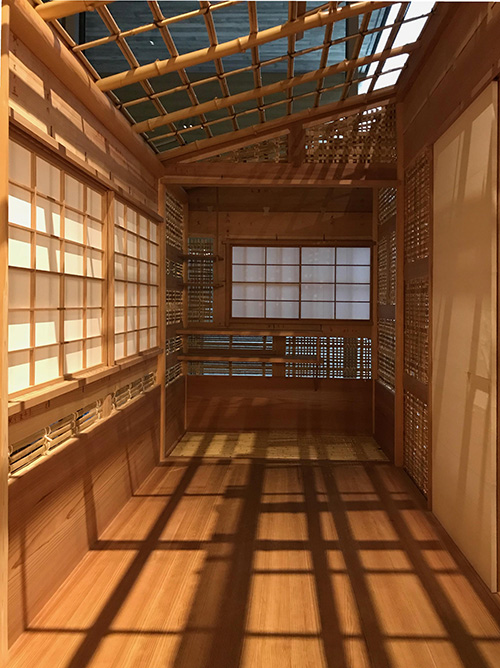
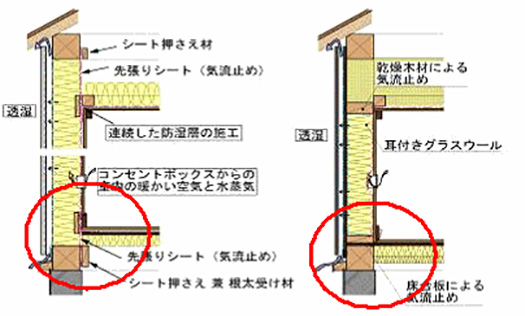
写真は展示のスケルトン茶室と新住協壁断面模式図の対比であります。
展示でメインになっていたこのスケルトン茶室を見るに至って
よく新住協・鎌田紀彦先生の講演で「大工さん向け」として
構造骨組を講演会場に演習用に仕立て上げて
「ここに断熱材を入れる」
「先に防湿シートを施工する」
と実地で施工手順などを説明されていた様子がフラッシュバックした。
鎌田紀彦先生の特徴は、現場大工さんたちに直接響く指導ができること。
いくら理論が正しくとも具体的実践ができなければ現実は変えられない。
利休が曲がり材を床柱として使わせた説得の様子を想像してみたら、
どうも、そういったシーンが既視体験として浮かんできたのです。
数寄屋大工の場合も、設計者・利休などから無理難題を持ちかけられる。
寸法精度の定かではない材をあえて「床柱に使え」とか。
常識的には入口寸法に満たない出入り口をギリギリ寸法で作れとか(笑)。
そうすると大工として「どうやったら建築として成立するか」と考えて
施工手順なり、自然木を柔軟に構造の中で収めていく工夫をする。
利休という人物も大工と同じ目線で考えるタイプだったのかも知れない。
それまでの常識的な大工作法にはなかったそういう工夫に
積極的にチャレンジしていく姿勢に於いて同質ではないかと気付く。

数寄屋茶室と高断熱高気密住宅というのは対立概念的に考えてきた。
一方は芸術的空間体験性を求め、一方は平明なあたたかさの環境を目指す。
芸術性のため隙間だらけの茶室で冬に震えながらガマンして茶を喫する。
高断熱高気密の茶室など邪道だみたいな伝統保守・しきたり重視的考え。
しかしこの展示を見ると芸術と熱環境という志向に違いはあるけれど、
大工仕事では手法を還元して考え納めを工夫するという共通性がある。
茶室はその後日本文化に「茶の間」という特徴的な空間を生み出す文化。
日本人の暮らし方のありようを変えた文化だった。
その過程での建築的工夫もまた決定的なものだったかも知れない。
作法とかふるまい方などの日本人らしさのマザーが茶の間で涵養された。
茶室では常識的ではない窓位置だとか、開口部構成とか、自然木素材などが
大工技量の進化に関与していたのかも知れない。
それは日本人としての空間体験の幅を広げた可能性がある。
一方の高断熱高気密の施工では断熱材という非自然的な有用物を
どのように既成建築技術の中に収めていくべきなのか、
相次いだ技術上のトラブルを乗り越えて安定的な手法にたどりつかせる
試行錯誤が積み重ねられたという意味でも、同質性があるのかも知れない。
高断熱高気密が日本温暖地域でさらに根付いていくためには
茶室が茶の間に変容していったような
ある「文化的」昇華が求められるかも知れない。
このふたつの大工仕事の革命要素について、今後も検証を進めてみたいと思います。

English version⬇

[Sukiya carpenter and highly insulated and airtight carpenter / Japanese good house ㊳-16]
Along with the historical exhibition of the evolution of wooden architecture at Takenaka Carpentry Tools Museum
It traces the flow of Japanese history and the evolutionary process of architecture and tools.
The photo is a comparison between the skeleton tea room on display and the schematic cross-sectional view of the Shinjukyo wall.
I came to see this skeleton tea room that was the main part of the exhibition
Often as “for carpenters” in a lecture by Professor Norihiko Kamada of Shinjukyo
Tailoring the structural framework to the lecture hall for exercises
“Put insulation here”
“Install the moisture-proof sheet first”
It flashed back that the construction procedure was explained in the field.
The characteristic of Professor Norihiko Kamada is that he can give guidance that directly affects the on-site carpenters.
No matter how correct the theory is, the reality cannot be changed unless concrete practice is possible.
Imagine how Rikyu persuaded him to use a bender as a floor pillar.
Apparently, such a scene came to me as a déjà vu experience.
Even in the case of a Sukiya carpenter, the designer, Rikyu, etc. can pose an unreasonable challenge.
I dare to use a material whose dimensional accuracy is uncertain, such as “use it as a floor pillar.”
Common sense is that you can make an entrance / exit that is less than the entrance size (laughs).
Then, as a carpenter, I thought, “How can it be established as an architecture?”
As a construction procedure, devise ways to flexibly accommodate natural wood in the structure.
Rikyu may have been the type of person who thinks from the same perspective as a carpenter.
In such a device that was not in the common sense large construction method until then
I realize that they are of the same quality in the attitude of actively taking on challenges.

Sukiya teahouse and highly insulated and airtight house have been considered as contradictory concepts.
One seeks artistic space experience, and the other aims for a clear and warm environment.
For the sake of artistry, in a tea room full of gaps, you can enjoy tea while trembling in the winter.
Traditional maintenance and customary thinking that seems to be an evil way, such as a highly insulated and airtight tea room.
However, looking at this exhibition, although there is a difference in the orientation of art and thermal environment,
In carpentry, there is a commonality of reducing the method and devising a way of thinking.
The tea room is a culture that creates a characteristic space called “tea room” in Japanese culture.
It was a culture that changed the way Japanese people live.
The architectural ingenuity in the process may also have been decisive.
A Japanese mother, such as manners and behavior, was cultivated in the living room.
The window position, opening composition, natural wood material, etc. that are not common sense in the tea room
It may have been involved in the evolution of carpentry skills.
It may have expanded the range of spatial experiences as a Japanese.
On the other hand, in highly heat-insulated and airtight construction, an unnatural useful material called a heat insulating material is used.
How should we put it in the ready-made building technology?
Overcome a series of technical troubles and arrive at a stable method
It may be homogeneous in the sense that trial and error has been accumulated.
In order for high heat insulation and high airtightness to take root in warm regions of Japan
It’s like the tea room transformed into a living room
Some “cultural” sublimation may be required.
I would like to continue to examine these two revolutionary elements of carpentry.

【The大工仕事「スケルトン茶室」/日本のいい家㊳-15】


戦国から江戸時代へと元禄くらいまで日本人口は一気に倍増。
関ヶ原の慶長の頃1,300万くらいから3,000万を超えた。
この段階では歴史上最大の経済発展期だったことでしょう。
それにともなって全国で建築の需要は旺盛に高まっていった。
多様なそれらに対応して宮大工・数寄屋大工・家大工、
さらには彫刻大工、指物師などに専門化が見られていったとされる。
利休のような「設計者」の特異な建築要求に対して
その設計趣旨を咀嚼して現実化するのが大工の器量だったのでしょう。
利休がたとえば「自然のままの丸太」で床柱を立てて欲しい、と希望すれば
その意を呈して、どのように完成度を高めるか、工夫を凝らした。
設計者は「たぶんできるんじゃないか」とリクエストしてくるけれど、
実際に建てる大工にすれば、どう手順すれば可能かと叡智を尽くすことになる。
たぶん、利休のような設計者の先には茶室発注者として権力者もある。
技量の粋を凝らすに足る報酬も用意されていたことだろう。
利休の「わび・さび」という設計コンセプトからすれば、
出来上がる茶室は「草庵」だけれど技術に於いては最先端が要求された。
どうもこのあたりの「呼吸」に日本的審美眼・文化の独自性があると思う。

そういった感慨を持つ展示が竹中大工道具館のメイン「スケルトン茶室」。
たぶん初期の利休の頃には数寄屋大工というような職掌は存在しなかっただろう。
利休のビジネスに出入りしていた大工棟梁が
「まったく、メンドイ仕事ですなぁ(笑)」といいながら手掛けていたに違いない。
いちばん気心の知れた大工の技量を内心で見込んで受注したのだろう。
「ここに自然のままの材を床柱で建てる」
「う〜む、上と下で寸法が全然違うけど」
「そこをなんとか」
「それとこの丸太、途中で大きく曲がっていますぜ・・・」
「回りは塗り壁でいくからなんとかなるだろう」
「そうだけど、下地をどう仕上げるか、う〜む」
というような好き勝手を芸術家的に夢想する設計者と
困惑する一方、ムラムラと職人魂を刺激された大工のやり取り。
日本的建築文化の極限かとも思える数寄屋・茶室の創始期には
こんな設計施工の丁々発止があったのではないだろうか。

こういう創始期を経て、日本権力者たちの間では
文化精神の内容はよくわからないままに見栄・虚勢の一種として、
数寄屋茶室がもてはやされ、全国に拡散していく中で
専門職化した大工の技術分化も発生していったのでしょう。
江戸期という、とにかくも実現した平和発展の時代が生んだ建築文化。
権力者をうまく操る茶室設計者という刀の刃の上の踊り手。
実際に利休はその刃の上で命を落としたけれど、
そうして落命したことがむしろ「茶道」という文化領域確立に生きた。

素裸になって見せられる大工手業を見ていると
日本および日本人、というコア部分を強く思わされる次第です。

English version⬇

[The carpentry “skeleton tea room” / Japanese good house ㊳-15]
From the Warring States period to the Edo period, the Japanese population doubled at once from the Genroku period.
During the Keicho period in Sekigahara, it increased from about 13 million to over 30 million.
At this stage, it was probably the greatest period of economic development in history.
Along with this, the demand for construction has increased nationwide.
Miya carpenter, Sukiya carpenter, house carpenter,
Furthermore, it is said that specialization was seen in sculpture carpenters and joiners.
For the peculiar building requirements of “designers” such as Rikyu
It must have been the carpenter’s skill to chew the design purpose and make it a reality.
If Rikyu wants the floor pillars to be erected with, for example, “natural logs”
With that in mind, he devised a way to improve the perfection.
The designer asks, “Maybe I can do it,” but
If you are a carpenter who actually builds it, you will do your best to figure out how to do it.
Perhaps there is also a powerful person as a tea room orderer ahead of designers like Rikyu.
There would have been enough rewards to elaborate the skill.
From Rikyu’s design concept of “Wabi-Sabi”
The finished tea room is “Kusaan”, but the latest technology was required.
I think that “breathing” around here has the uniqueness of Japanese aesthetics and culture.

The exhibition with such emotions is the main “Skeleton Tea Room” at Takenaka Carpentry Tools Museum.
Perhaps there was no such job as a Sukiya carpenter in the early days of Rikyu.
The carpenter who was in and out of Rikyu’s business
He must have been working on it while saying, “It’s a crazy job (laughs)”.
It seems that the order was received with the inward expectation of the skill of the most well-known carpenter.
“Building pristine wood here with floor pillars”
“Hmm, the dimensions are completely different between the top and bottom.”
“Somehow there”
“And this log has a big bend in the middle …”
“Because the surroundings are plastered walls, it will be somehow managed.”
“That’s right, but how do you finish the groundwork?
With a designer who dreams of being an artist
While confused, the exchange between Muramura and the carpenter who stimulated the craftsmanship.
At the beginning of Sukiya / Tea room, which seems to be the limit of Japanese architectural culture
I think there was just a start and stop of such design and construction.

After such an early period, among Japanese powers
As a kind of appearance and vain without understanding the contents of culture
As the Sukiya tea room is touted and spread all over the country
It seems that the technological differentiation of carpenters who have become professionals has also occurred.
Architectural culture born from the Edo period, an era of peaceful development that was realized anyway.
A dancer on the blade of a sword called a designer who manipulates powerful people well.
Rikyu actually died on that blade,
Rather, the loss of life helped establish a cultural domain called “tea ceremony.”

Looking at the carpenter’s handiwork that is shown naked
I strongly feel the core part of Japan and the Japanese people.

【江戸期・木工技術と日本人特性/日本のいい家㊳-14】


竹中大工道具館での大工仕事と道具類の進化探訪シリーズ。
当然だけれど木造建築の進化には木材の製材工程が枢要な技術。
そのように視覚を定めて見ると多様な色合いが見えてきますね。
日本で木造技術がどのようなプロセスをたどってきたか、
巨視的な視点を確認できた思いがします。

そんな大工仕事と道具の展示のなかで目を奪われたのが写真の建具。
「組子細工」と紹介されていましたが、きわめて繊細な「明障子」。
説明は以下の通りです。
〜日本建築独特の美を演出する明障子。陽射しを繊細な紋様に転換することで、
空間に奥行きが加わる。組子は釘や糊などを一切使わずに作られる。
細く薄い「組手〜くで」と呼ばれる棒状の部材に細工を施し、欄間や間仕切り
障子や襖とする。本作品は色味の異なる木材、ヒノキ、杉、朴(ほお)、漆、桐、イチイ
サンチン、神代杉、神代桂、神代ケヤキが使われている。
代表的な「三つ組手」や「送り卍組み」に加え、浮遊した頂点や曲線を組み合わせた
アラベスクや花柄には象嵌を施している。伝統技を超越した創意は
建具で風景画を表現するための挑戦であった。〜引用終わり。
よく芸術と職人仕事の境界、違いということが語られるけれど、
こういう手仕事の見事さ、繊細さには日本の職人のプライドが伝わってくる。
こういう日常建具のなかで育つ感受性はいったいどんなものかと想像しただけで
深くその仕事に頭が垂れてくる。
朝、目覚めるとき無意識から意識の世界の淡い時空間で
こんなメランコリックな造形が誘ってくれたら、
心理の深い部分で癒されるものがあると思うでしょう。
まず、通風重視の建具であるという機能性から、
このような彫刻的な製造過程が選択されていくのでしょうが、
その使用する樹種の多さまで考えると工程の複雑さは想像を絶する。
建築技術とは科学的合理性が基本にあると思いますが、
こういった建具職人のメンタルを想像していくと、
まったく別の日本人的精神性を強く感じさせられる。
どういう材料をどういう手順で選択して組み上げていくか、
丹念な工程管理を幾何級数的に考えた末に、出来映えをコントロールしている。
作品としてよりも、その工程管理を頭のなかで組み立てて
誤りなく実行していく気力の方に芸術性を感じさせられる。

戦国、安土桃山を経て江戸期になってくると
木工技術はさまざまに専門職的に分化発展していったとされる。
今日の日本人が受け継いでいるメンタリティの重要な部分を
この作品は感じさせてくれるように思っています。

English version⬇

[Edo period, woodworking technology and Japanese characteristics / Japanese good house ㊳-14]
A series of exploring the evolution of carpentry and tools at the Takenaka Carpentry Tools Museum.
Naturally, the timber sawing process is a key technology for the evolution of wooden construction.
If you look at it with your vision like that, you can see various shades.
What kind of process has wooden technology followed in Japan?
I think I was able to confirm a macroscopic perspective.

One of the things that caught my eye in the exhibition of carpentry and tools was the fittings in the photo.
It was introduced as “Kumiko work”, but it is an extremely delicate “Ming shoji”.
The explanation is as follows.
~ A shoji screen that creates the unique beauty of Japanese architecture. By converting the sunlight into a delicate pattern,
Adds depth to the space. Kumiko is made without using any nails or glue.
A thin and thin rod-shaped member called “Kumite-Kude” is crafted to create columns and partitions.
Shoji and sliding doors. This work is made of wood with different colors, cypress, cedar, park, lacquer, paulownia, and yew.
Sanchin, Kamidai cedar, Kamidai Katsura, and Kamidai zelkova are used.
In addition to the typical “triple hand” and “feed swastika”, floating vertices and curves are combined.
The arabesque and floral pattern are inlaid. Ingenuity that transcends traditional techniques
It was a challenge to express landscape paintings with fittings. ~ End of quote.
It is often said that the boundary between art and craftsmanship is the difference,
The pride of Japanese craftsmen is conveyed to the splendor and delicacy of such handicrafts.
Just imagining what kind of sensitivity grows in such everyday fittings
My head hangs deeply on the work.
When I wake up in the morning, from the unconscious to the faint space-time of the world of consciousness
If such a melancholic modeling invites me
You will find that there is something to be healed in the deep part of psychology.
First of all, from the functionality of being a fitting that emphasizes ventilation
Such a sculptural manufacturing process will be selected,
The process is unimaginable considering the large number of tree species used.
I think that building technology is based on scientific rationality,
Imagine the mentality of such a joinery craftsman,
It makes me feel a completely different Japanese spirituality.
What kind of material to select and how to assemble
After carefully considering process control geometrically, the workmanship is controlled.
Assemble the process control in your head rather than as a work
The artistry is felt by the willingness to carry out without mistakes.

In the Edo period after passing through Sengoku and Azuchi-Momoyama
It is said that woodworking technology has been differentiated and developed in various professional fields.
An important part of the mentality inherited by the Japanese today
I think this work makes me feel.

【日本特異建築「天主閣」発想は信長/日本のいい家㊳-13】


さてきのう、戦国末期安土桃山時代を画した安土城をみた。
天主という不思議な高層建築への志向性はほかのアジアとは異なる。
三内丸山、出雲神殿という深層の日本建築文化が復興するかのように
旺盛な建築需要、日本中での城砦建築ラッシュの熱狂の中から、
こういう志向性が歴史的に登場してくるのは非常に面白いと思う。

戦国期には各地域毎に武権が成立し戦争のための城砦がさかんに築かれた。
基本的には地形を活かした山城であったり平城の場合にも壕や石垣、塀を
重厚に巡らせて攻防のための知恵を絞った建築が盛んに建てられた。
戦争を研究してどうすれば勝てるかを突き詰めて研究していった。
このマインドは根源的な欲望であるだけに建築も究極的に発展した。
その国内権力戦争が最終局面になって行くにつれ戦争行為の建築表現である
城郭建築に対して天主という象徴性を持たせるようになってくる。
しかし、信長の安土城以前の城郭でこういう志向性を持ったものは不明。
戦国末期、地域活性化、経済発展を巡っての権力争奪意欲が限界まで達して
そうして獲得した武力権力を浸透させる手段の必要性に直面した。
信長以前の武将たちは室町幕府や朝廷権力の枠内で自らの位置付けを考えた。
しかし信長は独創的なアプローチで権力表現を建築として志向した。
安土城は琵琶湖に面した小高い山の頂上付近にさらに眺望を可能にした
多層階の木造建築城郭を建てている。
その建築目的において、単純な軍事要素ではなく「天下意識」に基づいた
政治的あるいは芸術的象徴性を重視しているとしか思えない。
そして近年の発掘では天皇の座所と想定できる建築遺構が発見され、
位置的にはその座所を見下ろす位置に安土の天主は建てられていたとされる。
信長は自分の死後、神になるという構想を持っていたとされている。
その権力以降、秀吉も家康もコピーしたのでこれらは強い普遍性を獲得した。
けれど、はじめて安土「天守閣」をみた人々は巨大木造建築ぶりに驚いただろう。
そのモチベーションにおいて同意できる建築だったのでしょう。

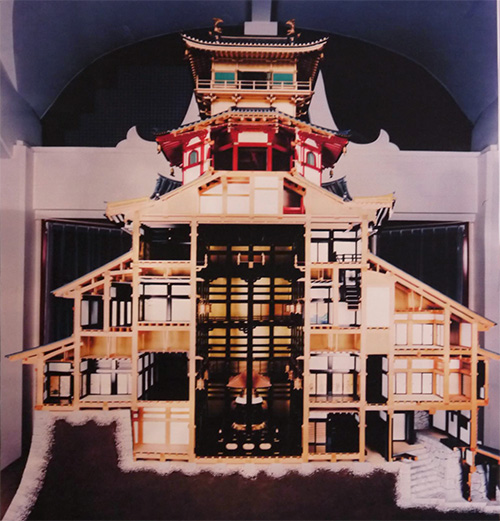
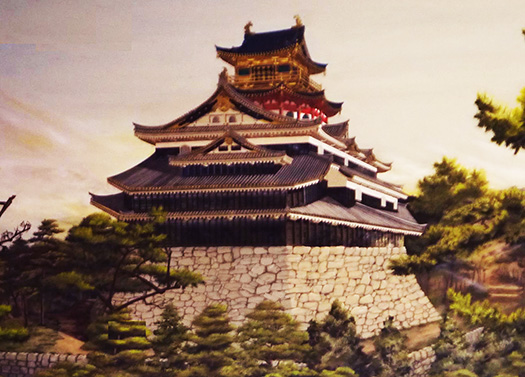
上は安土城の記念館で見学した資料からの写真類です。
一番上の安土城断面模型は内藤昌氏監修によるもの。
地階は周辺に土蔵を配置して中央に4層吹き抜け空間。真ん中に「宝塔」。
1階は諸臣の諸室類、対面所、大倉。2階は吹き抜け西側に舞台が張り出し、
周囲に大広間・座敷を配している。3階は信長の諸室・茶座敷。吹き抜けに面して
勾欄付きの縁が巡り中央に架橋されている。
4階は5階の控え室。屋根裏部屋。5−6階が「天主」区域。
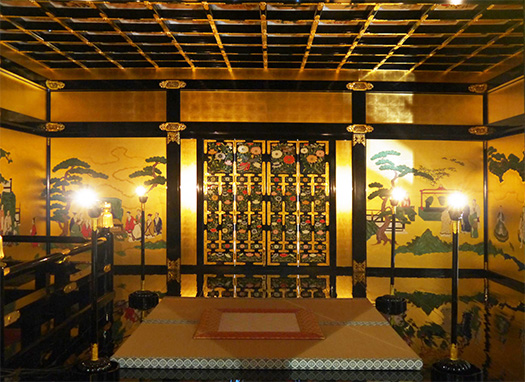
写真は記念館に復元された天主の室内空間。
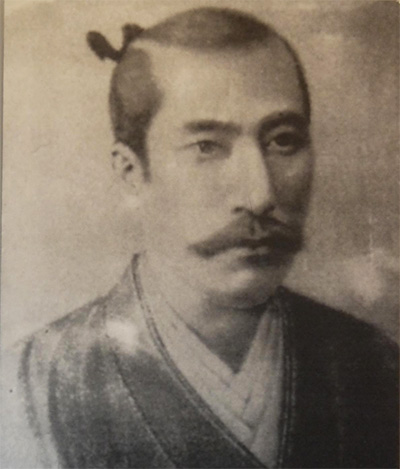
顔写真は天童・織田家という信長の死後、宗家を継いだ信雄を祖とする家に
残されていたという「外国人宣教師が描いた信長肖像画」。
天童織田家では「もっとも面影を伝えている」とされてきたそうです。
やはりアジア世界でもっとも「封建」が機能した国として
それがこのような稀有な建築表現に至ったように思われる。

English version⬇

[The idea of ​​the Japanese unique architecture “Tenshukaku” is Nobunaga / A good house in Japan ㊳-13]
Yesterday, I saw Azuchi Castle, which marked the Azuchi-Momoyama period at the end of the Warring States period.
The orientation towards the mysterious high-rise building of the heavenly lord is different from other Asian countries.
As if the deep Japanese architectural culture of Sannai Maruyama and Izumo Temple was revived
From the strong demand for construction and the enthusiasm of the fort construction rush all over Japan
I think it’s very interesting that this kind of orientation has historically appeared.

During the Warring States period, military power was established in each region, and forts for war were actively built.
Basically, even if it is a mountain castle that makes the best use of the terrain or a flat castle, you can use pits, stone walls, and fences.
A lot of architecture was built with a heavy circle and wisdom for offense and defense.
I studied the war and researched how to win.
Since this mind is a fundamental desire, architecture has also developed to the ultimate.
It is an architectural expression of the act of war as the domestic power war reaches its final stage.
The symbolism of the heavenly lord has come to be given to the castle architecture.
However, it is unknown which Nobunaga’s castle before Azuchi Castle had such an intention.
At the end of the Warring States period, the willingness to struggle for power over regional revitalization and economic development reached its limit.
We faced the need for a means of permeating the armed power thus gained.
The military commanders before Nobunaga considered their position within the framework of the Muromachi Shogunate and the imperial court power.
However, Nobunaga aimed to express power as an architecture with an original approach.
Azuchi Castle has made it possible to see more near the top of a small mountain facing Lake Biwa.
A multi-story wooden castle is being built.
For its architectural purpose, it was based on “world consciousness” rather than simple military elements.
I can only think of it as emphasizing political or artistic symbolism.
In recent excavations, an architectural remains that can be assumed to be the emperor’s seat was discovered.
Positionally, it is said that the lord of Azuchi was built in a position overlooking the seat.
Nobunaga is said to have had the idea of ​​becoming a god after his death.
Since his power, both Hideyoshi and Ieyasu have copied, so they have gained strong universality.
However, those who saw Azuchi’s castle tower for the first time would have been surprised at the huge wooden construction.
It must have been an architecture that I could agree with in that motivation.

Above are photographs from the materials visited at the Azuchi Castle Memorial Hall.
The top Azuchi castle cross-section model is supervised by Mr. Akira Naito.
The basement is a four-story atrium space with a dozo in the periphery. “Treasure tower” in the middle.
The first floor is the rooms of Omi, the meeting place, and Okura. On the second floor, the stage overhangs on the west side of the atrium,
There are large halls and tatami rooms around. Nobunaga’s rooms and tea room are on the 3rd floor. Facing the atrium
A rim with a column is circulated and bridged in the center.
The 4th floor is the waiting room on the 5th floor. attic. The 5th and 6th floors are the “heavenly lord” area.
The photo shows the interior space of the heavenly lord restored in the memorial hall.
The face photo shows Nobunaga’s ancestor, Nobunaga, who succeeded the Soke after the death of Nobunaga, the Tendo and Oda clan.
“Portrait of Nobunaga drawn by a foreign missionary” that was left behind.
It is said that the Tendo Oda clan has been said to be “the most memorable”.
As the country where “feudalism” worked most in the Asian world
It seems that it led to such a rare architectural expression.

【戦国経済成長と建築道具進化/日本のいい家㊳-12】


室町の世は戦国期を含めて人口増加の時代。
1115年の平安末期で724万人ほどだったものが、1600年段階で1390万人ほど。
500年間でほぼ人口倍増している。(上智大・鬼頭先生「歴史人口」資料より)
この歴史時間では各地方で自立的な経済圏が成立してその蜜を簒奪する武権も
同時に確立していった過程だといえるのでしょう。
関東平野などの未耕作地域が開墾されていって、各地域の発展が進んだ。
朝廷・皇統周辺での権力たらい回しと各地方への支配高等官派遣政治から
各地域権力者である武家がそれに支配されるバカらしさに気付いて
武力で権力を生み出していって、さらに地方の経済基盤を大きくした時代。
まことに「地方創生」が生き生きと展開していった時代でしょう。
封建というと否定的に捉えられるけれど、人類進歩では民主主義に向かう
必然的な社会プロセスが現出していった時代。戦国は
過酷な権力争奪の時代だけれど、地域発展の面では合理性が高いと思う。
極東アジア世界ではどうも日本だけが真正の「封建」を実現したのか。

きのう見たように、大鋸が木材の製材プロセスを一変させたことで、
従来からは隔絶したような木材生産が可能になったことで、
それを利用しての各地域での土木建築が活況を呈した。
戦争の攻防の要である城砦建築需要が盛り上がり、
しかもそれらがどんどん落城して常に需要の新陳代謝があった。
もしこの時代に建材商社があれば、ウハウハだったことでしょう(笑)。
まぁ戦争での景気なので笑い事ではないけれど、事実はそうでしょう。
ただ、首都京都では繰り返された戦火で都市家屋は繰り返し焼却され
安土桃山期になって建材不足、ヤマの森林不足が深刻化し、
北山に人工的に「杉山」が植林されたと言われ、それが北山杉という
ブランド林になっていったと言われる。
この逸話には日本の「市場価値」の真実があるように感じる・・・。
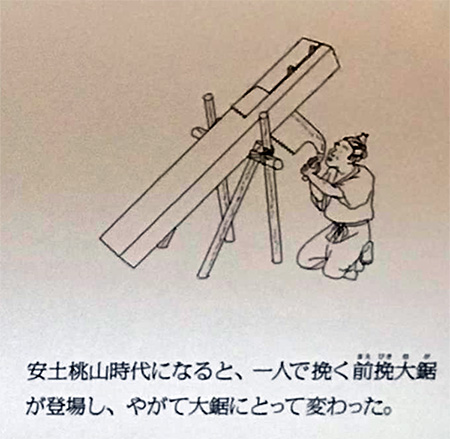
室町期に導入された大鋸はすぐに技術革新が起こってイラストのように
ひとりで操作する「前挽き大鋸」に進化して旺盛な需要に応えていった。
たしかに伐採地でか、建設地近くでかを問わず、2人1組の作業は
工程管理上、面倒だったことでしょう。必然的変化。
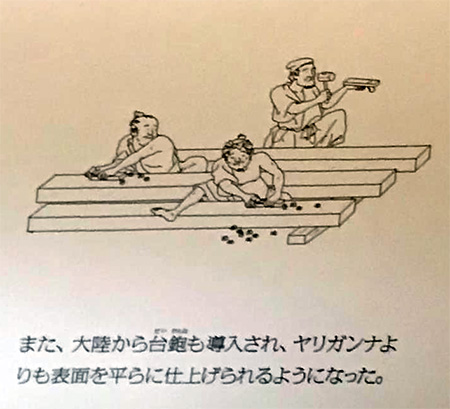
そして今日の「台カンナ」も導入されて木材加工技術はどんどん進化した。

こういう活況を呈した建築技術の発展の末に
写真のような「安土城」などの高層建築文化が盛り上がっていく。
そして一方では利休などの「数寄屋茶室」文化も併存した。
日本の木造建築が止揚されて独特の文化として成立していったのでしょう。

English version⬇

[Sengoku Economic Growth and Evolution of Building Tools / Good House in Japan ㊳-12]
The world of Muromachi is an era of population growth, including the Warring States period.
At the end of the Heian period in 1115, there were about 7.24 million people, but in 1600 there were about 13.9 million people.
The population has almost doubled in 500 years. (From Sophia University, Professor Kito’s “Historical Population” material)
In this historical time, an independent economic zone is established in each region, and there is also the military power to steal the honey.
It can be said that it is a process that was established at the same time.
Uncultivated areas such as the Kanto Plain have been cleared, and the development of each area has progressed.
From the power circumvention around the imperial court and the imperial court and the politics of dispatching high-ranking officials to each region
Being aware of the stupidity of the samurai, who are the powers of each region, being dominated by it
An era in which power was created by force and the local economic base was further expanded.
It must be an era when “regional revitalization” was truly developed.
Feudalism is considered negative, but human progress is toward democracy.
An era when inevitable social processes emerged. Sengoku
Although it is an era of severe power struggle, I think it is highly rational in terms of regional development.
In the Far East Asian world, did Japan realize the genuine “feudalism”?

As we saw yesterday, Daigiri changed the lumbering process of wood.
By making it possible to produce wood that has been isolated from the past,
Civil engineering and construction in each area using it was booming.
Demand for fort construction, which is the cornerstone of the offense and defense of the war, has risen.
Moreover, they were steadily falling and there was always a metabolism of demand.
If there was a building materials trading company in this era, it would have been ugly (laughs).
Well, it’s not a laugh because it’s a war economy, but it’s true.
However, in the capital city of Kyoto, urban houses were repeatedly incinerated due to repeated wars.
In the Azuchi-Momoyama period, the shortage of building materials and forests in Yama became more serious.
It is said that “Sugiyama” was artificially planted in Kitayama, which is called Kitayama cedar.
It is said that it has become a brand forest.
I feel that this anecdote has the truth of Japan’s “market value” …
Daigiri, which was introduced in the Muromachi period, soon undergoes technological innovation, as shown in the illustration.
It has evolved into a “front-ground Daigiri” that can be operated by itself, and has responded to strong demand.
Certainly, the work of a pair of people is done regardless of whether it is in a logging area or near a construction site.
It would have been troublesome in terms of process control. Inevitable change.
And today’s “Tai Kanna” was also introduced, and the wood processing technology has evolved steadily.

At the end of the development of such a booming building technology
High-rise building culture such as “Azuchi Castle” as shown in the photo will rise.
On the other hand, “Sukiya tea room” culture such as Rikyu also coexisted.
It seems that Japanese wooden architecture was suspended and established as a unique culture.

【室町期「大鋸」製材革命ビッグバン/日本のいい家㊳-11】


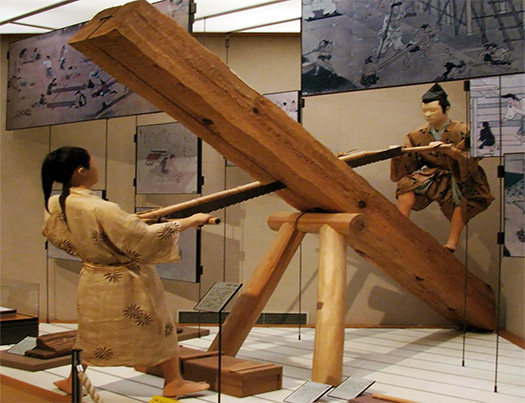
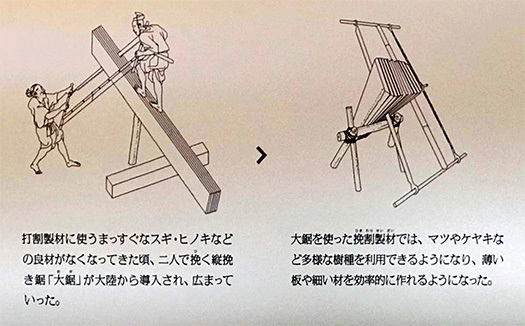
木材製材の歴史で「大鋸〜おが」は14〜15世紀室町時代に中国から導入された。
大鋸は長さが約2メートルあり2人がかりで左右あるいは上下から
縦挽きに挽いて木材を切る。木材建材の生産能率が飛躍的に上昇した。
竹中大工道具館展示では、法隆寺以降の時代について
この製材革命を持って打ち割製材から「挽き割製材」への画時代としている。
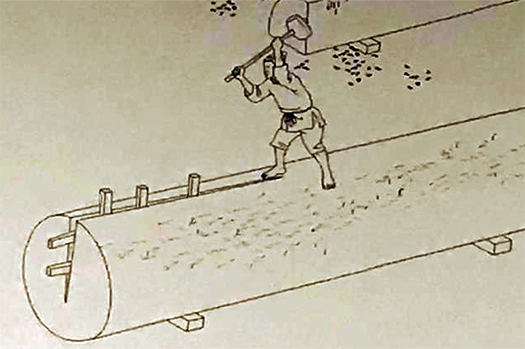
それまでの製材方法は「打ち割り」製材と呼ばれるもので、
以前紹介した竹中大工道具館イラスト展示では以下のようだった。

上の写真は千葉県の「国立歴史民俗博物館」展示のものです。
打ち割製材では切り倒した木材の「筋目」に沿って楔を入れて
木槌を振り下ろして、割って製材としていた。その結果、
構造材として利用しやすいのは、杉などの割りやすい材が中心であって、
利用地と伐採地の距離が遠隔化し材の供給に問題が生じていたに違いない。
この製材現場の実態が、日本の木造技術の進化にとって障害になっていた。
割りやすい木を採取し尽くすと供給が乏しくなっていった。
司馬遼太郎エッセイでも日本の大型木造建築の時代的増減に触れた件があり
大型木造建築が旺盛な奈良期から室町期まで減少するとされている。
司馬さんは原材料が伐採され尽くした結果、森林回復にそれくらい掛かった、
という説を上げていたけれど、どうもこの大鋸導入以前の状況だったと思われる。
四天王寺・法隆寺から東大寺・各地の国分寺建設などで
木造技術者は全国に拡散したけれど、やがてこの製材のボトルネックが生じた。
その結果、大規模建築が時代的に減少したのではないだろうか。
竹中大工道具館展示説明でも、木材の樹種がこの大鋸によって
飛躍的に多様化していって各地の身近な山から製材出荷が可能になった。
やはり打ち割り製材では手間が掛かりすぎ、かつ樹種の制約もあったのだ。
そして各地域の人口拡大、経済規模の拡大に沿って支配権力の拡散も、
戦国時代=地域活性化として現実化していった。
各地域の武力権力者は軍事拠点としての城砦建築を活発化させたけれど、
この「大鋸」革命によって構造材生産が幾何級数的に拡大したのだろう。

戦国期の戦争は同時に土木建築の競争でもあったのだと思われる。
武田信玄の甲州の産金とその土木技術の軍事転用や
墨俣の一夜城や高松城の水攻めなどの奇想天外な土木建築活用の秀吉など、
こうした製材革命による木材の大量利用が歴史の影で進行したのだと思う。
ジオラマ展示にはそういう民族的革命事態が暗示されている。
室町期の大鋸の輸入と兵器としての鉄砲輸入は日本史の重要な変化。
鉄砲はより大きく取り上げられるけれど、大鋸もそれ以上だったと思う。
戦争が活発化するのと各地で攻防のための築城は同時進行した。
当然、活発な用材の供給実態が想像されるけれど、
このことについての調査研究活動はあまり注目されていない。
秀吉の巨大な土木建築活用の実態などを見ると、
この「革命」のインパクトをまざまざと実感させられるのだけれど。・・・

English version⬇

[Muromachi period “Daigiri-Oga” sawmill revolution big bang / Japanese good house ㊳-11]
In the history of lumber lumber, “Daigiri-Oga” was introduced from China during the Muromachi period in the 14th and 15th centuries.
Daigiri is about 2 meters long and requires two people from the left and right or from above and below.
Cut the wood by grinding it vertically. The production efficiency of timber building materials has increased dramatically.
At the Takenaka Carpentry Tools Museum exhibition, about the era after Horyuji Temple
With this lumbering revolution, we are in the era of painting from split sawing to “grinding sawing”.
The lumbering method up to that point was called “splitting” lumbering.
The illustration exhibition at Takenaka Carpentry Tools Museum introduced earlier was as follows.

The photo shows the exhibition at the “National Museum of Japanese History” in Chiba Prefecture.
In split lumber, insert a wedge along the “streaks” of the cut down wood.
I shook the mallet down and broke it to make lumber. as a result,
Most of the materials that are easy to use as structural materials are easy-to-break materials such as cedar.
There must have been a problem with the supply of lumber due to the remote distance between the land used and the logging area.
The reality of this sawmill was an obstacle to the evolution of Japanese wooden technology.
When all the fragile trees were collected, the supply became scarce.
Ryotaro Shiba’s essay also touched on the changes over time in large-scale wooden architecture in Japan.
It is said that the number of large wooden buildings will decrease from the Nara period, when it was flourishing, to the Muromachi period.
Mr. Shiba took so much time to reforest as a result of logging being exhausted.
However, it seems that the situation was before the introduction of this Daigiri.
From Shitennoji / Horyuji to Todaiji / Kokubunji in each area
Wooden engineers spread all over the country, but eventually a sawn bottleneck arose.
As a result, the number of large-scale buildings may have decreased over time.
Even in the explanation of the Takenaka Carpentry Tools Museum exhibition, the wood species are selected by this Daigiri.
It has become dramatically diversified, and it has become possible to ship lumber from familiar mountains in each region.
After all, it took too much time and effort to use split lumber, and there were restrictions on the tree species.
And as the population of each region expands and the scale of the economy expands, the power of control also spreads.
It became a reality as the Warring States period = regional revitalization.
Powerful people in each region activated the castle construction as a military base,
This “Daigiri” revolution may have expanded the production of structural materials geometrically.

It seems that the war during the Warring States period was also a competition for civil engineering and construction.
Takeda Shingen’s Koshu gold production and military diversion of its civil engineering technology
Hideyoshi, who utilizes the strange civil engineering architecture such as Sunomata’s Ichiya Castle and Takamatsu Castle’s water attack, etc.
I think that the mass utilization of timber due to this lumber revolution has progressed in the shadow of history.
The diorama exhibition implies such an ethnic revolution.
Imports of large saws and guns as weapons during the Muromachi period are important changes in Japanese history.
The guns are taken up more widely, but I think the Daigiri was even more.
As the war intensified, the construction of castles for offense and defense proceeded at the same time.
Of course, you can imagine the actual supply of active lumber,
Research activities on this matter have received little attention.
Looking at the actual situation of Hideyoshi’s use of huge civil engineering buildings,
You can really feel the impact of this “revolution” …

【大陸から建築技術導入:法隆寺/日本のいい家㊳-10】


さて古代の日本列島での木造技術を見てきたけれど、
やがてアジア世界との交流が本格的に始まっていく。
天皇制というシステムと統一国家としての統治思想として鎮護国家政策で
各地で国分寺・国分尼寺が造営されて建築として
たぶん「見たこともない」キラキラとしたものとして
この列島の人々の心を占領していったに違いない。
中央集権国家体制の構築と、アジア的律令体制とが一体化して導入された。
建築の流儀として、そのデザイン細部まで入り込んできた。
見たような「出雲大社神殿」のような巨木建築の志向性とはかなり違いがある。
個人的には日本史では奥州での「産金」が大きな影響を及ぼしたと思います。
奈良期に大仏を造営したけれど鍍金にあたって国内でついに産金したことは、
「経済大国」ニッポンの初源体験だったのではと思っています。
四天王寺、法隆寺建設段階ではひたすらアジア世界価値感の導入だったものが、
人口増、経済発展が進みさらに自国内での産金によって
ジャパンasNO1みたいな自信が社会に充満していったのではないか。
その後のヤマト朝廷支配、その基本体制の定着にとって、
産金による自国への自信というものは大きかったのではないか。
天智期での白村江敗戦以降の中国からの脅威が律令体制の積極導入につながり、
仏教文化の積極受容が進められアジア世界への普遍化の流れがあったものが
自国産金で一気に自信回復した、と思えるのです。
そしてその産金地帯が日本権力体制の「汽水域」のような地域だったことが
その後の東北地方の政治動乱の伏線になっていった。

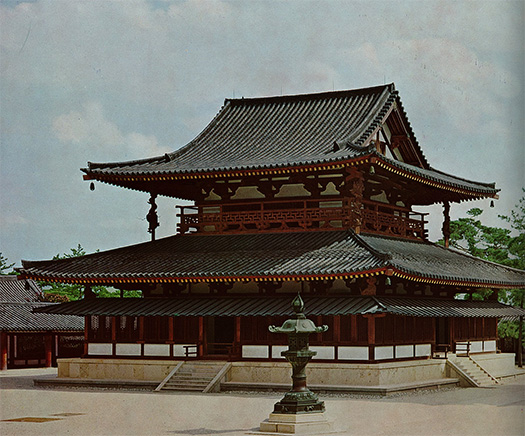
法隆寺建築はそのような国家の状況の中で象徴的な建築営為だった。
竹中大工道具館展示ではアジア世界からの技術導入的に捉えられている。
たしかにそういう側面は大きかっただろうけれど、一方で三内丸山、
出雲神殿建築の木造技術伝統がそれを容易に受容させたとも思える。
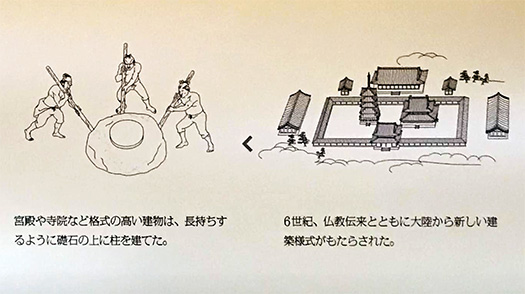
礎石の考え方も、出雲神殿でも掘っ立ての基礎部分には多くの砕石が多密度。
技術の受容に当たってたぶん、簡単に「応用」として土着できたのだと思う。
明治の西洋文化導入でも「世界の驚異」的なペースで進めたように。
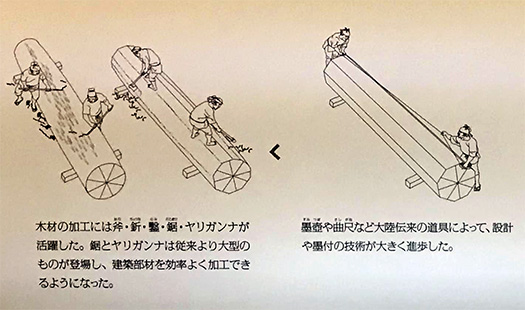
ノコギリやヤリカンナなど道具は先進のものが導入されただろうけれど、
その使い方は相当スピードで技術文化が定着していった。
法隆寺の建設が想定創建年607年、そこから国分寺建設開始が741年。
それまでの建築スタイルから移行し、それが全国で一斉に建築できるまで
底堅い技術基盤が確立したのだと考えると興味深い。
多数の新技術・新ツールを使いこなす職人が全国的にネットワーク形成された。
日本の歴史人口は上智大学経済学部教授・鬼頭宏さん資料で
奈良期の725年で450万人ほど。その人口規模で全国のクニで造営された。
その時代の最先端技術職人がそれを可能にさせたということ。
典型的な「技術史」と考えるとテーマとして面白いと思われます。

English version⬇

[Introduction of building technology from the continent: Horyuji Temple / Good Japanese House ㊳-10]
Well, I’ve seen the wooden technology in the ancient Japanese archipelago,
Eventually, exchanges with the Asian world will begin in earnest.
With the system of the emperor system and the guardian state policy as the idea of ​​governance as a unified nation
Kokubunji Temple and Kokubunnanji Temple were built in various places as architecture
Maybe as a “never seen” glitter
It must have occupied the hearts of the people of this archipelago.
The construction of a centralized national system and the Asian decree system were introduced in an integrated manner.
As an architectural style, the details of the design have been taken into consideration.
There is a considerable difference from the orientation of giant tree architecture such as the “Izumo Taisha Shrine” that you saw.
Personally, I think that “gold production” in Oshu had a great influence on Japanese history.
The Great Buddha was built in the Nara period, but the fact that it was finally plated in Japan was
I think it was the first experience of “economic power” Japan.
At the construction stage of Shitennoji and Horyu-ji, the introduction of Asian world value was earnestly introduced.
Due to population growth, economic development, and domestic gold production
I think society was filled with self-confidence like Japan as NO1.
For the subsequent Yamato court rule and the establishment of its basic system
I think the confidence in their own country from the money they produced was great.
The threat from China after the defeat of Baekgang in the Tenji period led to the active introduction of the decree system.
The positive acceptance of Buddhist culture has been promoted and there has been a trend toward universalization in the Asian world.
It seems that the self-confidence was restored at once with the domestic money.
And that the gold-producing area was a region like the “brackish water area” of the Japanese power system.
It became a hint of political turmoil in the Tohoku region after that.

Horyuji architecture was a symbolic architectural activity in such a national situation.
At the Takenaka Carpentry Tools Museum exhibition, it is seen as a technology introduction from the Asian world.
I’m sure that aspect was big, but
On the other hand, it seems that the wooden technology tradition of Sannai Maruyama and Izumo Temple architecture easily accepted it.
Even in the Izumo Temple, there are many crushed stones in the foundation of the digging.
In accepting the technology, I think it could have been easily indigenous as an “application”.
It seems that the introduction of Western culture in the Meiji era proceeded at a “world wonder” pace.
Advanced tools such as saws and spear canna would have been introduced,
The technical culture became established at a considerable speed in its usage.
The construction of Horyuji Temple is assumed to be in 607, and the construction of Kokubunji will start in 741.
From the previous architectural style to a new style, until it can be built all over the country
It is interesting to think that a solid technological foundation has been established.
A nationwide network of craftsmen who master a large number of new technologies and tools has been formed.
The historical population of Japan is based on materials by Hiroshi Kito, a professor at the Faculty of Economics, Sophia University.
About 4.5 million people in 725 during the Nara period. It was built in Kuni all over the country with its population size.
The state-of-the-art craftsmen of that era made it possible.
Thinking of it as a typical “history of technology”, it seems to be an interesting theme.