本文へジャンプ

【水回りがキレイだと好印象 東京町田「浮輪寮」探訪-5】


さて工事途中にお邪魔して、勝手に探訪記シリーズ。
迷子になったことがトラウマのようで仇討ちと全5回になりました。
ルポを許諾していただいた丸谷博男さんのご好意に感謝です。
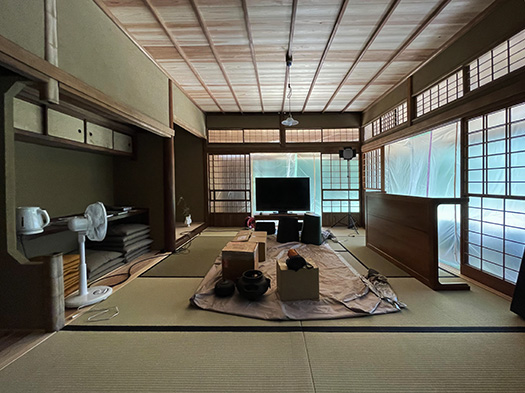
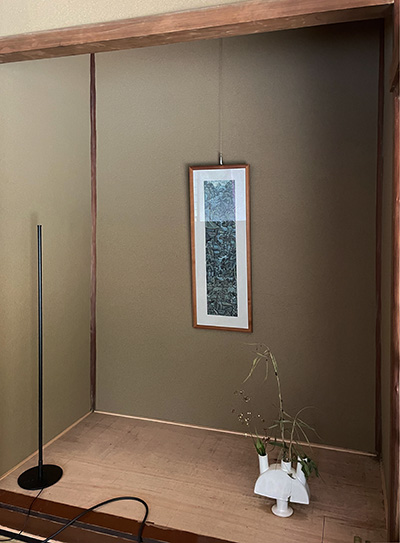
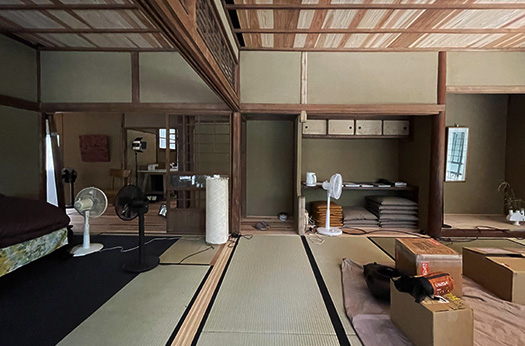
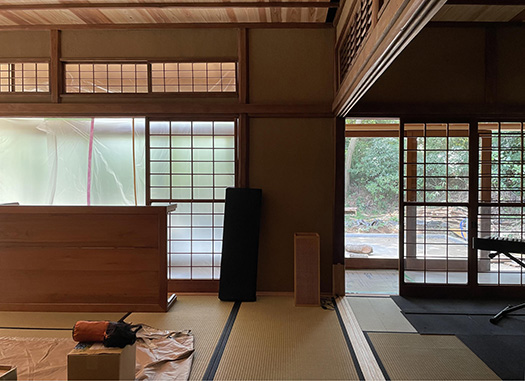
工事途中の写真撮影なので眼光紙背に徹するように
ほぼ個人的関心に沿って書き連ねてみましたが、
さすがに荷物類がたくさん映っているので
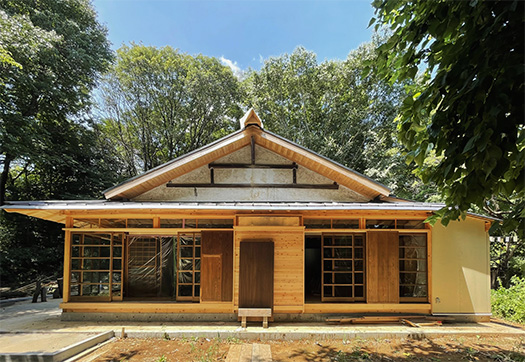
そのなかでもまともな部類の写真に絞って掲載してみました。
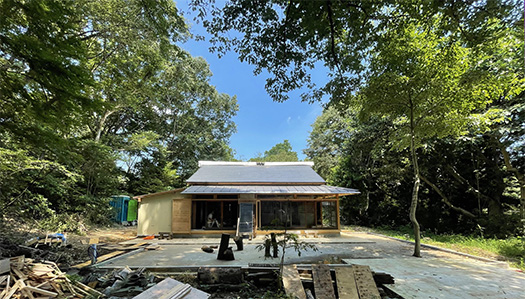
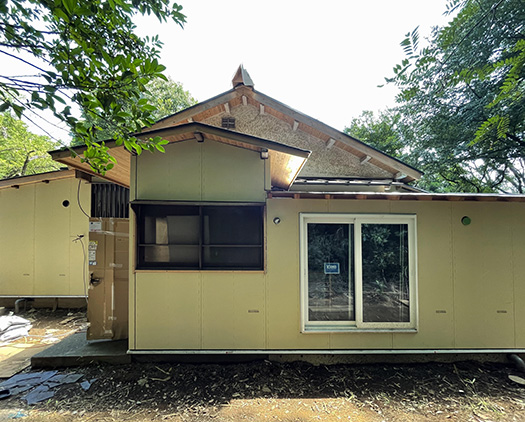
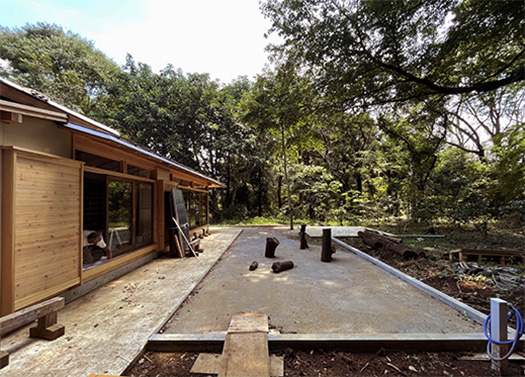
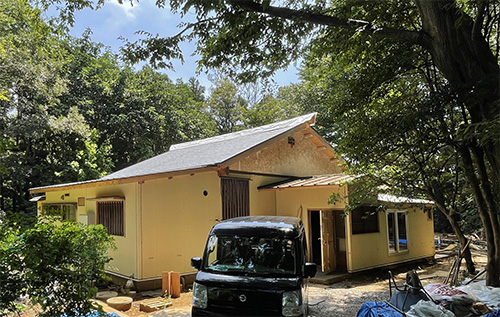
外観はシンプルな造作ですが、平屋に乗せた屋根がアクセントになっていて
均整が取れていて見ていて落ち着いた印象。
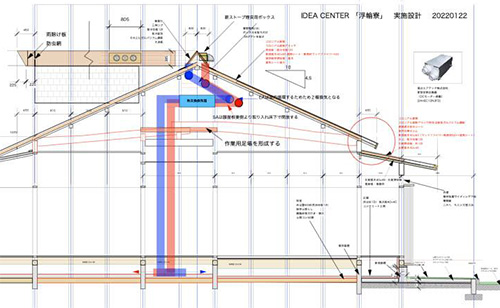
この屋根の小屋裏はどうなっているのか、
図面を確認する限り、空気集熱装置をスタンバイしていると思われます。
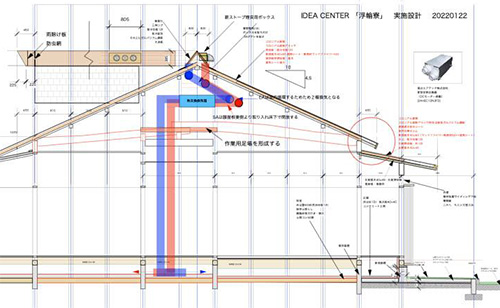
内観でも主要空間の和室以外の箇所については不分明でした。
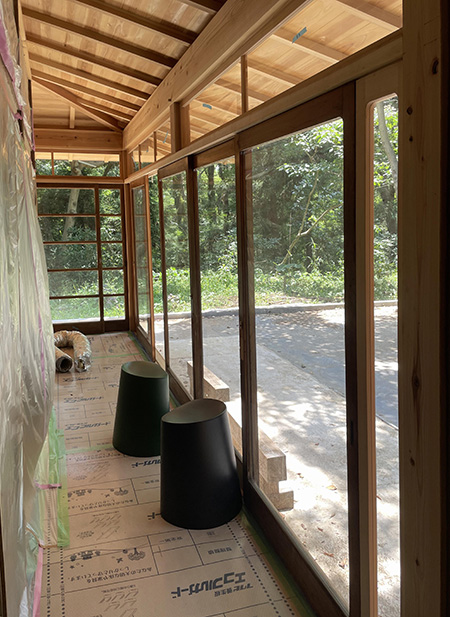
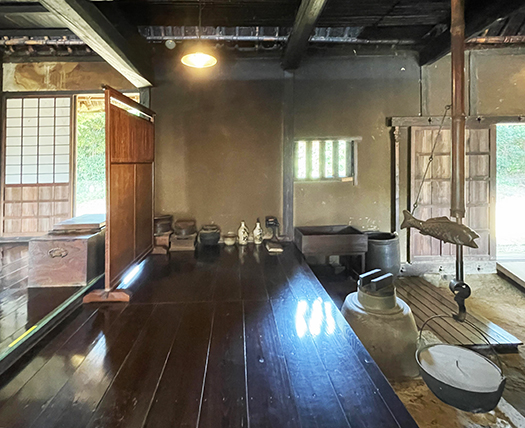
そういう中で、水回りについてはほぼ進捗が見られていた。
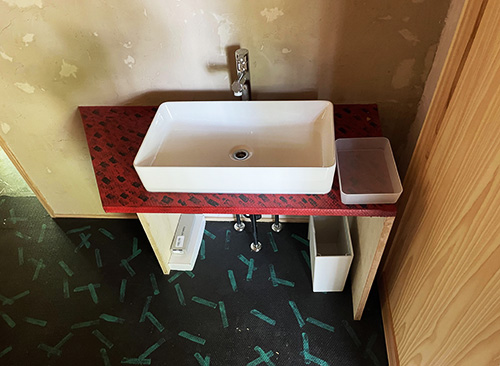
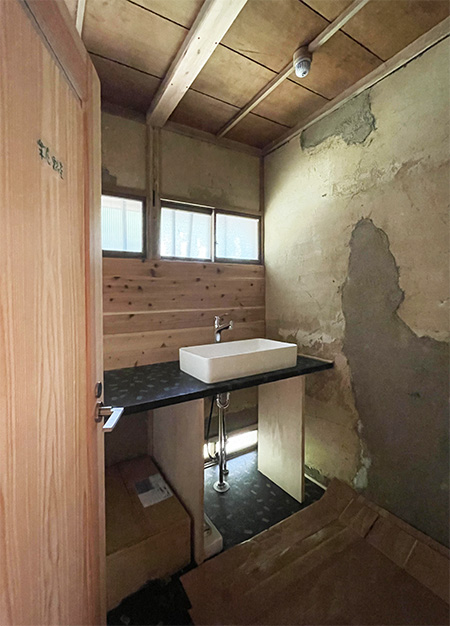
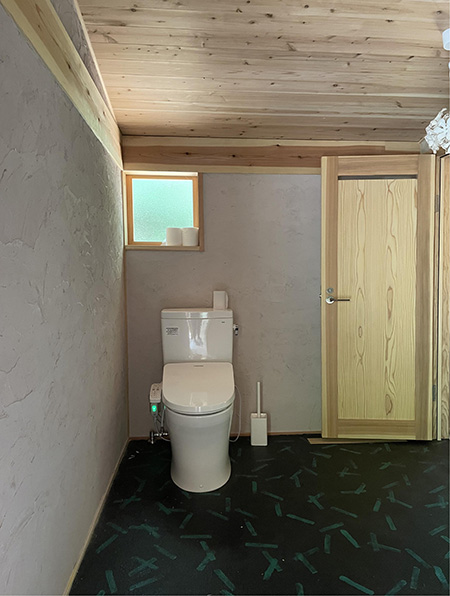
床面の新造作が姿を現していたので、
その雰囲気を感じられた次第。
設備の選択と配置、そしてその空間の雰囲気との対比。
毎日使われ、それも多くの来訪者が使うことを考えて、
やや非日常感とそこでの体験に補助線を引くような役割を
水回りには担わせているのかも知れません。
個人的に、床面のタイルカーペットのデザインと設備のコントラストが
「キレイ」と清潔の間をゆらいでいるような印象を受けていました。
旧宅からの塗り壁に囲まれた洗面も対比的で
むしろ「水」の役割を引き立てているように感じられた。
未完成の工事現場のような空間でしたが、
それを超えて設計意図やら、環境との相互関係を中心にルポ。
書いてみるとそれなりに自分としても面白い気付きを得られた。
やはり建築、住宅を作って行く営為というのは
実にたくさんの選択行為の積み重ねであり、その多様な選択肢から
ある手段を選択して改変が加わっていくことに「寄り添う」というか、
そういう本質部分を対話的に解剖してみる、みたいな気付き。
考えて見ると、古民家というものの取材と似ているかも知れない。

最近、温暖地域の住宅、古建築などの事例が多かったのですが、
一昨日まで北海道旭川で北海道の地域工務店グループ・アース21の
現場見学会が久しぶりに開催されておりました。
また、ブログを応援していただいている方から
「養蚕民家」を建設した開拓者の古建築情報もいただき、
それらを、明日以降掲載予定です。
つくづく感じるのですが、やはり住宅は現場感覚が非常に重要。
なんといっても空間についてのコミュニケーションなのですから
リアルな空気感を感受しながらのルポが基本。
やはり「日常を取り戻す」ことが大切だと痛感しています。

English version⬇

Cleanliness of the water area gives a good impression.
The key to on-site interviews is the points that you notice there. The basic principle of “communicating” is to always be sensitive to information. …….

Well, I visited you in the middle of construction and took the liberty of writing a series of exploratory notes.
It seems to have been a traumatic experience to get lost, and it became a total of five times with a vengeance.
I would like to thank Mr. Hiroo Marutani for his kindness in allowing me to do this reportage.
Since I was taking pictures during the construction process, I tried to keep my eyes on the road.
I have tried to write mostly according to my personal interest.
As you can see, there is a lot of baggage in the picture, so I thought it would be a good idea to show some of the baggage.
I have tried to focus on the decent photos among them.
The exterior is a simple structure, but the roof on the flat roof is an accent.
The roof is well-proportioned and gives a calm impression.
I wondered what was going on behind this roof.
From the drawings, it is assumed that an air collector is on standby.

Even in the interior view, I was unclear about the other parts of the main space except for the Japanese-style room.
In such a situation, progress was mostly made on the water area.

The new flooring had been revealed.
the atmosphere of the space.
The choice and placement of equipment and its contrast with the atmosphere of the space.
Considering the fact that the room will be used every day and by many visitors
the role of the water feature is to create a somewhat unusual feeling and to draw an auxiliary line to the experience of the space.
and the water feature may play a role in creating an extraordinary experience.
Personally, I think the contrast between the design of the carpet tiles on the floor and the facilities
I had the impression that the contrast between the design of the carpet tiles on the floor and the equipment waver between “clean” and “cleanliness.
The washroom surrounded by painted walls from the old house is also a contrast.
It seemed to enhance the role of “water” rather than the other way around.
The space looked like an unfinished construction site, but
Beyond that, the reporto focuses on the design intent and the interrelationship with the environment.
I found myself making some interesting discoveries when I wrote the report.
After all, the act of building architecture and housing is
The act of building architecture and housing is really an accumulation of many choices.
I would like to “lean in” to the process of selecting a certain means of alteration from among the various options.
I realized that I would like to try to dissect such an essential part of the process in an interactive manner.
When I think about it, it may be similar to the coverage of old private houses.

Recently, I have been working on many cases of houses and old buildings in warm regions.
The day before yesterday, a site tour was held in Asahikawa, Hokkaido, for the first time in many years by Earth 21, a Hokkaido regional construction company group.
The site tour was being held in Asahikawa, Hokkaido, for the first time in a while.
We also received a message from one of our blog supporters
We also received information from a blog supporter about the pioneer who built a “silkworm farm house,” and will be posting it tomorrow and onward.
We are planning to post them from tomorrow onward.
I always feel that the sense of site is very important in housing.
After all, we are communicating about space.
Therefore, it is important to report on the project with a realistic sense of the atmosphere.
I am keenly aware of the importance of “getting back to the everyday.

【和の大開口と北海道的ぼやき(笑) 東京町田「浮輪寮」探訪-4】


この建物を再生利用したいと丸谷さんが考えただけあって
その構成素材の素性には和風建築としての格調が感じられます。
写真の空間は水盤に面したメイン居室の座敷2間。
ふすま建具で仕切られたものが開放されみごとな広間が広がる。
周囲の植栽・森の様子らが水盤をも演出装置として座の目線で楽しめる。
いかにも日本の伝統的高級住宅手法が全開している。
近接した自然を建物の内部にまで引き込むという日本人の発想を感じる。
春夏秋の3シーズンで周囲の自然と完全に一体化することを
花鳥風月思想、あるいは老荘思想として和の精神性と感じ続けていた。
「冬さえガマンすれば・・・」という四季への感覚。
開口部の緩衝装置としては障子と非常時用の雨戸程度で、
あくまでも眺望最優先の思想になる。
なので「家は庭があってはじめて家庭なのだ」みたいな生活哲学になる。
一方北海道住宅は冬には大量の積雪で庭木が雪でやられる不安が大きく
庭のキャンセル率が高くなっている。
一生懸命に庭仕事に努力しても、楽しめる時間はせいぜい半年。
北海道人にしてみれば豊かな大自然との対話は1方向からの眺望で十分で
外にちょっと出ればいやでも視線に飛び込んでくると考える。
大空と自然との対話は1方向の窓からもダイナミックに感じられる・・・。
もし大開口空間を作るときには「開く」と「閉じる」の対話作業。
寒冷地での熱環境的には2面の開口部が全開している状態は難しい。
日射取得効果と3重ガラスの性能で熱環境のバランスを考えることになる。
和の眺望空間は高断熱住宅を見続けている人間としては、飛躍した空間。
浮輪寮は建築の用途が「IDEA CENTER」ということで非住宅。
発想の自由度を第1に考えた建物として古建築の美感を受容したのでしょう。
こういう開放型空間でやさしい気候環境と対話したいと考えるのは自然。
北国人としてはこういう自然との対話志向性を理解しつつ、
気候風土と調和させるにはどうしたらいいかと知恵と工夫で立ち向かう。
そういうハンデキャップレースはそれなりに楽しい(笑)。
「拡張された花鳥風月」をどうやったら北海道は獲得できるか、
こういうテーマ設定はなかなか無限に蠱惑的かと。

こういうあたりの居住環境性について
東京町田の環境の中で、春夏秋の季節感と冬対応をどうされているのか、
どんな試行をされているのか、機会を見てぜひ取材したいと思っています。
ただやはりわたし的には日本人なので、蒸暑の夏などに
こういう空間美のなかで感じる花鳥風月に憧憬する部分は大きいです。
失って知る、民俗記憶のなかのいごこちの良さみたいなものか。

English version

A Japanese-style large opening and Hokkaido-style blurring (laughs) Exploration of Tokyo Machida “Ukirinryo” – 4
A space in which the Japanese concept of “Kacho-fu-getsu” (flowers, birds, winds, and the moon) is abstracted. Hokkaido people, who are not able to perceive the same things in the same way, are oriented toward the “expansion of Kacho-fu-getsu” by force. …

Mr. Marutani wanted to revitalize this building.
The materials used in its construction are of a Japanese architectural quality.
The space in the photo is the two tatami rooms of the main living room facing the water table.
The room is divided by fusuma fittings, which are then opened to reveal a magnificent spacious room.
The surrounding plants and forest can be enjoyed from the viewpoint of the water table as well.
This is a traditional Japanese luxury residence in all its glory.
The Japanese concept of drawing nature into the interior of the building is very much in evidence.
The three seasons of spring, summer, and fall are to be completely integrated with the surrounding nature.
I have always felt that the idea of “Kacho-Fu-Getsu” or “Lao-Zhuang” is the spirituality of harmony.
The sense of the four seasons, “If only we could endure winter….
The only buffer devices at the openings are shoji screens and emergency storm shutters.
The view is the highest priority.
Therefore, the philosophy of life is that “a house is a home only if it has a garden.
On the other hand, in Hokkaido, there is a great deal of snowfall in winter, and there is great concern that the garden trees will be damaged by the snow, resulting in a high rate of garden cancellations.
The cancellation rate of the garden is high.
Even if you work hard on your garden, you can only enjoy it for half a year at most.
For Hokkaido residents, a view from one direction is enough to interact with the abundant nature.
If you go outside for a moment, it will jump into your line of sight.
The sky and nature can be dynamically felt even from a window in one direction….
If you create a large-opening space, it is a dialogue between “open” and “close”.
In terms of thermal environment in cold regions, it is difficult to have two side openings fully open.
The balance of thermal environment is to be considered in terms of solar radiation acquisition effect and triple glazing performance.
The Japanese view space is a leap forward for someone who has been looking at highly insulated houses.
The floating dormitory is a non-residential building, as its architectural use is an “IDEA CENTER.
As a building that considers the freedom of ideas first and foremost, it must have accepted the aesthetics of old architecture.
It is natural to want to interact with a friendly climate in such an open space.
As a northerner, I understand this desire to interact with nature, but I am also concerned about how to harmonize with the climate.
We in the North understand this desire to interact with nature, but we also have the wisdom and ingenuity to find ways to harmonize with the climate.
Such handicap races are fun in their own way (laughs).
How can Hokkaido achieve an “extended Kacho Fu Fugetsu”?
I think this kind of thematic setting is infinitely fascinating.

About the residential environment in these areas
I would like to know how they are dealing with the seasons of spring, summer, and fall, and winter in the environment of Machida, Tokyo, and what kind of trials they are making.
I would like to interview them when I have a chance.
However, as I am Japanese, I would like to visit a place where I can enjoy the beauty of the space in the summer when it is hot and humid.
I am a Japanese person, and I admire the beauty of the flowers, birds, winds, and the moon in such a beautiful space.
It is a kind of comfortableness in folk memories that I have lost.

【東京の自然を映す水盤デザイン 町田「浮輪寮」探訪-3】


この浮輪寮で「池を作るんです」と丸谷さんから聞いていた。
ちょうど飛鳥宮での「苑池」の取材をしていた時期だったので、
そんなイメージかと思っていたのですが、見てみたら
ごらんのような深さを抑えた面的な池だと言うことがわかった。
水盤というか鏡池とでも言えるものだった。
北海道では建築手法としてはあまり見ることのない装置。
トマムに「水の教会」という安藤忠雄の作品があるけれど、
冬には1カ月間ほど「氷の教会」に変貌することは知られている。
ただ、それにしても天候次第であることは言うまでもない。
結婚式場という特異な用途で奇跡的に受容された建築でしょう。
水盤は視覚効果・実際的効果として涼房的装置であることはあきらか。
とくにこの町田の里山とでもいえる環境の中では
周辺のみごとな緑と反響する視覚的効果がきわめて高そう。
北海道は気候で、東京は都市化圧力でどちらも奇跡的に存在ともいえる。
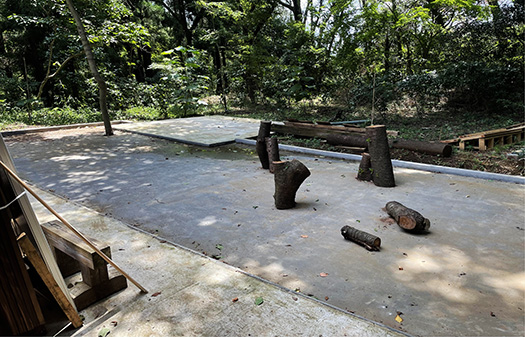
・・・っていうことですが、いまはまだ水盤が姿を現していない
コンクリート面が打設された段階であります。
しかし、この底面のフラットぶりから容易にその効果がわかる。
それをさらに効果的にするためにバランスを考えた木材オブジェも配置。
これは龍安寺石庭の飛石のように機能すると思われる。
そして自生していたと思われる樹木がそのまま水盤内に取り込まれている。
この水盤は浮輪寮のメイン座敷空間・縁側と相対する配置なので、
四季折々の空と植物たちの姿を映し出し続けることでしょう。
水盤が完成した後、ぜひその光景を実感してみたいと思わせます。

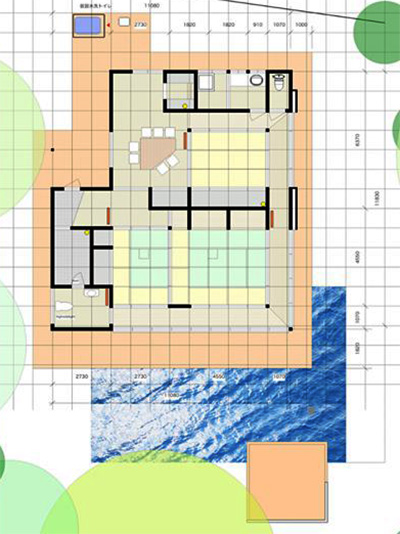
上は配置図・間取り図ですが、水色に彩色された箇所が水盤位置。
建物との相関関係を合わせて考えると「どう見えるか」の想像が膨らむ。
というか、こういう自然環境という表現の舞台を得て
自由闊達に空間をキャンバス化している様子が楽しく感じられる。

北海道という建築の舞台はそもそも大自然が旺盛にある。
圧倒的な迫力で四季の魅力を語りかけているけれど、
東京のような人工都市空間では、こういう自然環境は得がたい存在。
とくに人間環境にセンシティブに取り組み続けてきた設計者としては
空間創造意欲を激しく刺激されるような場なのでしょう。
東京なのに迷子になるような自然環境という奇跡。
温暖地の自然というのはこんな風なんだ、という邂逅感も感じられる。
現代の北海道人は東京に対して、皇居とか公園などの公共空間以外で
「自然を感じる」という空間視覚体験は持ちにくい。
水盤という作戦はなかなかいいアイデアだと強く印象づけられた次第。
・・・なんですが、いまのところはまだコンクリート面と
材木などが散乱している状況。美観的には心頭を滅してみる(笑)。

English version⬇

Water table design reflecting the nature of Tokyo Exploring Machida, Tokyo “Ukirinryo” – 3
The miraculous location of the satoyama-like environment that still remains. The free space design using the remaining old private house as the painting material. The design of the space was free, using the remaining old private house as the painting material.

Mr. Marutani had told me that “we are going to build a pond” at this floating dormitory.
It was right around the time I was covering the “garden pond” at Asuka Palace.
I thought that was the kind of image I had in mind, but when I saw it
As you can see, it turned out to be a surface pond with a reduced depth.
It was a waterbed or a mirror pond, if you will.
It is a device rarely seen as an architectural technique in Hokkaido.
There is a work by Tadao Ando called “Water Church” in Tomamu.
It is known to be transformed into an “ice church” for about a month in winter.
But even so, it goes without saying that it depends on the weather.
It is probably an architecture that was miraculously accepted for its unique use as a wedding hall.
It is obvious that the water basin is a cooling device for visual and practical effects.
Especially in this satoyama-like environment of Machida
The visual effect of echoing the beautiful greenery in the surrounding area seems to be extremely high.
Hokkaido’s climate and Tokyo’s urbanization pressure are both miraculous.
The water table has not yet appeared.
The concrete surface has just been poured.
However, the flatness of this bottom surface easily shows its effectiveness.
To make it even more effective, wood objects are also placed for balance.
This is supposed to function like the stepping stones in the Ryoanji stone garden.
Trees that are thought to have grown wild are incorporated directly into the water basin.
This water basin is placed relative to the main seating area and veranda of Ukirinryo, so that it is possible to enjoy the seasonal sky and plants.
It will continue to reflect the sky and plants in each of the four seasons.
After the water basin is completed, we are eagerly awaiting to experience the spectacle.

Above is the layout/floor plan, but the area colored in light blue is the water table location.
Considering the correlation with the buildings together, the imagination of “how it would look like” will grow.
Or, rather, with this kind of natural environment as a stage for expression
I enjoy the way the space is freely and generously transformed into a canvas.

The architectural setting of Hokkaido is rich in nature.
The charm of the four seasons is expressed with overwhelming power, but in an artificial urban space like Tokyo
In an artificial urban space like Tokyo, this kind of natural environment is hard to find.
As a designer who has always been sensitive to the human environment
I think it is a place that stimulates my desire to create space.
The miracle of a natural environment where you can get lost in spite of being in Tokyo.
It is also a chance encounter with the nature of a warm climate.
The people of Hokkaido today have a spatial visual experience of “feeling nature” outside of public spaces such as the Imperial Palace and parks in Tokyo.
It is difficult for people in Hokkaido to have a spatial visual experience of “feeling nature” outside of public spaces such as the Imperial Palace and parks in Tokyo.
I was strongly impressed by the idea of the water basin.
I was strongly impressed by the idea of using a water table, but at the moment, it is still a concrete surface and lumber scattered around the area.
However, at the moment, the concrete surface and lumber are still scattered. I will try to destroy it aesthetically (laugh).

【温暖地古民家の熱環境デザイン 東京町田「浮輪寮」探訪-2】


寒冷地住宅の方向に発展してきた北海道住宅で
一般的に「デザイン追究」系と思われてきた「建築家」たちが
木製3重ガラス入りサッシの導入では地域で先端的に関わっていた。
防寒性を高めることとデザイン性を高めることが
同時に追究されていた。寒冷地環境の中で北海道の建築家たちは
積極的に北欧からの輸入サッシ導入を市場で先導してきた。
わたしどものReplan誌はそういう状況を踏まえて
その先導性に注目し、意図的にユーザーに情報拡散してきました。
そういう時代状況の中で本州地域の建築家にはやや距離感があった。
言ってみれば個人主義の全面開放だけとも言える自由奔放デザイン至上主義。
そういう建築家による北海道住宅建築での「不具合」も散見された。
取材時の否定的な気付きをReplan誌にそのまま掲載したこともある。
そういう建築家が多いなかでOMソーラーの志向性は独自性を持っていた。
主導者の奥村先生の「環境志向」というものには説得力があった。
性能を目指す作り手として北海道との同質性も感じていた。
まぁ、どうしても論争になる部分もあって誌面で公平に両論併記したこともある。
寒冷地と温暖地でアプローチ方法に違いがあることには理解できる、と。

今回の「浮輪寮」でも志向としては太陽熱集熱利用の志向性はあるようです。
ただ、今回の物件は古民家であり、それを性能改修するには
たぶん建て替えに近い改修になるのだろうと思う。
見る範囲ではそういう断熱気密の徹底ぶりはそれほど気付けなかった。
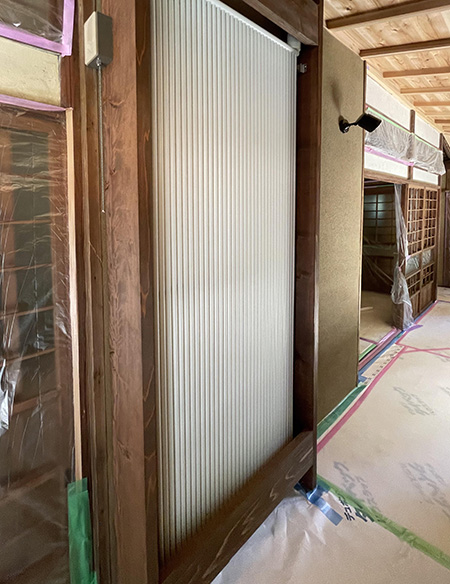
ただ、不可欠な暖冷房として温水循環装置が数カ所、要所に配置されていた。
こういう古民家での暖冷房としてデザイン的な調和性は高いと思われた。
っていうか、この暖冷房デザインには日本的な昇華を感じさせる。
一種の木製建具的な感覚受容が可能に思われる。
こういうあたり、温暖地域での建築家の選択眼を感じる思い。
古材に囲まれた空間で、黒っぽい木枠の彩色は調和的。
この温冷水循環暖冷房についてはいろいろな住宅実例を見て来たけれど、
空間全体の中での配置バランスも「ほどよく感じ」られることが、
重要な要件なのだと改めて気付かされる。
和の感覚でモダンの暖冷房設備を納めていくのは大いに参考になると思う。
改修での断熱のレベルがどれほどを想定しているのかは未確認。
見た範囲では5箇所ほどの暖冷房器設置だった。
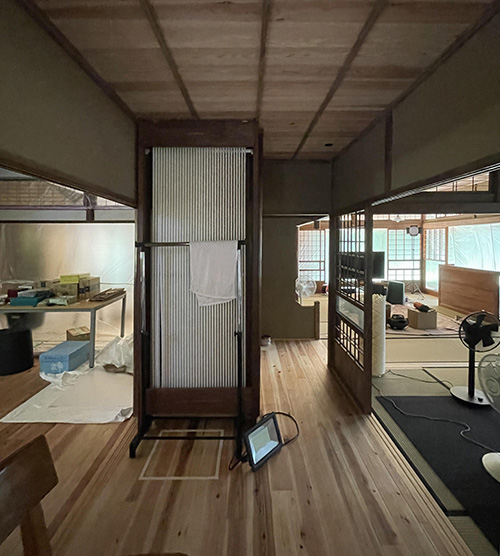
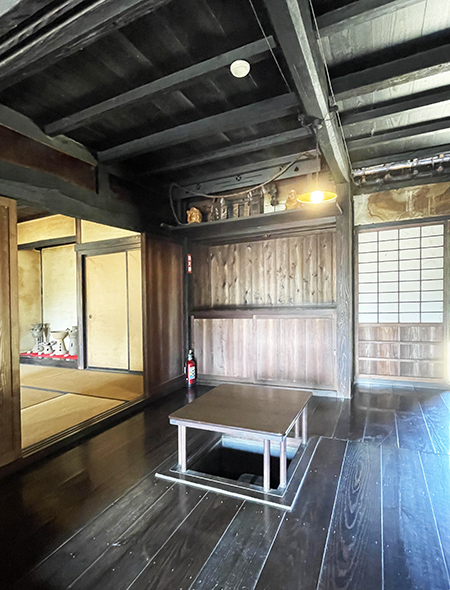
いちばん上の写真は玄関を入っての室内全景だけれど、
この木製枠に囲われた暖冷房チューブはそれと気付かないさりげなさ。
冬以外でも室内にあり続ける北海道の薪ストーブと相似的。
中間期にもそれほど違和感をもたらさないとも思える。
住宅設備の納め方の感受性、温暖地の技とも感じた次第。

English version⬇

Thermal Environment Design of an Old Minka House in a Warm Area: Visit to “Ukirinryo” in Machida, Tokyo – 2
Although the level of insulation has not yet been investigated, the heating and cooling system is surprisingly suited to an old private house. The heating/cooling system is not too different even in the middle of the year. The house is not so strange even in the middle of the year.

Hokkaido housing has developed in the direction of cold-weather housing.
Architects” who are generally considered to be “design pursuits” were at the forefront in the introduction of wooden triple-glazed wood sash windows.
were at the forefront of the introduction of wooden triple-glazed wood sashes in the region.
The improvement of thermal protection and design were being pursued simultaneously.
and design at the same time. In the cold climate environment, Hokkaido architects
Hokkaido architects have actively led the market in introducing imported sashes from Scandinavia.
Our Replan magazine is based on this situation.
We have been focusing on this leadership and intentionally spreading information to our users.
In such an environment, architects in the Honshu area have been somewhat distant from the market.
In other words, it could be said that they only opened up to the full extent of individualism and free-spirited design supremacy.
There were some “glitches” in Hokkaido residential construction by such architects.
I once published a negative observation I made during an interview in Replan magazine as it was.
While there were many such architects, the orientation of OM Solar was unique.
The “environmental orientation” of the leader, Dr. Okumura, was very persuasive.
As a builder aiming for performance, I also felt a homogeneity with Hokkaido.
Well, there were inevitably some controversial parts, and I have fairly presented both sides of the argument in the magazine.
He said that it is understandable that there are differences in approach between cold and warm regions.

The “Ukinawa Dormitory” also seems to be oriented toward the use of solar heat collection as an orientation.
However, this property is an old house, and to make a performance renovation of it
I think it will probably be a renovation similar to rebuilding.
As far as I saw, I didn’t notice such thoroughness of insulation and airtightness that much.
However, hot water circulators were placed in several places as essential heating and cooling systems.
The design of the heating/cooling system in such an old house seemed to be highly harmonious.
In fact, the design of this heating and cooling system was very Japanese in its sublimation.
It seems possible to accept it as a kind of wooden fixture.
This is the kind of design that one would expect from an architect in a warm climate region.
The coloring of the black wooden frame is harmonious with the space surrounded by old timbers.
I have seen many examples of this hot- and cold-water circulation heating/cooling system in various houses.
I have seen many examples of this hot/cold water circulation heating/cooling system, but I realized once again that it is important to have a “moderate feeling” in the balance of the arrangement within the overall space.
I am reminded once again of the importance of the balance of the arrangement in the overall space.
I think it will be very helpful to install modern heating and cooling equipment with a Japanese sense of style.
We have not yet confirmed what level of insulation is expected in the renovation.
As far as I could see, there were about 5 heating/cooling units installed.
The top photo is a panoramic view of the interior as seen from the entrance.
The heating/cooling tubes enclosed by the wooden frame are so casual that it is hard to notice them.
It is similar to a wood stove in Hokkaido, which remains inside the house even outside of winter.
It is not so strange in the middle of the year either.
I felt that this is the sensitivity of the way housing equipment is installed and the skill of a warm climate region.

【東京町田 自然のなかの迷宮「浮輪寮」探訪-1】


北海道発で高断熱高気密住宅を中心に生活デザインのウォッチを続けていて
そういった住宅性能進化の南下の趨勢を見ながら
徐々に関東圏以南地域に興味が広がっていく。
そんななかで建築家の丸谷博男さんと知遇を得て、氏の関わった
OMソーラーの歴史的経緯なども知見としては知るようになった。
氏はOMソーラー・開発者、東京芸大の奥村昭雄氏(故人)の門人で
草創期の実験住宅の施主として工法開発の最前線に立たれていた。
わたしも興味を持ってその活動には時折取材をしてきています。
一定の距離感は感じているけれど、それはそれとして
理念については興味と親近感を持たせていただいています。

丸谷さんからその最近の活動についてご案内もあって
東京出張の折に時間を見つけ、いまの「浮輪寮」活動の進行ぶりを参観。
他用との兼ね合いから時間を確定させられず、また建築場所を探し当てるのに
ほぼ絶望的に道に迷ってしまった(笑)こともあって氏への取材は未了。
写真はことし8/1時点の工事中の様子を撮影したもの。
またいただいた住所近辺には以前探訪した「武相荘」もあったので
なんとなく地域的な親近感、風土的な親しさも感じられた。
氏は吉村順三氏・奥村昭雄氏の芸大建築の流れを体現されているので、
関東・東京の建築のある傾向について感じ取れる部分がある。
いまの「浮輪寮」計画とは、東京町田の緑豊かな環境に残っていた和風建築を
リフォームして文化芸術の拠点として再生利用するプロジェクト。
「え、ここが本当に東京の一角なのか」と思うほどに
ひとを迷走させるような瞑想的(笑)環境空間であります。
あまり事前準備に時間を掛けられず「ま、行けばなんとかわかるだろう」
くらいの東京での住宅探訪の気軽さで考えていたのですが、
住所をクルマのナビで入力しても要領を得ない。
「あれ、なにこれ」と焦るほどに緑のなかに迷い込んでしまう。
ようやく写真画面越しに体感した現場はたいへん印象深い建築でした。
まだリフォームまっ盛りの物件ですが、
氏が取り組まれたい意図はなんとなく推量できるかと思っています。

ということでリフォーム工事中ですが、
「せっかく来たんだから・・・」ということで撮影した写真を公開し
丸谷さんには了解いただいていますので探訪記的に書き進めたいと思います。
今週はいろいろ多用になっているので飛び飛びになるかも知れませんがよろしく。
なお、「浮輪寮」詳細については以下をごらんください。
https://www.facebook.com/groups/abcdefghijklmnopqrstwxyz/

English version⬇

Tokyo Machida: Labyrinth in Nature “Ukirinryo” Exploration-1
I never thought I would get lost in the metropolis of Tokyo. I was made to feel vicariously the sukiya spirit that seeks out this kind of nature-rich environment (laugh) …….

We are continuing to watch lifestyle design with a focus on highly insulated and airtight housing from Hokkaido.
Watching the southward trend of such housing performance evolution
I gradually became more interested in the Kanto region and southward.
In this context, I made the acquaintance of architect Hiroo Marutani, who was involved in the development of the OM Solar
I became acquainted with Mr. Hiroo Marutani, an architect, and came to know about the historical background of OM Solar, which he was involved in.
Mr. Marutani was a student of Akio Okumura (deceased) of Tokyo National University of Fine Arts and Music, the developer of OM Solar.
He was at the forefront of the development of the construction method as the owner of an experimental house in its pioneer period.
I have been interested in his activities and have covered them from time to time.
I feel a certain distance from them, but that’s about it.
I have a certain distance from them, but that is not to say that I am not interested in their philosophy.

Mr. Marutani has informed me of his recent activities.
I found time during a business trip to Tokyo to observe the progress of the current “Ukirinryo” activities.
I was not able to fix a time due to other commitments, and I was almost hopelessly lost in the search for the building site.
The interview with Mr. Kikuchi was not completed due to a combination of other commitments and the fact that he was almost hopelessly lost trying to locate the building site.
The photo was taken during construction as of August 1, 2011.
I also found “Busoso,” which I had visited before, near the address I received from him, so I felt some familiarity with the area.
I felt a sense of familiarity with the area and its climate.
Mr. Yoshimura embodies the architectural trend of Junzo Yoshimura and Akio Okumura of the University of the Arts, so I felt a certain trend of architecture in the Kanto and Tokyo areas.
I could sense a certain trend of architecture in the Kanto and Tokyo areas.
The current “Ukirinryo” project is a renovation of a Japanese-style building in the lush green environment of Machida, Tokyo, and its redevelopment as a center for culture and the arts.
The “Ukirinryo” project is a renovation of a Japanese-style building in the lush green environment of Machida, Tokyo, to be used as a center for culture and art.
The project is a project to renovate a Japanese-style building in Machida, Tokyo, which was left in a lush green environment, and to use it as a center for culture and the arts.
It is a contemplative (laugh) environmental space that leads one astray.
I did not have much time to prepare for the project, so I just went to Tokyo to explore the houses.
I was thinking of it as a casual visit to a house in Tokyo, but when I entered the address into my car’s navigation system
However, when I entered the address into the car’s navigation system, I couldn’t get the gist of it.
I was lost in the greenery, wondering what this was all about.
The site I experienced through the photo screen was a very impressive building.
The property is still in the midst of renovation.
I think I can somewhat guess what Mr. Kato’s intention is.

So, while the remodeling work is in progress, he said, “Since I’ve come all this way…
I took these photos because I came all this way…
I have Mr. Marutani’s approval, so I would like to write about the project in the form of a diary of my visit.
I have a lot of things to do this week, so I may jump around a bit, but I will do my best.
For more information about “Ukirinryo”, please refer to the following.
https://www.facebook.com/groups/abcdefghijklmnopqrstwxyz/

【じわり秋冷 夏の終わりと世界経済の行方】


きのうの札幌は朝で20度ほどの気温。
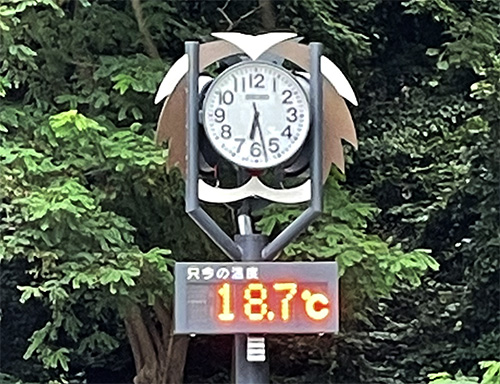
写真のように一昨日では18.7度ほどまで下がって来ていました。
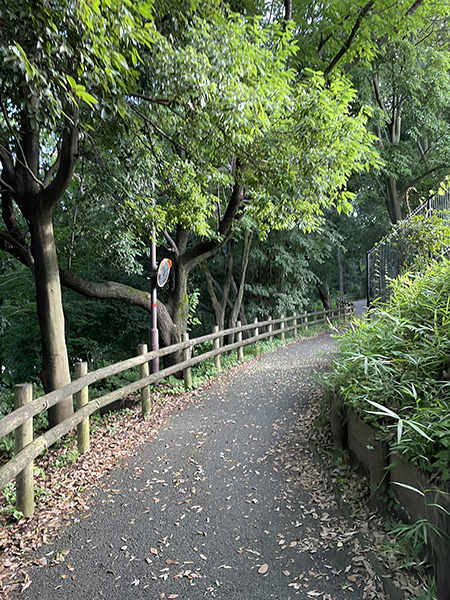
散歩道・北海道神宮隣接の円山動物園前の気温計。
さすがにこれくらいになると半袖Tシャツでは心許ないので
長袖のジャージを着込んできております。
ことしの北海道はスカッとした天候は少なくて
夏の盛りも曇りがちという様子でしたが、
じわじわと季節は深まってきて一抹のさみしさが空気感に漂ってきます。
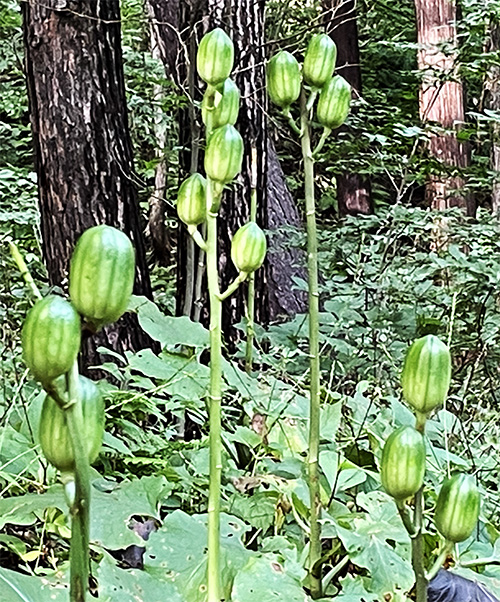
ことしはあまり見られなかったオオウバユリも花を過ぎ結実時期。


イキモノの世界でもこの様子は明瞭で
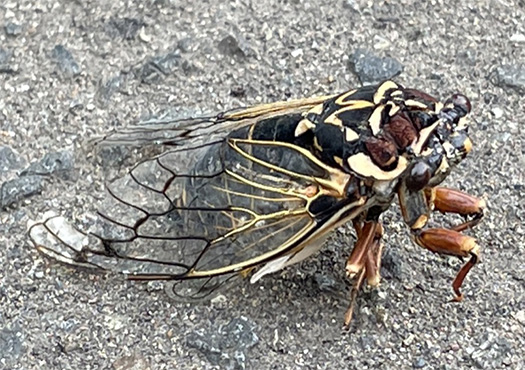
上のセミさんはこの状態で動かなくなっているし、
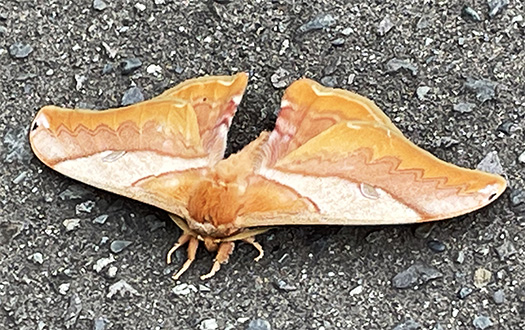
下の写真の蛾も散歩道の足下でほぼ動かなくなっている。
ハネの色合いは枯れ葉の擬態であることがあきらかで
よく観察してみてはじめて蛾だと認識できた次第です。
死んでいるのかと木の枝で突いてみると、まだ動いてはいました。
しかしすでに力弱く静寂をただ待っている感じ。
どこかの草むらにでも移動させようにもつかまる体力が失せている。
やむなく舗装歩道に放置しておきましたが、
やがてなにかに蹴飛ばされ踏みつけられるのかなと。
まぁ自然の摂理なので、人間がどうこうできるものでもない。

2022年の夏も感染症の猛威がまだまだ継続していて
じんわりと季節感を感じるほどの余裕を持てないまま過ぎつつあります。
経済動向を見ているとこの秋には大きな変動勃発の予感。
アメリカでは物価高、インフレが猛威をふるっているし、
それに対してFRBがかなり荒療治的に対応すると宣言を出している。
一方で中国では無謀なゼロコロナ政策で経済にマイナス影響が色濃い。
不動産バブルによるこれまでの経済成長路線に急ブレーキが掛かって
金融を含めた社会動向に非常に危機的な情報があふれてきている。
この秋にもなにか大きな動乱が発生する可能性がある。
こんな状況からか、中国外交トップが日本の外交担当者と7時間もの
長時間対話を行ったという情報も伝わってきている。
中国外交部は8月18日、外交トップの楊潔篪・共産党中央政治局委員と
日本の秋葉剛男・国家安全保障局長が8月17日、天津市で
「中日第9回ハイレベル政治対話」を共同開催したと発表した。
・・・中国は対米関係の行き詰まりがあれば伝統的に日本を利用する。
中国経済の危機的状況からの一種の外交的サインなのかも知れない。
HONDAは中国企業群とのデカップリングを情報発信して
場合によっては中国事業を見放す方向だと受け取れるサインを出した。
TOYOTAにもそういう動きが見られるという情報。
いずれの情報からも秋以降の変動要因がマグマの胎動のように感じられる。

English version⬇

[Slowly cooling autumn, the end of summer, and the global economy.
The Fed’s response to the U.S. economic modulation and the expansion of China’s economic turbulence factors. Are major autumn fluctuations beginning to emerge like a magma? …

The temperature in Sapporo yesterday was about 20 degrees Celsius in the morning.
The day before yesterday, the temperature had dropped to about 18.7 degrees Celsius, as shown in the photo.
The thermometer in front of Maruyama Zoo adjacent to Hokkaido Shrine.
As one would expect, a short-sleeved T-shirt is not comfortable when the temperature is this low.
So I put on a long-sleeved jersey.
This year in Hokkaido, there was not much clear weather.
The weather has been cloudy even in the height of summer, but the season is slowly deepening.
The season is gradually deepening, and a hint of loneliness is in the air.
The day lilies, which have not been seen very often this year, have passed their blooming stage and are now in the fruiting stage.

Even in the world of iminos, this situation is clear.
The cicada above is motionless in this state, and the moth in the photo below is almost motionless under the foot of the walkway.
The moth in the photo below is almost motionless under the foot of the walkway.
The coloration of the honeycomb is clearly a mimicry of dead leaves.
It was not until I observed it closely that I recognized it as a moth.
I poked it with a tree branch to see if it was dead, but it was still moving.
However, it was already weak and just waiting for silence.
I tried to move it to the grass somewhere, but it had lost the strength to hold on.
I had no choice but to leave it on the paved sidewalk.
I wondered if something would eventually kick it away and trample it down.
Well, it is the order of nature, and there is nothing we can do about it.

In the summer of 2022, the onslaught of infectious diseases is still continuing.
The summer of 2022 is passing by without enough time to feel a sense of the season.
Looking at economic trends, I have a feeling that we could see major changes this fall.
In the U.S., high prices and inflation are still raging.
The Fed has announced that it will respond to this situation in a very drastic manner.
Meanwhile, China’s reckless zero-corona policy is having a strong negative impact on the economy.
The economic growth path that has been driven by the real estate bubble has been suddenly braked, and social trends, including financial ones, are extremely critical.
Information on social trends, including the financial sector, is becoming very critical.
There is a possibility that some major upheaval will occur this fall.
Perhaps because of this situation, we have received information that a top Chinese diplomat had a seven-hour long dialogue with a Japanese diplomat.
The Chinese Ministry of Foreign Affairs announced on August 18 that it would hold a meeting with Japanese diplomats to discuss the situation.
On August 18, China’s Ministry of Foreign Affairs held a meeting between top diplomats Yang Jiechi, a member of the Communist Party’s Central Political Bureau, and
The Chinese Ministry of Foreign Affairs reported that on August 18, top diplomats Yang Jiechi, a member of the Communist Party Central Political Bureau, and Takeo Akiba, Director-General of the National Security Bureau of Japan, held the
The 9th China-Japan High-Level Political Dialogue was jointly held in Tianjin, China, on August 17.
… China traditionally turns to Japan when there is a deadlock in its relations with the United States.
This may be a kind of diplomatic sign from the critical situation of the Chinese economy.
HONDA will send out information about decoupling with a group of Chinese companies.
HONDA has sent out information about its decoupling from a group of Chinese companies, a sign that could be taken as a sign that it is abandoning its China business in some cases.
There is also information that TOYOTA is also making such a move.
All of this information suggests that the factors that will cause fluctuations from autumn onward are like an embryo of a magma.

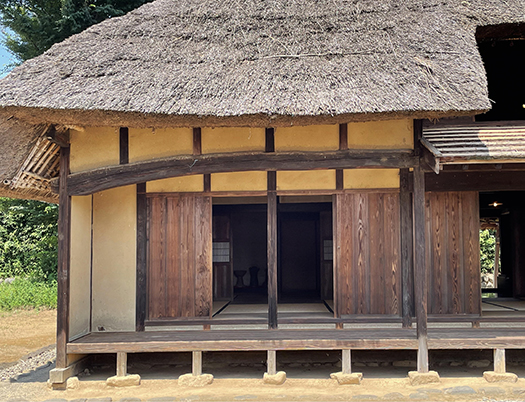
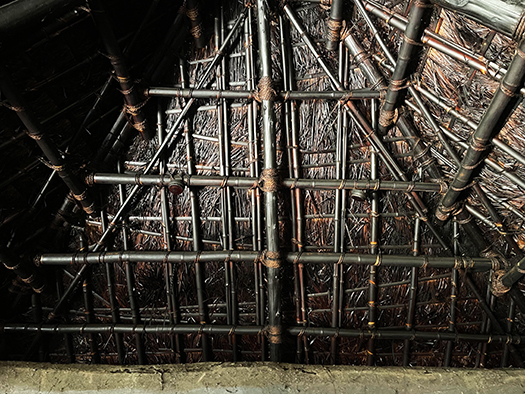
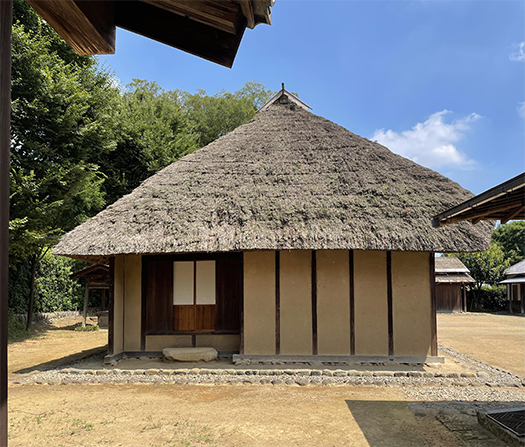
【古墳時代・高床式住居の復元 in 前橋大室公園】


きのうの続きです。
竪穴住居はより歴史が古い形式の「民家」であり、
「定住」のごく初期・縄文時代が始まる頃から建てられ続けた。
それに対して農耕文化が始まるとその農業生産物を保存するための
「高床式」建築が建てられ始める。
竪穴はその地域での年平均気温程度という「地熱」を室内気温として
確保できることを人類は経験的知恵として持っていた。
日本列島社会でも平安期くらいまでは普通の民家として存続していた。
一方で稲作農業文化が広がっていくとともに
その生産物を長期保管するための用として通風性に優れた建築が求められた。
土間の蓄熱性に注目した竪穴と食料保存のための除湿性・通風性の高床。
吉野ヶ里遺跡などでは環濠の周囲などにたくさんの高床倉庫が復元されている。
保存性に優れた食料・コメを長期にわたって保管するのだが、
その様子はわかりやすい「財」のありかを示すモノであり、
他からは「あそこに宝物がある、討って奪おう」という考えを抱きやすい。
そこで「環濠」を巡らせて防衛することになる。
縄文期にはあまり確認できない「戦い」の痕跡が弥生になると一気に増えていく。
だから「歴史」という、主として戦争・権力争奪が起動力である
人類史の過程が始まるということなのでしょうが・・・。

で、この高床の場合は、主要な内部空間を空中に浮かせるので、
建築としてはより困難な目標に挑戦することになる。
柱梁による構造が明確になり、また「壁」という存在も明確になる。
竪穴の場合は屋根と壁が一体なので、垂直に造作される壁というものは
人類史全体としては案外最近体験する概念なのだと思います。
バイタルな感覚の段階でも造作可能な竪穴に対して
高床になると、緻密な計算に基づいて作業進行させる必要が出てくる。
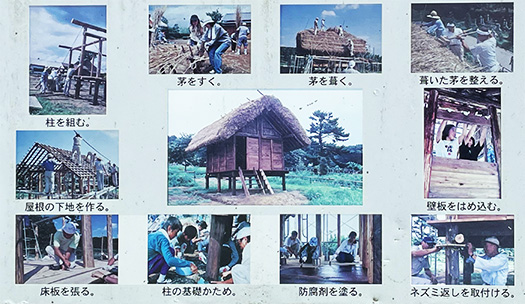
保存食物を狙うネズミからの防衛のための「ネズミ返し」など
より高次な造作まで知恵と工夫が必要になってくる。
そこでこの大室公園での復元でも、より高学年の小学校高学年、
中学校の生徒さんたちが中心になっている。
たぶん数学的概念をより強く持つ必要性があるのでしょう。
そういえば、食糧の計画的生産という稲作農業には、当然土木による
自然改造も必須になっていくことを合わせて考えると、
このような建築の発展は、ロジカルシンキングを強く促されたのだとも思える。
古墳などの造営には精密な「設計」作業があったことがわかるけれど、
こういう部分から論理思考という進歩発展が必然化したと腑に落ちる。
なかなかこの前橋市教育委員会の復元取り組み、素晴らしい。

English version⬇

Kofun Period, Stilt Dwelling Restoration in Maebashi Omuro Park
In contrast to the vital but thermo-environmentally intuitive rationality of the pit, the stilts give the impression of a mathematically logical evolutionary development. Restoration mainly for upper elementary school students. ・・・・.

Continued from yesterday.
The pit dwelling is a much older form of “private house,” and was
They were built from the very beginning of the Jomon period.
In contrast, when the agricultural culture began, “stilt houses” were built to preserve the agricultural products.
In contrast, when the agricultural culture began, “stilt houses” began to be built to preserve the products of agriculture.
The pit was able to maintain a “geothermal” indoor temperature that was about the average annual temperature of the area.
The human race had the experiential wisdom to know that a pit could maintain the “geothermal heat,” which was about the average annual temperature of the area, as the indoor temperature.
In the Japanese archipelago, the pit continued to exist as an ordinary private house until around the Heian period (794-1185).
On the other hand, as the culture of rice farming spread
As the culture of rice farming spread, there was a demand for buildings with excellent ventilation for long-term storage of the products of that farming.
The pit, which focused on the heat storage capacity of the earthen floor, and the high floor, which provided dehumidification and ventilation for food preservation.
At the Yoshinogari site, many high-floor warehouses have been reconstructed around moat encircling structures.
They were used to store food and rice, which had excellent preservation properties, for long periods of time.
The stilts are used to store food and rice for long periods of time, and their appearance is a clear indication of the whereabouts of “goods.
It is easy for others to think, “There is a treasure there, let’s attack and take it.
Therefore, the moat encircling the site was used as a defensive measure.
The traces of “battles” that cannot be seen in the Jomon period increase dramatically in the Yayoi period.
So “history,” which is primarily driven by wars and power struggles
I guess you could say that the process of human history begins….

And in the case of this stilt, since it floats the main interior space in the air
as an architecture, it will be a more challenging goal to achieve.
The structure with columns and beams becomes clear, as well as the presence of “walls”.
In the case of the pit, the roof and the wall are one, so the vertical wall is a
I think that the concept of a vertically constructed wall is a concept that is experienced more recently than one might think in the whole of human history.
In contrast to the pit, which can be built even at the stage of vital sensation, the vertical wall is a concept experienced more recently in human history as a whole.
In contrast to a pit, which can be built with the vital senses, the construction of a high floor requires a work progression based on precise calculations.
For example, a “rat trap” to defend against rats that target preserved food.
This requires wisdom and ingenuity in the construction of even higher structures.
Therefore, in this restoration project at Omuro Park, upper elementary school and junior high school students are playing a central role.
The students in the upper grades of elementary school and junior high school are playing a central role in the restoration at Omuro Park.
Perhaps there is a need to have stronger mathematical concepts.
Come to think of it, rice farming, with its planned production of food, naturally requires civil engineering to
the modification of nature through civil engineering will also become indispensable.
This development of architecture seems to have strongly encouraged logical thinking.
We know that the construction of ancient tombs and other structures involved precise “design” work, and we can see that the development of architecture in this way strongly encouraged logical thinking.
It becomes clear that the development of logical thinking was inevitable from this part of the process.
The Maebashi Board of Education’s restoration efforts are quite impressive.

【子ども参加の竪穴住居づくり in 前橋大室公園】


古墳と関根家住宅という前橋市の「大室公園」。
関根家住宅のとなり側にはこの古墳のまわりにかつてあった
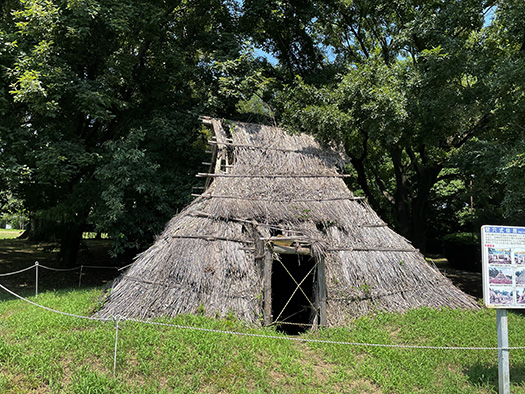
「古代集落」としての竪穴住居が復元建築されていた。
古墳は古代社会「集落」の中核痕跡。
多くの労力がその築造にはかかわり動員されていた。
その後の社会発展の中で「ムラ」という共同体になった社会一体性が
きっと存在していたに違いない。
支配者への奴隷的絶対服従ばかりとは考えられない部分があっただろう。
農業経済を基盤として関東「新開地」にあらたな人間社会が育っていった。
それまでの関東地域の状況というのは不明だけれど、
農業土木労働によって目的的に河川水を活用して
食料生産を計画的に行っていくという文化が初めて根付いていったのだろう。
吉野ヶ里遺跡で見られるように地域豪族と農業構成員集団による開発が
組織だって運営されていった。日本社会のコア部分。
支配層の痕跡は古墳などで残っているけれど、
かれらはかれらだけで生きられたわけではない。
その支配にしたがって、日々の生産活動に従事した民人が多数いた。
地域の教育委員会としてそういう人々の思いを追体験する住まいを
子どもたちの集団参加で復元している住居がみられた。

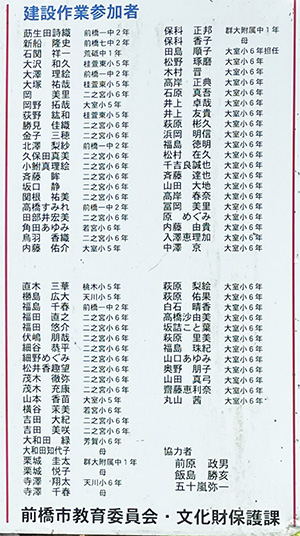
「建設作業参加者」ということで小学生多数の名が書かれていた。
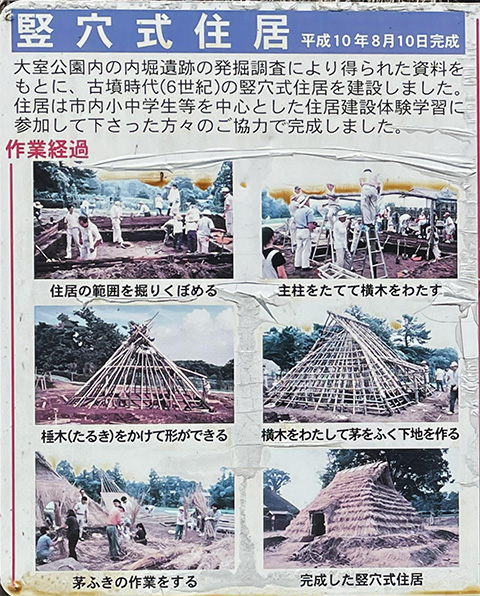
その建設作業の様子も看板に写真入りで記録保存されている。
父兄のみなさんも名前があるので親子で参加されたのでしょう。
っていうか、写真を見る限り子どもたちのために
一生懸命作業に取り組んでいるお父さんたちの労働奉仕の様子が伝わる(笑)。
子どもたちから「お父さん頑張れ」という声援がこだまして
その声に夢中で応えていることがあきらか。微笑ましい。
竪穴というのはこの「地面の掘り下げ」からすべてが始まるけれど、
これは住まいの「安定した室内気温環境」を確保する根源的目的営為。
古代の人々が地域の気候のなかでどう安定的な暮らしの場を確保したか、
子どもたちは自身とお父さんたちの身を以て体験したでしょう。
地面を掘るスコップ状の道具とその作業はいわば人類の基本労働。
親子でいっしょに作業することで「世代を繋いでいく」という
住宅というものの本質を噛みしめられたのではないだろうか。
出来上がった住居は凜としていて、
子どもたちの「作った誇り」のようなものが自然と感じられた。
「おお、すごい。よくやったなぁ」
はるかなご先祖さまたちの家づくりの苦労を体験できる機会って
なかなか得がたい体験だろうと思う。じんわり感動。

English version⬇

Children’s Participation in Making a Pit Dwelling in Maebashi Omuro Park
Restoration of the pit of our ancestors. Securing a “stable indoor environment” to sustain life. Children facing the basic “use” of humankind. Children’s participation in the construction of a pit dwelling.

Omuro Park” in Maebashi City is a place of ancient burial mounds and the Sekine family residence.
The Sekine family residence is located next to an “ancient village” that once existed around the burial mound.
The burial mound is a core trace of an ancient “settlement”.
Kofun tumuli are the core traces of “settlements” in ancient society.
A lot of labor was involved in their construction.
In the subsequent development of society, there must have existed a social unity that became a community called “mura”.
must have existed.
There must have been more than just slavish obedience to the rulers.
A new human society grew up in the Kanto region based on the agricultural economy.
Although the situation in the Kanto region up to that time is unknown
The culture of planned food production was based on the purposeful use of river water through agricultural and civil engineering labor.
The culture of systematic food production by purposefully utilizing river water through agricultural engineering labor must have taken root for the first time.
As can be seen at the Yoshinogari site, development was organized and managed by local powerful families and agricultural groups.
and agricultural groups, as seen at the Yoshinogari site. This is the core of Japanese society.
Traces of the ruling class can be found in ancient tombs, but they did not live on their own.
they were not able to live on their own.
There were many people who were engaged in daily productive activities in accordance with the ruling class.
As a local educational committee, we are restoring a house to relive the thoughts and feelings of these people with the collective participation of children.
The local board of education is restoring the houses with the collective participation of children.

The names of many “first grade elementary school students” were written as “participants in the construction work.
The construction work was also recorded and preserved on the signboard with photographs.
The names of the parents are also on the sign, so it is likely that both parents and children participated in the construction.
Or rather, the photos show that they were there for the children.
The fathers’ labor service is conveyed as they work hard (laughs).
The children were cheering “Go, Dad!
It was obvious that the fathers were enthusiastically responding to the children’s cheers. It was very funny.
In a pit, everything begins with this “digging of the ground.
This is a fundamental activity to ensure a “stable indoor temperature environment” for the house.
We can learn how ancient people secured a stable place to live in the local climate.
The children will have experienced firsthand how ancient people secured a stable living environment in the local climate, both themselves and their fathers.
The shovel-like tools used to dig the ground and the work involved are the basic labor of mankind.
By working together, parents and children were able to understand the essence of “passing down the generations.
I am sure that by working together, parents and children were able to understand the essence of housing, which is to “pass it on from generation to generation.
The finished house was interesting and interesting.
The children’s pride in their work was evident.
The children were naturally proud of their work, saying, “Wow, that’s great. You did a great job.
It must be a rare opportunity to experience the hard work of our distant ancestors in building their homes.
I think it must be a very rare experience to have the chance to experience the hard work of our ancestors in building their houses. I was deeply moved.

【民藝と世界共通ライフスタイル 「赤城型」養蚕民家-8】


民藝的建築の探訪者、早稲田大学建築科の今和次郎氏の記録に導かれて
この群馬前橋の関根家住宅を深掘り探究してみた。
寄棟型茅葺き屋根の前面部を大胆にカットして生物種としての
カイコの生態に最適適応するように「環境性能」実現に踏み込んだ住宅。
北海道の積雪寒冷条件に対し居住環境性能との格闘を開始した
北海道の家づくりとほぼ同時期にこういう民藝的住宅があった。
このことに深く思いが至っておりました。
民藝とはモノや生活雑器の方に着目されやすいと思うけれど、
各地域でのものづくりの最たるものとしての家づくりで、一棟一棟、
地域の大工たちは知恵と工夫の限りを尽くして施主の要求と格闘してきた。
用をどこまでも追い求めながら、同時に地域製造業の作り手として
評価を高めるように創意工夫と建築の美感を競い合ったのだと思う。
そのプロセスで茅葺き屋根前面部の大胆な切り落としという
独自工法の開発にまで至った。
その真摯な家づくりの姿勢に今和次郎先生は「民藝の真髄」を見出したのだろう。
北海道の家づくり、その環境性能の格闘は孤独な地域努力だったのではなく
はるかな遠雷のように違う目的ながら知恵と工夫で明治初期、
まったく新しい地平を開いていた家づくりを発掘できた思い。
物言わぬカイコから思わぬエールが聞こえてきたようで、楽しくもある(笑)。


そして住宅の手ざわりの部分でのモノの手づくり感。
現代でも「注文住宅」という呼び方で一棟一棟の住宅は
さまざまな創意工夫が込められながら作り出されているのだけれど、
この明治の職人さんたちの家づくり細部ディテールまでの
手づくり感にはまことに圧倒される。
今日の住宅ではキッチンやトイレ、そしてエアコンや暖房機器、換気装置など
大手メーカーの工業生産ラインで作られる設備が
大きな要素を占めているけれど、明治の作り手たちはそれこそ
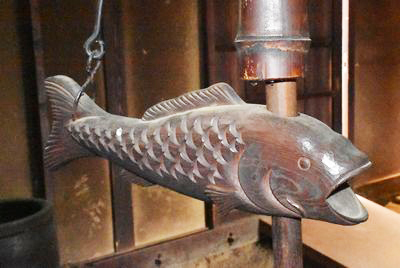
ダイドコロ火力の火力調節、自在鉤の「小猿」まで専門職人の手づくり。
一定の家内制手工業での量産はあっただろうけれど、
細かい使い勝手の部分や現場での納まりについて責任を持っていた。
家を住みこなす住人とこういう「民具」との共感など、
そこにも民藝的な手ざわり感が感じられてほほえましい。
生活を彩る多くの道具たちも、それぞれが個性的な彩りを放っている。

現代的な世界標準的な合理性をしっかり確保しながら、
しかし一方ではひとびとの日々の暮らしとこころを豊かにさせる
民藝的なあたたかみ、ぬくもりを大切にしていくべきだと思われた。
現代・高断熱高気密の技術をベースに、民藝的発展に期待したい。
私見だけれど、北海道のブロック外断熱住宅など、
素材から断熱手法、打ち放しのような肌ざわりなど、
思わぬ部分で「民藝」要素を強く感じさせられている。<この項、終了>

English version⬇

Universal Lifestyle and Mingei The “Akagi-style” silkworm-farming folk house – 8
Houses are the most local asset. Mingei is difficult to define the concept of “beauty of use,” but it is the core of local craftsmanship. Toward the modern Mingei house.

Guided by the records of Mr. Wajiro Kon of Waseda University’s Department of Architecture, an explorer of folk-artistic architecture
I did in-depth coverage of this Sekine family residence in Maebashi, Gunma.
The front part of the hipped thatched roof has been boldly cut to optimally adapt to the ecology of the silkworm, a living species.
The front part of the thatched roof is boldly cut to optimally adapt to the ecology of the silkworm, a living organism.
The house was built at about the same time as the houses built in Hokkaido, where the Japanese struggled with the environmental performance for survival in the cold and snowy conditions of Hokkaido.
This kind of folk-art style housing existed at about the same time as Hokkaido’s house building.
I was deeply moved by this fact.
Mingei is a term that tends to focus more on objects and daily utensils, but it is also a term that refers to the most important aspects of craftsmanship in each region.
However, in each region, the local carpenters worked hard to create each house one by one, using their wisdom and ingenuity to make the best of their craftsmanship.
Carpenters in each region have been wrestling with the client’s demands with the utmost of their wisdom and ingenuity.
While pursuing the best use of their skills and knowledge, the carpenters of the region have also been striving to be the largest manufacturer in the region.
I think they competed with each other to enhance their reputation for originality, ingenuity, and aesthetics.
This process even led to the development of a unique method of boldly cutting off the front part of the thatched roof.
This process even led to the development of a unique construction method, which involved boldly cutting off the front part of the thatched roof.
This sincere approach to house building must have been recognized by Mr. Wajiro Kon as the “essence of folk craftsmanship.
The struggle to build houses in Hokkaido and their environmental performance was not a solitary regional effort.
It was not a solitary local effort, but rather a faraway thunderstorm of wisdom and ingenuity that opened up entirely new horizons in the early Meiji period.
I felt as if I had been shown a completely new horizon of house building in the early Meiji period.
It was as if I heard an unexpected cry from a silent silkworm, and I enjoyed it (laugh).

And the handmade feel of things in the handcrafted part of the house.
Even today, each house is called a “custom-built house.
but the handmade feeling of the details of the house
The sense of handmade in every detail of house construction by craftsmen in the Meiji era is truly overwhelming.
The handmade sense of detail and craftsmanship of these Meiji craftsmen is truly overwhelming.
In today’s houses, kitchens, toilets, air conditioners, heating systems, ventilation systems, etc. are all handmade on industrial production lines by major manufacturers.
air conditioners, heating systems, ventilation systems, and other equipment made on industrial production lines by major manufacturers.
but the Meiji makers were not so much concerned with the details as they were with the
The fire control of the “daidokoro” fireplace and even the “kozaru” (small monkey), a free hook, are all handmade by professional craftsmen.
Well, there must have been a certain amount of mass production by cottage industry, but
However, they were responsible for the detailed usability of the house.
The residents who lived in the house and these “folk tools” were in sympathy with each other.
The sense of touch of folk craftsmanship can be felt in the relationship between the residents who live in the houses and these “folk tools.
Many of the tools used to add color to daily life are also unique and colorful in their own way.

While ensuring the rationality of modern global standards
On the other hand, on the other hand, there is a folk art-like warmth that enriches people’s daily life and spirit.
and warmth of folk art that enriches people’s daily life and spirit.
I look forward to the development of the folk art style based on modern, highly insulated and airtight technology.
In my opinion, the block-insulated houses in Hokkaido, for example, should be built in the same way.
I would like to see the development of folk art style based on modern high thermal insulation and high airtightness technology.
I am strongly impressed by unexpected “folk art” elements.

【日本人のDNA的家族専用ゾーン 「赤城型」養蚕民家-7】


この関根家の家族のための日常、ケの空間。
土間とつながる作業動線をもつダイドコ、外には井戸があって
炊事洗濯に必要な用水が確保されている。
カイコの世話のための2階への動線起点のアガリハナは一体型の板の間であり、
神棚のあるウラザシキには掘り炬燵型のテーブル。
神棚の下に中空の棚状空間があり、やや小さめだが仏壇の位置なのか。
そうだとすれば、神仏先祖たちと日々の暮らしに感謝する様子が
みえてくる光景かも知れない。
「仏さんに手を合わせてからご飯だよ」
と言われて拝礼し、ついでに神さまにもあいさつして炬燵に潜り込んで
テーブル上の食事に向かっていた様子が目に浮かんでくる。
「いただきま〜す」
土間まで開放された空間で、日々の労働からいっとき解放時間をすごす。

で、こういう「家族だけのための空間」っていうのは
この大きな関根家住宅全体の中ではごく小さな面積。
土間は本質的に農作業の場であり、この養蚕の家では板敷きの間も、
カイコのために使われることも多かったとされる。
2階は常時カイコと製糸生業のための空間。
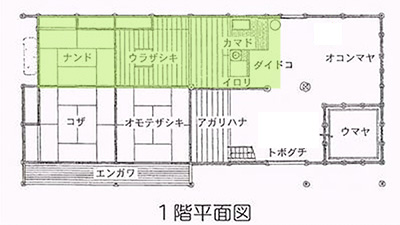
プライベートゾーンは主に家族寝室である畳敷きのナンド6畳(押入付き)
ウラザシキ8畳、ダイドコおおむね8畳ということになる。
全部で押入も算入しても24畳、なので12坪ほどに集約される。
この空間面積でふつうは8人程度の家族全員が集っていた。
その他のオモテ座敷・コザなどはハレの場であって半ば公共的空間だった。
質素倹約に勤めながら、つねに公的な用途に備えて家を維持する、
そんな日本人のDNA的な家屋意識というものが浮かび上がってくる。
この公共への対応力、家の「奥行き」が家格を表現していた。
武家に至っては「滅私奉公」という生き方が本旨とされた。
庶民はそこまでではないが、それでも公共への帰依は存在した。
明治になって世界との対話がはじまったとき
素朴な人間欲求と個人主義価値感に基づく「経済社会」と遭遇したとき、
こういう日本社会の価値感は揺らいだに違いない。
しかし明治のスタートから第2次大戦直前までで人口規模は
約3,000万人から8,000万人ほどまで増加し、経済規模も拡大した。
欧米世界標準を受け入れることで近代国家としての成功を成し遂げた。


さてそれから戦後を迎えて以降、この世界標準的ライフスタイルは
普遍的に日本の家屋のありようを変えていっている。
葬式や法事会合などは専用施設に役割移転し、
親族でも相手の家に宿泊するという習慣は大きく廃れた。
近隣のホテル宿泊などでプライバシーへの気遣い不要に変化した。
そういう「公的交流」の場が家から失われて、
家族だけの空間が住宅のもっとも肝要な目的に変化してきている。
かつての「公共空間」のような役割空間が家から消えた後、
さて、わたしたち現代日本人はどんな意味のある空間を欲するのだろうか。
そういえばコンパクトとか、平屋という志向性は強まっている。
民家のミライが非常に興味深い・・・。

English version⬇

Japanese DNA family-only zone “Akagi-style” silkworm farm house-7
The house is about 12 tsubo in area, which is enough for a family to live together. The family strived to be thrifty and respected public space. The public sitting room space has disappeared in the modern age, but now….

Daily life for this Sekine family, ke space for the family.
The daidocho has a work flow line that connects to the earthen floor, and there is a well outside to
Outside, there is a well that provides water for cooking and washing.
Agarihana, the starting point of the flow line to the second floor for taking care of the silkworms, is an integrated board room.
The urazashiki, which houses a Shinto altar, has a kotatsu-type table.
There is a hollow shelf-like space under the altar, which is rather small, but is it the location of a Buddhist altar?
If so, it may be a scene of gratitude to the gods, Buddha, ancestors, and daily life.
After praying to the Buddha, we eat our meals.
Then, after greeting the gods, I got under the kotatsu (table-top table) and went to the table to eat.
I can just picture the way they were eating their meals on the table.
Itadakimasu!
In the space that is open to the earthen floor, we spend a moment freeing ourselves from the daily labor.

This kind of “space just for the family” is a part of the whole Sekine family’s house.
This “space just for the family” is a very small area of the entire Sekine family’s large residence.
The earthen floor is essentially a place for farm work, and in this sericultural house, the wooden floor was often used for silkworms.
The second floor was always used for silkworms and silkworms.
The second floor is always a space for silkworms and the silk production industry.
The private zone consists mainly of the family bedroom, 6 tatami-mat nando (with a closet), 8 tatami-mat urazashiki
The private zone was mainly used as a family bedroom: 6 tatami mats for Nando (with a closet), 8 tatami mats for Urazashiki, and roughly 8 tatami mats for Daido.
The total space is 24 tatami mats, including the oshirooms, which means that the total space is about 12 tsubo.
Usually, a family of about 8 people would gather in this space.
The other areas, such as the omote-zashiki and koza-zashiki, were the “hare (formal occasions)” and were half-public spaces.
While striving to be frugal and thrifty, the Japanese always maintained their houses for public use.
This is the DNA of the Japanese sense of the house.
This ability to respond to public needs and the “depth” of the house expressed the family’s status.
The samurai family was expected to live a life of “selflessness and devotion.
Although the common people were not to that extent, they still had a devotion to the public.
When dialogue with the world began in the Meiji era
When they encountered an “economic society” based on simple human desires and individualistic values, the values of Japanese society were shaken.
These values of Japanese society must have been shaken.
However, from the start of the Meiji era to just before World War II, the size of the population
However, from the start of the Meiji period to just before World War II, the population grew from about 30 million to about 80 million, and the economy expanded as well.
By embracing Western world standards, Japan achieved success as a modern nation.

Since then, after the postwar period, this world-standard lifestyle has been universally changing the way Japanese houses are built.
Since the postwar period, this world-standard lifestyle has been universally changing the way Japanese houses are built.
Funerals and memorial services have been relocated to dedicated facilities, and the custom of staying with relatives in the other’s home has largely disappeared.
The custom of staying at the other party’s house, even for relatives, has largely disappeared.
The custom of staying at a nearby hotel has changed so that people no longer need to worry about privacy.
The place for such “public exchanges” has been lost from the home.
The most important purpose of a house is to provide a space for the family to live together.
Now, we modern Japanese are wondering what kind of role space, like the “public space” of the past, we will be able to play after the disappearance of such space.
What kind of meaningful space will we modern Japanese desire after the role of “public space” disappears from our homes?
The trend toward compactness and one-story houses is increasing.
The minka future is very interesting…