本文へジャンプ

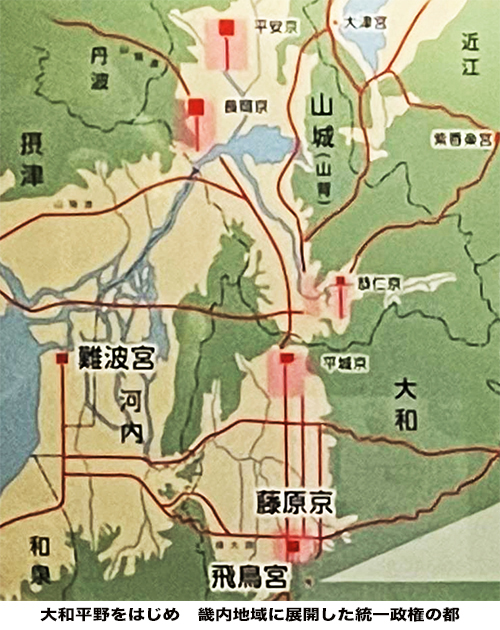
【地政学で大和を都に選択 by神武帝 (列島37,000年史 第54回)】


きのうは日本国家成立の頃の海の交通路を再探訪。
古代史を考えるようになっていつも不思議だったのはどうして倭国はあんなにも朝鮮半島にこだわっていたのか、ということ。
半島最南端の多島海地域に任那という「衛星国家」も存在していた。当然経済的な強い利権関係がそこにあって、その確保に強い執着を持っていたのだろう。
やはり水田農耕経済を発展させる鉄などの経済利器の伝播の道だったことがこうした執着の原因とみなせる。
国土の気候風土性もあって農業耕作地としては韓半島地域よりも数段適地だった。耕作適地を所有できるという欲望・強い憧憬からアジア大陸からの移住者もニューフロンティアとして列島を目指したのだろう。
やがて山陰地方を嚆矢として鉄鉱石の国内生産が可能になり、北九州地域からの鉄器などの文化流入に依存する社会ではなくなっていく。

『出雲国風土記』には、飯石郡の条に”波多小川。鉄あり”仁多郡の条には”以上の諸郷より出す所の鉄、堅くして、もっとも雑具造るに堪ふ”とある。「鉄あり」とは川から砂鉄を採ったこと「諸郷より出す所の鉄」とは各郷で鉄生産が行われていたことを示しています。平安時代の『政事要略』の記載によると、地子雑物(地代)として鉄や鍬が定められていたのは出雲、伯耆、備後、備中であることから、これらの地域が古代における鉄の産地として知られていたと考えられます。〜引用「出雲国たたら風土記」より要旨。

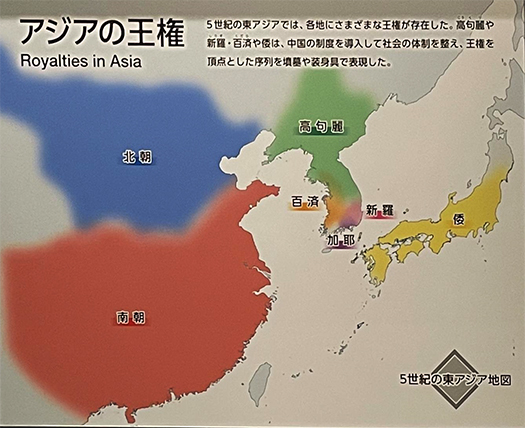
国内政治的には大和地域に「東征」したという伝承を強く持つヤマト王権が徐々に全国支配を強めて行くことになる。半島地域は統一がなかなか進展しなかったのに、どうして日本列島ではヤマト王権の支配強化が進んだのか、対比的で面白い。たぶん魏志倭人伝に書かれた「国」乱立気味の北部九州、桃太郎伝説を持つ岡山・吉備の王権、出雲を中心とする環日本海王権などなど小国分立はある時期までは韓半島と同様の状態だったように思える。
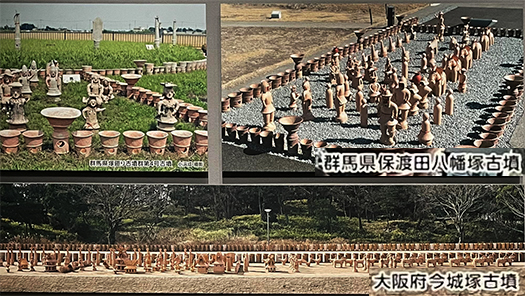
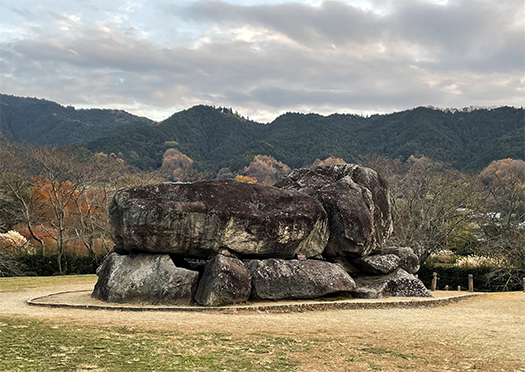
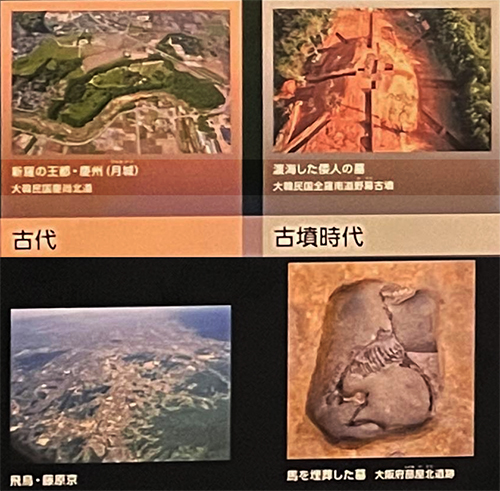
写真は日本各地の首長墳墓古墳を飾った埴輪と大和平野にある蘇我氏の墳墓と伝わる石舞台。

北部九州などは玄界灘の対岸の任那地域同様、各地で権力分散傾向。韓半島国家は中国の大陸王朝権力との複雑極まりない権謀術数があって、分裂が常態化していた。対して日本社会では「東征後」のヤマト王権の支配権の確立が進んだのは、この中国の王朝との遠さが統一を進める方向に働いたのだと想像できる。その後の東アジア外交でこの統一国家日本という存在感は大いに外交的効果があったと思う。また、そのことがヤマト王権の国内支配にとって強いパワーにもなったと思える。
ヤマト王権の中心人物たちにとって当初基盤であった北部九州では列島の「統一国家」形成は不可能であり、その王権中心地域として地政学的・戦略的に大和平野を強く狙った結果なのだろう。その戦略の正しさにやがて出雲などの他の王権は服従して行くことになった。

English version⬇

Yamato Chosen as Capital Based on Geopolitics by Emperor Jinmu (The 37,000 Year History of the Japanese Archipelago, Vol. 54)
Japan continued to intervene in the peninsula in search of iron. Eventually, Japan produced its own iron. This enabled Japan to conduct independent diplomacy with China. …

Yesterday, we re-explored the sea transportation routes around the time of the establishment of the Japanese nation.
When I began to think about ancient history, I always wondered why the Japanese were so obsessed with the Korean peninsula.
There was also a “satellite state” called Rinna in the southernmost peninsula in the Archipelago region. Naturally, there was a strong economic interest there, and Japan must have been obsessed with securing it.
This obsession can be attributed to the fact that Nana was the route for the spread of iron and other economic tools that developed the paddy field and agricultural economies.
The climate of the region was more suitable than that of the Korean peninsula for agricultural cultivation. The desire to own land suitable for cultivation and the strong yearning for such land may have led migrants from the Asian continent to the archipelago as a new frontier.
The San’in region became the first to produce iron ore domestically, and the society was no longer dependent on the influx of iron tools and other cultural products from the Kitakyushu region.

The Izumo no Kuni Fudoki (Izumo Province Climate Record) mentions in an article on Iishi County, “Hata Ogawa. In the “Izumo no kuni fudoki” (Izumo Province Fudoki), an article from Iishi County states, “There is iron in Hata Ogawa,” and an article from Nita County states, “Iron from the above villages is hard and most suitable for making miscellaneous tools. The phrase “iron is available” indicates that iron sand was extracted from the river, and “iron from various villages” indicates that iron production was carried out in each village. According to the Heian-period “Seijo Yosaku,” iron and hoes were stipulated as jiko zoshimono (land rent) in Izumo, Hoki, Bingo, and Bichu, suggesting that these areas were known as iron-producing regions in ancient times. 〜The summary from “Izumo-no-kuni Tatara-fudoki” quoted above.

In terms of domestic politics, the Yamato royal power, which is strongly believed to have “conquered” the Yamato region, gradually strengthened its control over the whole country. It is interesting to contrast why the unification of the peninsula region did not make much progress, while the Yamato kingdom strengthened its rule in the Japanese archipelago. It seems that until a certain point in time, the division of small states, such as Northern Kyushu, where the “kingdoms” described in the Wei-Shi-Wa-jin-Den are in disarray, the royalty of Okayama and Kibi, which have the Momotaro legend, and the Japan Sea Rim royalty centering on Izumo, were in a similar state to that of the Korean peninsula.

The photo shows haniwa terra-cotta tombs decorating the tombs of chiefs throughout Japan and a stone stage in the Yamato Plain, which is believed to be the tomb of the Soga clan.

The northern part of Kyushu, as well as the Nina region on the other side of the Genkai Sea, tends to decentralize power in various parts of Japan. The Korean peninsula had an extremely complicated power struggle with the dynastic power of the Chinese mainland, and division was the norm. In contrast, in Japanese society, the establishment of the Yamato kingdom’s dominance “after the Eastern expedition” progressed, and we can imagine that this remoteness from the Chinese dynasties worked in the direction of advancing unification. I believe that this presence of a unified Japan had a great diplomatic effect in subsequent East Asian diplomacy. It also seems to have been a powerful force for the Yamato dynasty’s dominance in Japan.

【玄海灘と瀬戸内を越える櫓櫂船(日本列島37,000年史 第53回)】


今回は古代日本と朝鮮半島を結ぶ重要な交通手段であった「櫓櫂船(ろかいせん)」について。
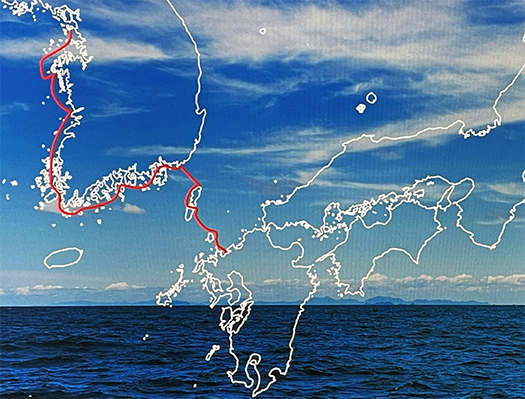
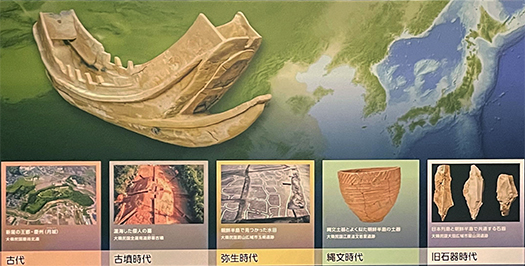
画像1枚目は国立歴史民俗博物館で展示されていたおおむね3世紀頃と思われる古代の移動の様子。
この画像からは魏志倭人伝が表現した倭国と朝鮮半島地域との交通状況が察せられる。ここで活躍していた移動手段が櫓櫂船だ。
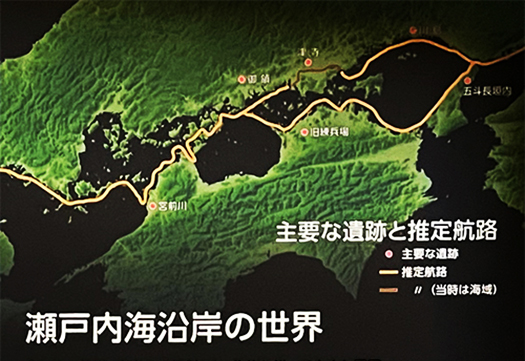
櫓櫂船とは、読んで字のごとく艪(ろ)と櫂(かい)を使って人力でこぎ進む形式の船のこと。2枚目のパネル写真のように多人数で艪を櫂でこぎ進む。

人力の船というと現代では馴染みの無いもののように思えるが、実はそうでもない。
櫓櫂船にまつわるエピソードを持つ現代の有名人として、旧西鉄ライオンズの大投手・稲尾和久がいる。
「神さま・仏様・稲尾様」と讃えられた稲尾選手はこの櫓櫂で体力ととくに手首のパワーを付けたと言われる。

〜1937年に大分県別府市北浜に7人兄弟の末っ子に生まれる。父・久作は漁師で、
母・カメノは久作が釣った魚を売り歩き生計を立てていたが、行商中に産気づいて
和久を産んだという。漁師を継がせたいと考えていた父親の意向で1944年に
北国民小学校に入学すると稲尾は父に連れられて伝馬船に乗り、艪を仕込まれた。
稲尾は幼少時代について「薄い板一枚隔てて、下は海。いつ命を落とすか分からない
小舟に乗る毎日だったが、おかげでマウンドでも動じない度胸がついた」と語っている。
また、強靭な下半身はこの漁の手伝いによって培われた。〜(Wikipediaより引用)

上記の逸話からはなにか、古代の櫓櫂に通じるものを感じる。
とくに九州の海の男らしい、玄界灘の荒々しい波濤に挑む様子が匂い立ってくるようだ。

魏志倭人伝では伝聞として倭国への交通路が記述されているが、この玄界灘の波濤を超える船便は地域の生活伝統としてさらに古い時代からあったことだろう。
とくに半島側の出発地域は古代「任那」という倭国の勢力範囲もあった。
対馬から釜山までの最短距離49.5km、朝鮮半島は九州に比べ半分以下の近距離。
航海の様子のパネル写真は現代での実験航海のように思えるが、このように12人ほどでの櫓櫂で50km-100kmの外洋を渡ることがあっただろう。
そういった海の男の生き様伝統が九州北部にはあったことが想像できる。
古代、朝鮮半島の白村江(現在の錦江河口付近)で行われた日本・百済遺民の連合軍と唐・新羅連合軍との間の戦争である「白村江の戦い」で異国の海にて戦死した同胞もこうして渡海しただろう。

こうしてはるか昔の朝鮮半島と日本との海を越える交通事情について思いを馳せていると、過去に旅した韓国釜山の夜のことを思い出す。はるかな現代、韓国釜山のカラオケ店で海峡にまつわる演歌を歌いまくった(笑)。
その音色、リズム感がいかにも日本人の原点を想起させてくれた。

そういう海峡を越えての海の交通が瀬戸内海に入っていく。韓半島もそうだけれど、瀬戸内海もまた多島海そのもの。
さまざまな海流をたくみに利用しながら、難波津を目指した交通が日本人の生活文化のある基本旋律を構成したようにも思える。
やっぱり北島三郎的な海の男の演歌リズムが似合うのではないか。
韓半島から瀬戸内海という日本文化の主要なハイウェーそのものがかなり強い心情的基底を作ったというのは間違ってはいまい。
古い昭和人間には、まだこういう肉体的感覚が残っている(笑)。

English version⬇

Oar-boat over the Genkainada Sea and the Seto Inland Sea. 37,000 Years of Japanese Archipelago History-53
The culture of sea men in Kitakyushu, which nurtured the great pitcher Kazuhisa Inao. The base of the enka is the sentiment of the men who were responsible for the route from the Genkainada Sea to the Seto Inland Sea. …

In this issue, I would like to talk about “oar boats,” which were an important means of transportation between ancient Japan and the Korean Peninsula.
The first image shows the ancient movement of oared boats, which were exhibited at the National Museum of Japanese History and Culture, and are thought to date back to roughly the 3rd century.
This image shows the traffic situation between Japan and the Korean peninsula as described in the Wei-Shi-Wa-jin-Den. The means of transportation used here was the oared oar boat.
As shown in the second panel, a oar boat was rowed by a group of people using oars and oars.

Although the word “oar boat” may sound unfamiliar today, it is actually not so.
One modern-day celebrity with an episode related to oarboats is Kazuhisa Inao, the great pitcher for the Nishitetsu Lions.
Inao, who was praised as “God, Buddha, and Inao-sama,” is said to have used this oar to develop his physical strength and especially his wrist power.

〜Inao was born in 1937 in Kitahama, Beppu City, Oita Prefecture, the youngest of seven children. His father, Hisasaku, was a fisherman.
His father, Hisasaku, was a fisherman, and his mother, Kameno, earned her living by selling fish caught by Hisasaku.
She gave birth to Kazuhisa when she realized she had given birth while peddling. His father wanted him to take over as a fisherman, and in 1944, he enrolled at Kita Kumin Elementary School.
When he entered Kitakumin Elementary School in 1944, his father took him on a boat and trained him to use a Japanese oar (oroku).
Inao recalls his childhood, “A thin board separated us, and the sea was below us. You never know when you might lose your life.
I was in a small boat every day, but it gave me the courage not to be fazed when I was on the mound.
He also developed his strong lower body by helping with the fishing. ~ (quoted from Wikipedia)

The above anecdote reminds me of the oar oars of ancient times.
In particular, we can smell the way he was a man of the sea in Kyushu, challenging the wild waves of the Genkai Sea.

The Wei-Shi-Wa-jin Biography describes the transportation route to Japan as a hearsay, but the boat service over the waves of the Genkai Sea must have existed from an even older time as a regional lifestyle tradition.
In particular, the departure area on the peninsula side was also the area of influence of the ancient Japanese state of “Nina”.
The shortest distance from Tsushima to Pusan is 49.5 km, and the Korean peninsula is less than half the distance of Kyushu.
The panel photo of the voyage seems like an experimental voyage in modern times, but there must have been times like this when oarsmen with about a dozen oarsmen crossed the open sea at 50-100 km.
We can imagine that such a tradition of life of sea men existed in northern Kyushu.
In ancient times, the “Battle of the Paekchon River,” a war between the allied forces of Japan and Baekje and the allied forces of Tang and Silla in the Paekchon River (near the mouth of the present-day Geum River) on the Korean peninsula, would have been fought on foreign seas, and their compatriots would have crossed the sea in this way.

Thinking about the long-ago transportation between the Korean Peninsula and Japan, I was reminded of a night I spent in Busan, South Korea, in the past. In the far-off present day, I sang enka songs related to the straits at a karaoke bar in Pusan, Korea (laugh).
The tone and rhythm of the song reminded me of the origin of the Japanese people.

The sea traffic across such straits entered the Seto Inland Sea. Like the Korean Peninsula, the Seto Inland Sea is an archipelago itself.
It seems to me that the traffic that aimed at Naniwazu, while skillfully utilizing various ocean currents, constituted the basic melody of the Japanese way of life and culture.
The enka rhythm of a man of the sea, in the style of Saburo Kitajima, would be a good fit for this piece.
It is not wrong to say that the main highway of Japanese culture from the Korean peninsula to the Seto Inland Sea itself created a very strong emotional basis.
Old Showa people still have this kind of physical feeling (laughs).

【最初期戸籍に見る「家族=共同体」 日本列島37,000年史-52】


現代の暮らしは核家族化が進み、しかもその収入源は企業勤務なので、
農耕を基盤とした社会経済構造とはまったく変わってしまった。
家という財産が全国各地域に広く拡散して大都市化が進展している。
そういう現代的常識はしかし、歴史的にはきわめて特異とも思える。

連載ブログ記事として取り組んできた国立歴史民俗博物館展示での古代までの
社会のありようの分析ですが、本日は戸籍について。
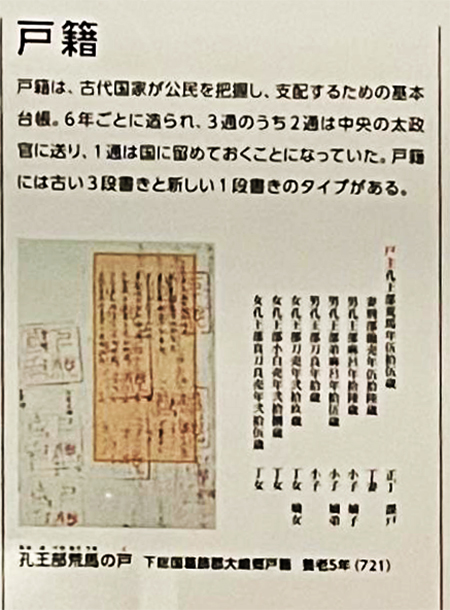
パネル写真からの復元なので図が不鮮明なのはご容赦ください。
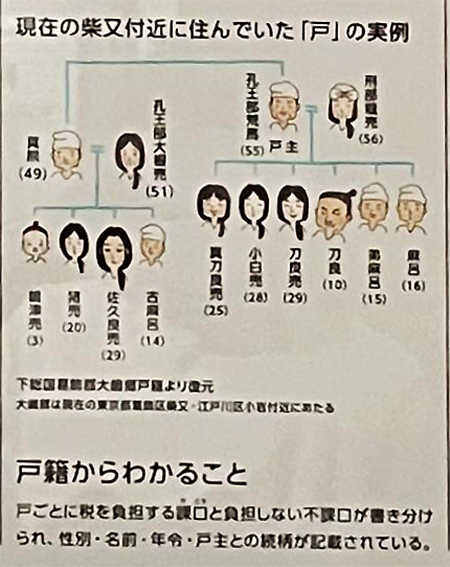
孔王部荒馬(あなおべのあらうま)という人を「戸主」とした戸籍記録。
現在の東京都葛飾区柴又付近に住んでいた。
戸籍記録の年代は721年の養老5年。いまから1300年前の「家族」ですね。
戸主としてはひとりとなっているけれど、戸籍からは
孔王部荒馬さんの妹さんとそのお婿さんが同居している。
この時代、結婚しても女性は実家の姓を名乗っている。
世帯という概念からすると2世帯同居していると見なせます。
まずは戸主の方ですが、奥さんはひとつ年上の女房。
で、子どもは大きく2つの世代が混合している。
29、28、25歳という3姉妹がいて、それとは離れた年代の16、15、12歳の3兄弟。
この時代を考えると夫婦も55と56歳とかなりの高齢。
どうも家族の成立過程では再婚で、どちらかの連れ子が同居の可能性。
ただ、それにしても56歳の女性の産んだ男子の末っ子は10歳なので、
この女性は46歳の時に出産したことになる。
現代でも数少ないと思える高齢出産であります。
なので、ひょっとすると3姉妹のうちの誰かの連れ子という可能性もある。
いずれにしてもこちらの家族だけでも8人家族。
一方の同居の妹さんの一家は全部で6人家族。
こちらも姉さん女房で2歳差。で、こちらも子どもの年代差が大きく
29歳の長女に3歳の末娘という驚きの幅です。
どう考えても3歳の子どもは「孫」と考えた方がふさわしい。
婚外子という、一般的だったとされる出産形態まで含めて
こちらもどうもいろいろな状況が推測可能ですね。
プライバシーの問題もあって詮索はこれ以上は不可能(笑)。
現代でこそ大都会の葛飾区ですが、この1300年前当時はやや低湿地の農業地帯。
田畑を耕してなんとか一家総勢14人の家計を支えていたのでしょうか。
それこそ稼げることはなんでも取り組んだに違いない。
家というか、むしろ中小零細企業というのが実態に近いのかも知れない。
そうした必死さがやがて「一所懸命」という考えの基盤を形成したのでしょう。

こういった家族の形はほんの数十年前くらいまで一般的だった。
家を持つということは難事業だったので、相続で受け継ぐ以外では
なかなか新築するということは難しかった。
翻って現代ではこの点は大きく変化してReplanのような住宅メディアも成立する。
人口増加以上に、家族関係の変容ということが日本人の住環境を
大きく変化させてきた基本要因だと言うことがわかりますね。
昔人とはいえ、プライバシーに関わる情報解析、失礼いたしました。

English version⬇

The Family = Community as Seen in the Early Family Registers 37,000 Years of the Japanese Archipelago – 52
Although they lived together by blood, their marital relations were extremely complicated. The family is more than a family; it is a microenterprise-like economic entity that conveys the desperation of its members. …

Modern life has changed completely from the agrarian-based socioeconomic structure, as the nuclear family has become the norm, and the source of their income is corporate employment.
The socio-economic structure based on agriculture has completely changed.
The property of the home has spread widely throughout the country, and metropolitanization has developed.
Such a modern common sense, however, seems to be very peculiar historically.

I have been working on a series of blog posts analyzing the state of society up to ancient times at the National Museum of Japanese History exhibit.
Today, I would like to talk about the family register.
Please forgive the blurriness of the figures, as they are reconstructions from panel photographs.
This is a record of a family register that names a person named Arauma Aonobe as the “head of the household.
He lived near present-day Shibamata, Katsushika-ku, Tokyo.
The family register record is dated 721, the 5th year of Yoro. That is 1,300 years ago.
Although he is listed as the sole head of the family, the family register shows that
Kouoube Araba’s sister and her son-in-law lived together.
In this era, even after marriage, women still took the family name of their parents.
In terms of the concept of a household, two households can be considered to be living together.
First, there is the householder, whose wife is one year older than him.
And the children are a mixture of two major generations.
There are three sisters, ages 29, 28, and 25, and three brothers, ages 16, 15, and 12, who are of a different age from them.
Considering this time period, the couple is also quite old, 55 and 56 years old.
Apparently, in the process of establishing the family, they remarried, and it is possible that one of the stepchildren is living with them.
But then again, the youngest of the boys born to the 56-year-old woman is 10 years old.
This means that this woman gave birth when she was 46 years old.
This is an older birth, which seems to be one of the few in modern times.
So, it is possible that she is a stepdaughter of one of the three sisters.
In any case, this family alone has eight members.
On the other hand, the family of the sister who lives with us has a total of six members.
She is also an older sister, and there is a two-year age difference between them. The age difference between their children is also large.
The oldest daughter is 29 years old and the youngest daughter is 3 years old.
No matter how you think about it, it is more appropriate to consider the 3-year-old child as a “grandchild.
The children were born out of wedlock, a form of childbirth that is said to have been common in the past.
Apparently, various circumstances can be inferred here, too.
I can’t pry any further due to privacy issues (laugh).
Katsushika-ku is a big city today, but 1,300 years ago, it was an agricultural area in a rather low marshy area.
I wonder if the family managed to support itself with a total of 14 members by cultivating the fields.
That is exactly what they must have worked on whatever they could earn.
It may not have been a house, but rather a small to medium-sized micro-enterprise, which is probably closer to the actual situation.
Such desperation must have formed the basis for the idea of “working hard.

This type of family structure was common until just a few decades ago.
Owning a house was a difficult undertaking, so it was difficult to build a new house except by inheritance.
It was difficult to build a new house unless it was inherited.
Today, however, this has changed dramatically, and housing media such as Replan are now available.
More than population growth, the transformation of family relationships is the basic factor that has changed the housing environment of the Japanese people.
This is the basic factor that has changed the living environment of Japanese people more than population growth.
I am sorry for the analysis of information that is related to privacy, even though I am an old-timer.

【中国・天下大乱 ようやくの空虚な習近平発言】


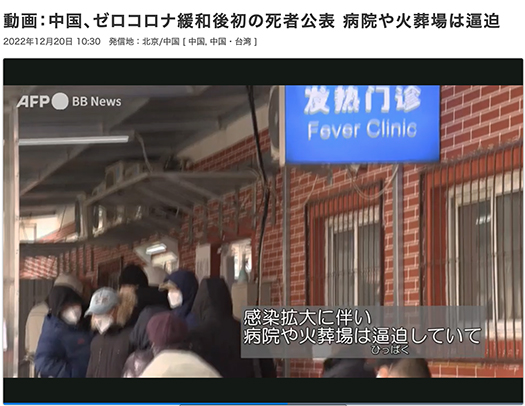
ゼロコロナ政策から180度転換後、中国で深甚な感染爆発が起こっているようだ。
中国当局はまったく情報管理主体として機能していない状況で
およそ誰も信じていない死者数・感染者数を発表している。
いまはそれすら放棄して「下部組織」による「参考」情報発信という無責任さ。
一方でアメリカ政府は独自の情報把握の結果、深甚なパンデミック状況を認識し、
救いの手を差し出そうとしたが、他方入国管理について対中シャットアウトした。
公的情報開示がなされていない中で各種の未確認情報が雪崩を打っている。
20日間で2億4800万人が感染したという情報リーク。1日1,000万人超の感染。
裏付けるように「中国・浙江省「コロナ感染1日最大200万人に」
地方政府が相次ぎ独自推計 実態示さない中央政府と対照的」〜東京新聞12/25.
先日、習近平辞めろ・共産党下台という反政府運動が起きたことで
歴世の中国社会が経験してきた「天下大乱」状況に突入と直感したけれど
そのプロセスにどんどん現実性が高まっている。
共産党政権の統治の「正統性」が大きく瓦解している。
そもそも最高指導者たる習近平自身がこのパンデミックに対して
これまでひと言も発言してきていなかった。
民がこれほどの阿鼻叫喚状況に突き落とされているのに、
最高政治責任者がいっさい発言もせずに責任を取ろうともしていない。
ゼロコロナと声高に自分の功績のように自慢し続けて
都合が悪くなったらいっさい発言しない「皇帝権力者」の姿。

さすがにまずいと思ったのか、ようやく【AFP=時事】12/26(月) 23:31配信で
「中国主席「人命守る」措置を指示 コロナ規制緩和に伴う感染急拡大で」
というアナウンスが発せられた。不鮮明な発言だけれど、以下。
「中国の習近平国家主席は26日大幅に規制緩和して以来初めて、
公の発言を行い、人命を守る措置を講じるよう当局に促した。」
「感染症の予防と制御は現在、新たな状況や課題に直面している」
「疫病の予防と制御に向けた地域社会の防衛線を強化し、人民の生命、
安全、健康を効果的に保護していく」と表明した。〜国営中国中央テレビ(CCTV)。
・・・語られている内容は、ほぼ無内容な官僚的作文文章。
最高政治指導者として血の通った決意というものがまったく感じられない。
逆に今この段階でこういう言い方で「お茶を濁す」のがかれの本性かと。
支配ゲームには一生懸命だけれど統治責任にはまったく無自覚。
考えられるのは、浙江省のような対応がされることで支配機構内部ですら
中央権力機構側での掌握ができなくなっているということ。

さてこれは他国のことなので、まずは日本として
こういう隣国の状況に対してどのように対処していくべきか、が大事。
いまや日本外務大臣の既定の訪中計画すら執行できない対手の混乱状況。
内政の失敗を軍事的緊張に転嫁する動きも尖閣・台湾で見えてきてもいる。
天下大乱から、日本社会を防衛するための用意が必要でしょう。

English version⬇

China’s Empty Speech after the Tianxia Rebellion
The supreme power whose true nature is seen through by the Chinese people. The history of the Yi Surname Revolution proves the power of the Chinese people. We need to prepare for the wave of turmoil. …

After a 180-degree turnaround from the zero-corona policy, there appears to be a profound infection explosion.
The Chinese authorities are not functioning as information management entities at all.
The Chinese authorities have been announcing a number of deaths and infections that almost no one believes.
Now, they have abandoned even that and are irresponsible enough to transmit “reference” information by their “subordinate organizations.
On the other hand, the U.S. government has been aware of the seriousness of the pandemic situation and has been trying to help.
On the other hand, the U.S. government, aware of the serious pandemic situation, tried to offer a helping hand, but on the other hand, it shut out immigration control to China.
In the absence of public disclosure, an avalanche of unconfirmed information has been released.
The leaked information that 248 million people were infected in 20 days, with more than 10 million infected per day.
As if to corroborate, “Zhejiang Province, China: ‘Up to 2 million people infected with corona a day'”.
In contrast to the central government, which has not shown the actual situation, local governments have been making their own estimates one after another.
The recent anti-government movement of “Xi Jinping, Quit, Communist Party, Downtown” is a clear example of the kind of anti-government movement that Chinese society has experienced in past generations.
I had a hunch that we were entering a situation of “upheaval under the rule of heaven,” which has been experienced by Chinese society for many generations.
But the process is becoming more and more realistic.
The “legitimacy” of the Communist regime’s governance is in a major state of collapse.
In the first place, Xi Jinping himself, the supreme leader, has not said a word about this pandemic.
Xi Jinping, the Communist Party’s supreme leader, has not said a single word about the pandemic.
The people are in such a desperate situation, and yet the supreme political leader has not said a word.
The people are being plunged into such a desperate situation, and yet the supreme political leader has not said a word and is not taking responsibility.
They keep boasting loudly about Zero Corona as if it were their own achievement.
The “emperor of power” who keeps boasting loudly about his achievements as if they were his own and never speaks up when things go bad.

Perhaps they thought it was a bad idea, but finally, at 23:31 on 12/26 (Mon.), AFP reported the following.
Chinese President Orders Measures to “Protect Human Life” in Response to Rapid Spread of Infection Following Easing of Corona Restrictions.
The announcement was issued. The statement is unclear, but here it is
“Chinese President Xi Jinping made public remarks for the first time since the country’s drastic easing of restrictions on coronas on April 26.
“In his public remarks, he urged authorities to take measures to save lives.”
“The prevention and control of infectious diseases now faces new circumstances and challenges.”
He urged the authorities to “strengthen community lines of defense to prevent and control epidemics and effectively protect the lives, safety, and health of the people.
We will strengthen the community’s line of defense for epidemic prevention and control, and effectively protect the lives, safety, and health of the people,” he stated. ~State-run China Central Television (CCTV).
…What is being said is a bureaucratic composition of almost no content.
The content of what was said was almost contentless, bureaucratic composition, and I felt absolutely no sense of bloody determination as the supreme political leader.
On the contrary, I think it is his true nature to “muddy the waters” in this way at this stage of the game.
He is trying his best to play the game of domination, but he is completely unaware of his responsibility in governing.
It is conceivable that the response like Zhejiang’s will be a sign that even within the ruling structure, the central power structure will not be able to control the situation.
The central power structure has lost its grip on the situation.

Now that this is another country’s problem, we must first ask what Japan can do to deal with this kind of situation in its neighbor.
How should Japan deal with such a situation in a neighboring country?
Now, Japan’s foreign minister is unable to execute even his predetermined plan for a visit to China.
There is also a movement to shift domestic political failures to military tensions in the Senkaku Islands and Taiwan.
We need to be prepared to defend Japanese society against a major upheaval in the world.

【外付けSSDデータ消失 IT的「諸行無常」・・・】


9/16 外付けSSDトラブルが出張中に発生。
Macの電源ケーブルを荷物に入れるのを忘れたのでカミさんに依頼して至急、
宿泊先ホテルまで送ってくれるように依頼した。一方到着するまでの2日間
仕事するのに「代替電源」を上野の電気ショップで購入した。
電気ショップの店員さんの言うままの機種。
それでホテルに入って外付けHDを接続させた。
Macの方は問題なく起動していたけれど、外付けSSDが認識されない。
最近のMacは本体の記憶領域が小さいので
過去データを含めて外付けドライブにほぼ環境保存している。
そのデータが認識されないのでは、身動きできない。
やむなく、以下のような対応を行った。
1 秋葉原で外付けSSD、USB-C接続のものを購入する。
2 Macに接続して新規の「写真データバック」保存箇所として設定する。
3 iPhoneに保存の写真類を読み込ませる。
4 当面の取材とブログ表現として活用。
ただし既存SSDのバックアップに復元させる手段も要確認。
5 外付けSSDについてはたぶん電気的「物理」ショックが原因と思えるので、
帰宅後、安定した既存環境に戻せば復活する可能性があり、
ダメでも札幌のデータ復旧センターで対応してもらった方が安心。
秋葉原のデータ復旧センターでは時間が掛かったときに遠距離になって困難。
で帰還後札幌で復元作業を依頼。・・・ところが数日で復旧困難の返答。
しかたなくSSD本体のメーカーに復元の依頼。
そこから2ヶ月以上のスパンがあって、最近結論。
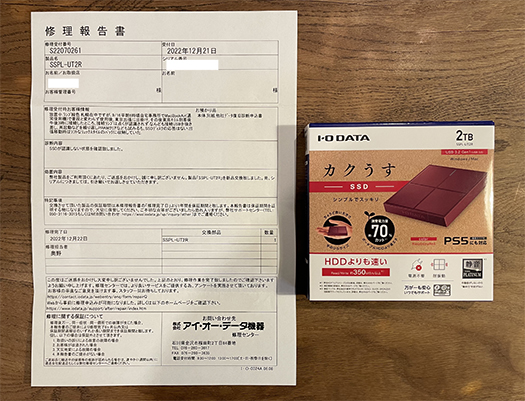
12月24日データ復元は不可能ということで交換したSSDが届いた。
やはり電源トラブルの可能性が高いということで、昇天。
3年程度の個人的取材写真データの消失。まぁいろいろな思いが沸くけれど
それを詮索していても得られることは枝葉末節のことばかり。
やむを得ない。人生にはいろいろな不可抗力が働く。
今後の対応としてはクラウド利用か。ただ大量では高コストなので絞る必要。
そのためのデータ取捨選択作業は時間という、より大きなコストがかかる。
仕事的データは当然、都度社内netに外化するので大きなトラブルはない。
あってもなんとか対応していくことは可能。
なので、現実的には引き続き注意深く外付けドライブを使うことになる。
自分とITの折り合いはそんな現在状況かなぁと。

しかし今回の経験から人間とテクノロジーの関係について気付きもあった。
情報についての価値判断が自分自身の高齢化によって
大きく変換するのだと言うこと。端的には「ま、しょうがない」と
諸行無常観が襲ってきて、達観せざるを得ないということ。
ITはそういった心理からは遠い存在だと思っていたけれど、
そういう感覚も含めていくようになる、という気付きでしょうか。
人間のやることなので、受容して先を向いていくしかないのでしょうね。
今年起こったことが今年中に決着してよかった、みたいな清々しさもある。

English version⬇

External SSD data loss – IT-esque “all things are possible”…
I was surprised at the loss of data in an instant. I tried everything, but I can’t turn back the flow of the river.All worldly things are transitory…. IT’s all action is impermanent.

9/16 External SSD trouble occurred during business trip.
I forgot to put the power cable for my Mac in my luggage, so I asked my wife to send it to the hotel where I was staying as soon as possible.
I asked my wife to send the cable to the hotel where I was staying as soon as possible. On the other hand, I had to wait for 2 days until I arrived at the hotel.
I bought an “alternative power supply” at an electronics store in Ueno, Tokyo.
I bought the model that the clerk at the electronics store told me to buy.
So I went into the hotel and connected the external HD.
The Mac started without any problem, but the external SSD was not recognized.
Recent Macs have a small storage space in the main unit.
I have saved most of the environment data including past data on the external drive.
If that data is not recognized, I can’t move around.
We had no choice but to take the following measures.
1 Purchase an external SSD with USB-C connection at Akihabara.
2 Connect it to the Mac and set it as the new “photo data back” storage location.
3 Load the photos stored on the iPhone.
4 Use it for the time being for coverage and blog expression.
However, make sure there is a way to restore to the existing SSD backup.
5 As for the external SSD, it is probably due to an electrical “physical” shock.
There is a possibility that it can be restored if it is restored to a stable existing environment after returning home.
Even if it is not possible, it is safer to have the data recovery center in Sapporo deal with the problem.
It would be difficult to recover the data at the data recovery center in Akihabara because of the long distance when it took a long time to get there.
Therefore, we requested the restoration work in Sapporo after returning to Japan. However, they replied that it would be difficult to recover the data in a few days.
We had no choice but to request the manufacturer of the SSD to restore the data.
After more than 2 months of waiting, they recently came to a conclusion.
On December 24, we received the replaced SSD because data recovery was impossible.
The possibility of power supply trouble was still high, so I ascended to heaven.
Loss of about 3 years of personal interview photo data, etc. Well, many thoughts come to mind.
But I can’t help but feel that I can’t get anything from prying into it.
It is unavoidable. In life, there are various force majeure.
The future solution is to use the cloud. However, it is necessary to narrow down the number of data because a large amount of data is too expensive.
The data selection process for that purpose is time-consuming and costly.
Naturally, work-related data is externalized to the company’s internal network on a case-by-case basis, so there are no major problems.
Even if there is a problem, it is possible to handle it somehow.
So, in reality, I will continue to use external drives with care.
I think that’s how I see the relationship between myself and IT at the moment.

However, this experience also made me realize something about the relationship between humans and technology.
I realized that my value judgments about information will change dramatically as I age.
I think that at some point, our value judgments about information will be greatly transformed by our own aging. In short, “Well, that’s just the way it is.
I think that IT is far away from this kind of mentality.
I used to think that IT was far away from this kind of mentality.
I guess I have come to realize that IT is far away from that kind of mindset, but I will come to include that kind of feeling in my work.
I guess we just have to accept it and look ahead, because it is a human thing to do.
There is a refreshing feeling of being glad that what happened this year was settled by the end of this year.

【湿雪停電・変動気候と人類のエネルギー対応】


奈良の知人から先日「今朝は庭の景色が一変して雪景色」という知らせ。
文面からは奈良(橿原市)でこれだから、さぞ北海道は・・・というニュアンス。
なんですが、わたしどもの北海道は広大で一部は湿り雪での停電がありますが、
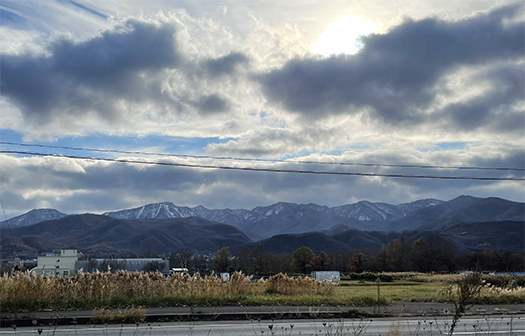
わたしの住んでいる札幌市はむしろ平年よりも高温で少雪気味。
ここ1−2日でも雨交じりで道路や敷地がグチャグチャという状況。
重い湿った、まるで北陸・新潟のような雪の状況。
この「湿雪」一番の問題点は電気の配電ネットワークへの打撃。
北海道でも一例では鉄骨配電塔が倒れて数日間、地域停電が発生したことがある。
気候としての冬の湿り雪はたぶん地球全体で見ても日本列島の特徴かも。
日本海という温暖傾向の海から発生する多量の水蒸気が
偏西風の影響を受けて日本列島の海岸に沿って降雪させる。
その時の気温状況で雪質は軽かったり重かったりする。
軽い、気温の下がった状況での降雪は比較的対応はやさしい。
ただただ寒いだけなので、住宅で言えば高断熱高気密で防衛できる。
しかし重たく湿った雪は、電気のネットワークに深甚な被害を与える。
さきの新潟の停電はまだ完全に復旧できない状況でまた降雪がきている。

先日の新潟中心の降雪・停電被害ではクルマの大渋滞にスポットが当たった。
わたしも福島県で年末、降雪の余波でクルマ大渋滞に遭遇したけれど
「関東から来るクルマがノーマルタイヤで動かなくなって大渋滞」と
東北人のみなさんは一様に口にされる。
今回の件がどうであったのかは詳細を把握していませんが、
大きな話題になっていたのは「電気自動車(EV)大丈夫か?」の点。
ガス欠が起こってもガソリンを渋滞車両に配れるけれど、
電気欠のクルマにはどうするの?という命にも関わる疑問点。
とくにEVバッテリーが低温には弱いというのはほぼ常識。
また、太陽光発電(PV)は冬場の連続する大雪時期には発電しない。
札幌の気候条件下では冬場の2−3ヶ月は発電を予期していない。
しかし考えられているのはEVとPVのワンセットの生活エネルギー対応。
当然蓄電池がそこに介在するというカタチが想定されている。
一番必要な冬場の移動手段が場合によっては「電欠」で確保できない。
どうも、この刷り込まれたライフスタイルモデルは
ヨーロッパ的な、あるいは大陸的な標準気候モデルだと思える。
そのそも、そのイギリスでは洋上風力の一本足に賭けた結果、
「思ったほど風が吹かなかった」ことで根底的な戦略見直しに迫られたし、
原発停止以降のエネルギー戦略としてロシア天然ガス一本足を選んだドイツは
ロシアの無道なウクライナ侵略を招来させてしまった。
エネルギー戦略の破綻で電力の異常高騰にヨーロッパ全域は襲われている。

ほぼ毎年のように繰り返し襲ってくるこの「湿り雪」と停電サイクルのなかで
アジア極東の変動気候に見舞われ続ける国のエネルギー戦略は
混乱する世界の「主流」追随型でいいのか、大いに疑問だと思われる。

English version⬇

Wet Snow Power Outages, Changing Climate and Humanity’s Energy Response
Renewable single energy strategy failed in Europe. It caused Russia’s spineless war. What is Nippon’s strategy under Far East Asian climate conditions? …

A friend of mine in Nara informed me the other day that the scenery in his garden had changed to snow this morning.
The text implied that since this was the case in Nara (Kashihara City, Nara Prefecture), Hokkaido must be… well…
But Hokkaido, where I live, is a vast island with power outages due to wet snow in some parts, but not in others.
However, Sapporo, where I live, is rather hotter than normal and has less snow than usual.
Even in the past day or two, the roads and grounds have been a mess due to the rain.
The snow is heavy and wet, just like in Hokuriku and Niigata.
The biggest problem with this “wet snow” is the damage to the electric power distribution network.
In one case in Hokkaido, a steel distribution tower collapsed, causing local power outages for several days.
Wet snow in winter as a climate is probably a characteristic of the Japanese archipelago as a whole.
A large amount of water vapor generated from the warm-trending Sea of Japan
The westerly winds cause snow to fall along the coasts of the Japanese archipelago.
The quality of the snow can be light or heavy depending on the temperature conditions at the time.
Snowfall under light, cooler temperature conditions is relatively easy to deal with.
Since it is just cold, it can be defended with high insulation and airtightness in terms of housing.
Heavy, wet snow, however, can cause serious damage to electrical networks.
The recent power outage in Niigata has yet to be fully restored, and another snowfall is on its way.

The recent snowfall and power outage in the center of Niigata highlighted the heavy traffic congestion of cars.
I was also in Fukushima prefecture at the end of the year when I encountered heavy car traffic jams in the aftermath of the snowfall.
I was in Fukushima prefecture at the end of the year when I encountered heavy car traffic jams in the aftermath of the snowfall.
I have also encountered heavy traffic jams in Fukushima Prefecture at the end of the year in the aftermath of the snowfall.
I don’t know the details of what happened this time.
I don’t know the details of what happened this time, but the big topic of conversation was, “Are electric vehicles (EVs) OK? point.
If you run out of gas, you can distribute gasoline to the cars in traffic, but what do you do with the cars that run out of electricity?
But what about cars that run out of electricity? This is a life-threatening question.
It is common knowledge that EV batteries are vulnerable to low temperatures.
In addition, photovoltaic (PV) power generation does not work during the continuous heavy snowfall in winter.
Under Sapporo’s climatic conditions, power generation is not expected for 2-3 months in winter.
However, what is being considered is a single set of EV and PV for daily energy needs.
Naturally, a storage battery is expected to intervene.
In some cases, the most necessary means of transportation in winter cannot be secured due to a lack of electricity.
Apparently, this imprinted lifestyle model is not
This imprinted lifestyle model seems to be a European or continental standard climate model.
And yet, in the United Kingdom, the bet on a single leg of offshore wind power has resulted in a “wind not blowing as fast as expected.
The UK was forced to fundamentally rethink its strategy after betting on a single leg of offshore wind power, which “didn’t blow as much wind as expected,” and
Germany, which chose a single leg of Russian natural gas as its energy strategy after the cessation of nuclear power plants
This led to Russia’s outrageous invasion of Ukraine.
The collapse of the energy strategy has led to an abnormal rise in the price of electricity throughout Europe.

In this “wet snow” and power outage cycle that strikes repeatedly, almost every year.
The energy strategy of a country that continues to be hit by the variable climate of the Asian Far East is
It is highly doubtful that the energy strategy of a country that continues to be hit by the variable climate of the Asian Far East can follow the “mainstream” of a world in turmoil.

【国家官制「大蔵省」の始原記録か 日本列島37,000年史-51】


大蔵(財務)省などの官僚制度は最初期の大宝律令体制から1300年以上の歴史。
そもそも国家というのは、水田農耕という社会集団形成・基盤産業革命によって
生み出された剰余価値=「保存可能な食糧など」を管理し
その価値を管理する必要性から「まつりごと」が生成したことは自明だろう。
その基本を構成するのは、日本社会ではコメの管理。
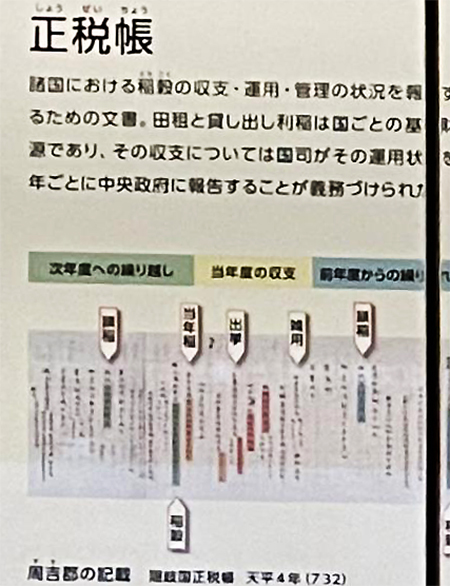
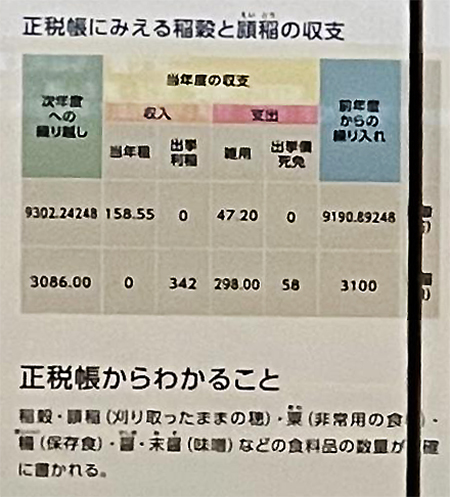
国立歴史民俗博物館でその様子の記録のパネル展示。
図表では一部が展示パネルを保護するガラスの陰影があって
タテにスジが入ってしまったことはご容赦願いたい。
また、読解不分明な箇所もあるけれど、おおむね内容はわかる。
日本という始原期の国家による「正税帳」という
食糧国家管理の様子が克明に記録されている展示です。
この税を納めるために人びとが汗水を流し農作業労働に勤しんだ光景が
強く脳裏に浮かんでくるように感じられる。

Wikipediaで確認すると「官僚制(官制)」には以下の記載。
〜律令制(大宝律令)以前
律令制以前において、体系的な官制は整備されていない。
ヤマト王権形成期においては「姓(カバネ)」と呼ばれる血縁集団から
「氏(ウジ)」と呼ばれる同族集団が現れ、この「氏」や「部」と呼ばれる職能集団が、
それぞれの勢力や能力によって王権内の仕事を分掌した。「氏・部」は
各々、土地と人民を所有・支配した(部民制)。次第に「姓・氏・部」は、
王権によって序列化・統制され、私的な集団から公的な制度へ編成されて行く。
(→氏姓制度、人制、八色の姓)
一方、皇族(大王の一族)を中心の支配体制を強化し、血縁や勢力にとらわれない
人材登用を進めるため、官位(冠位)制度(官職と位階の制度)も取り入れられる。
603年(推古11年)聖徳太子が制定した冠位十二階は、その嚆矢である。
この官位制度は冠位十二階から律令による官位制まで、数度の変遷がある。
氏姓制度と官位制、および職掌を体系的に整備したのが律令制。
668年(天智8年)に最初の「令(りょう)」である近江令が制定され、
689年(持統3年)の飛鳥浄御原令において初めて体系化されたといわれる。
701年(大宝元年)に成立した大宝律令は集大成となった。〜
いかにわたしが歴史の授業をきちんと聞いていなかったかが解明された(笑)。
大蔵省の後継組織によるつい最近の「増税」の声に引きずられ掘り起こした。

ただ、日本人はこういう税制管理体制に対して
正面からそれへの反抗を見せたことは歴史上かつてない、とも言われる。
税を納めることでさまざまな社会の秩序が維持されていること、
その「正統性」に対して異議申し立てはなかったのだ。
聖徳太子によって「和を以て貴しと為す」大方針が示され、歴世、
そのことはおおむね「まつりごと」に反映されてきたといえるのだろうか。
わたしには古代の「民主主義宣言」とも感じられる。
日本で「易姓革命」というものは起こらなかったのが歴史事実。

English version⬇

The Ministry of Finance” government system in the primitive period.
The Ministry of Finance, a “festival” that also used national defense as an excuse to raise taxes, is the original “Ministry of Finance” government system. The national policy of “Harmony is Precious” is something to think about now. The Japanese Government

The bureaucratic system such as the Ministry of Finance (Daizo) has a history of over 1,300 years since the first period of the Taiho Ritsuryo system.
In the first place, the state was created through the formation of social groups based on paddy field agriculture and the industrial revolution.
The state was formed out of the need to manage the value of surplus value (i.e., “storable food, etc.”) generated by the formation of social groups and the basic industrial revolution of rice paddy farming.
It should be obvious that “matsuri” was created out of the need to manage this value.
In Japanese society, the basis for this is the management of rice.
Panel exhibition of records of this situation at the National Museum of Japanese History.
In the chart, part of it is shaded by the glass protecting the display panels.
I hope you will forgive me for the vertical lines in the figures.
Also, although there are some parts that are not clear enough to read, the contents are generally understandable.
The “Shozeicho” or “tax book” of the primitive Japanese state clearly records the state management of foodstuffs.
This exhibit clearly records the state management of foodstuffs by the primitive nation of Japan.
The scene of people working hard to pay this tax through sweat and toil on the farm is very vivid in my mind.
The exhibition is a strong reminder of the scene of people’s toil and hard work to pay the tax.

Wikipedia lists the following for “bureaucracy (kansei)”: ~Ritsuryo system (Taiho Ritsuryo)
〜Before the Ritsuryo system (Taiho Ritsuryo)
Prior to the Ritsuryo system, no systematic government system was established.
In the period of the formation of the Yamato kingdom, the clan system was changed from a blood group called “kabane” to a clan called “uji”.
The “clan” or “division” of the Yamato kingship was formed by the power and ability of each of these clans.
These “clans” and “divisions” divided the work of the royal authority according to their own power and abilities. The “clans and divisions” were
Each clan or division owned and ruled the land and the people (tribal system). Gradually, the “families, clans, and divisions” became hierarchical and controlled by the royal authority.
The “family name, clan, and division” were gradually ranked and controlled by the royal authority, and organized from a private group into a public system (→ clan-surname system, personhood system).
(→ clan and surname system, personhood system, eight-color surname)
On the other hand, in order to strengthen the ruling system centering on the imperial family (the family of the great kings) and to promote the appointment of human resources regardless of blood and power
In order to promote the appointment of human resources, a system of official positions and ranks was introduced.
The 12 ranks of coronation established by Prince Shotoku in 603 (11th year of Suiko) are a pioneering example of this system.
The system of official ranks has undergone several changes from the Crown Twelve Ranks to the Ritsuryo system of official ranks.
The Ritsuryo system system systematically established the clan and family name system, the system of official ranks, and the duties and responsibilities of each position.
In 668, the first “ryo” (decree), the Omi decree, was enacted.
The Asuka Jomihara Order of 689 (Jito 3) is said to have systematized the system for the first time.
The Taiho Ritsuryo Code of 701 (the first year of the Taiho era) was the culmination of this system. ~…
This is a good example of how I have not been listening to my history lessons properly.
The recent calls for “tax hikes” by the successor organization of the Ministry of Finance have made me dig it up.

However, the Japanese people have never shown any outright defiance of this kind of tax management system.
However, it is said that the Japanese have never before in their history shown such a head-on defiance of the tax administration system.
The fact that various social orders are maintained through the payment of taxes, and the fact that the “legitimacy” of the tax system is challenged.
There was no objection to the “legitimacy” of the tax system.
Prince Shotoku set the general policy of “harmony is the noblest”, and this policy was generally reflected in “matsuri goto” throughout the ages.
Has this policy been generally reflected in the “festivals” throughout history?
I feel that this is an ancient “declaration of democracy.
It is a historical fact that the “Easy Family Reformation” did not take place in Japan.

【日本国家創成期の北海道島 日本列島37,000年史-50】


国立歴史民俗博物館の古代史展示の大革新に刺激されるブログシリーズですが、
やはり時系列でときどき触れられている北縁世界、北海道島と東北北部社会に
北海道人としては強く惹かれざるを得ない。
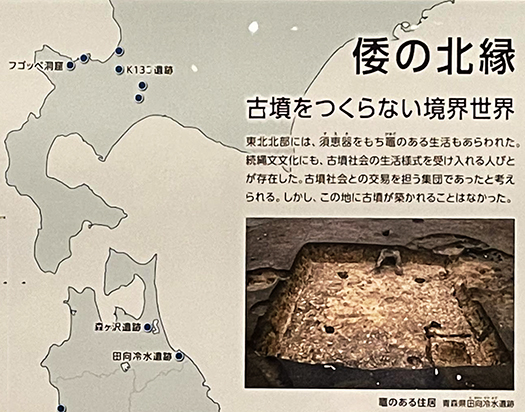
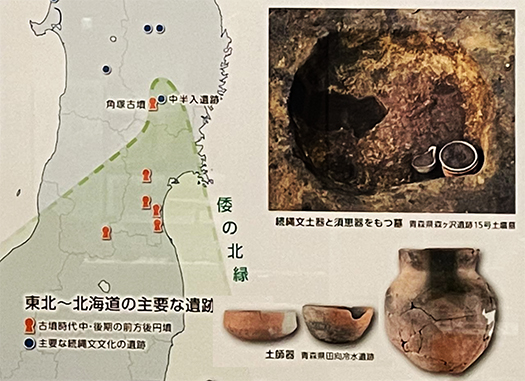
「古墳をつくらない境界世界」というように紹介パネル。
なんですが、わたしは札幌近郊の江別古墳群をよく見ている。
いまは高速ICの江別西を一般道に下りて北上していくと左手の丘陵地帯に
それはある。しかしたしかに始原期の古墳ではなく
やや時代が下った奈良・平安期に造営されたと言われている。
なので、正しくは「つくったけれどかなり遅れた」世界なのだと思う。
この国家始原期の古墳時代には北海道は参加していない。
積雪寒冷という条件から、ごく一部の津軽平野地域を除いて
その生活文化基盤である水田農耕は北海道・東北北部には波及しなかった。
ごく一部の津軽平野部も、その後の十和田の火山噴火被害で一時消滅した。

続縄文といわれるライフスタイルが北海道・北東北では継続した。
しかし一方で仙台平野地域までは古墳時代の痕跡が残る。
仙台市内にも「遠見塚古墳」があり、国道4号線に面している。
やはり水田農耕の北限地域というラインに沿って
境界が区画されて、列島社会は分断されていたということなのでしょう。

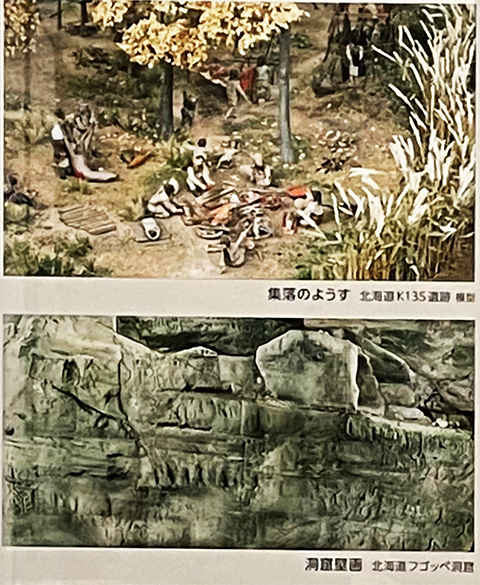
この続縄文期の北海道島の様子は地元のことなので
この千葉県の国立歴史民俗博物館展示で見るといかにも懐かしい(笑)。
そうなんですよ、こうやって暮らしていたんですよ、と声を上げたくなる。
縄文的ライフスタイルとしては適地でもあり、
季節毎にカムイの食の恩恵に従順に暮らしを営んでいたと思える。
余市のフゴッペ洞窟には日本海側での北方アジアとの交流痕跡もある。
しかしさらに北のサハリンには北からの中国権力の影響もあって
それと緊張関係も惹起する趨勢になっていくし、さらにオホーツク文化人という
アムール川河口地域から大型海生動物をハンティングしながら
オホーツク沿岸地域に南下定住しはじめた人びととの緊張関係も芽生えた。
時代をやや下ればそうした相克が阿倍比羅夫の武力を利用する事態も勃発する。
決して孤立的にあったのではなく、常に日本社会との連動が続いていた。

・・・って、日本社会から移住してきたわが家系のことも考える自分がある。
移住者の末裔としての自分自身としては強い「故郷」感がふたつある。
環瀬戸内海的な感覚と、北方日本海沿岸的感覚。
こういう独自なシンクロ感覚というのはわたしの世代としては自然。
考えようによってはそういう強い帰属意識をふたつながら持てることで
多様な日本社会という視点でも考えられるのではないかと
最近は「いい方向」で考えるようにしている。
どっちに対しても親近感と理性的判断力を持てるみたいな。妄想ですね(笑)。

English version⬇

Hokkaido Island in the Early Days of the Japanese Nation: The 37,000-Year History of the Japanese Archipelago – 50
The Japanese culture-centered viewpoint and the perspective as an emigrant to Ezo. As a resident of Hokkaido, I want to have an affinity and calm reason for both. …

This blog series is inspired by the great innovation of the National Museum of Japanese History’s ancient history exhibit.
I am still strongly attracted to the northern rim world, Hokkaido Island and northern Tohoku society, which are sometimes mentioned in chronological order.
As a Hokkaider, I cannot help but be strongly attracted to the northern border world, Hokkaido Island and northern Tohoku society, which are mentioned from time to time.
The panel introduces the northern border world as “the border world that does not create ancient tombs.
I have often seen the Ebetsu tumulus group in the suburbs of Sapporo.
Nowadays, when you exit the Ebetsu Nishi highway IC onto the public road and head north, you will find a hillside on your left.
It is located on the hillside to the left. However, it is not a burial mound of the primitive period, but rather a slightly later burial mound
It is said to have been built in the Nara and Heian periods, which is a little later than the original period.
Therefore, I think it is a world that was “created but quite late” to be correct.
Hokkaido did not participate in the Kofun period of the primordial period of the nation.
Except for a few areas in the Tsugaru Plain, Hokkaido did not participate in the Kofun period of the primordial period of the nation.
Paddy field agriculture, the basis of life and culture, did not spread to Hokkaido and the northern Tohoku region.
A small portion of the Tsugaru Plain area was temporarily destroyed by the subsequent volcanic eruption in Towada.

The “Continuation Jomon” lifestyle continued in Hokkaido and the northern Tohoku region.
On the other hand, traces of the Kofun period remain as far as the Sendai Plain area.
In Sendai City, there is the “Tomizuka Tumulus,” which faces National Route 4.
It is still along the line of the northern limit of rice paddy farming.
The boundaries were demarcated along the line of the northern limit of rice paddy farming, and the society of the archipelago was divided.

This Continued Jomon Period on Hokkaido Island is so local.
How nostalgic it is to see it in this National Museum of Japanese History exhibit in Chiba Prefecture (laughs).
It makes me want to shout out, “Yes, this is how we lived.
It’s also an apt place for a Jomon lifestyle.
It seems that they lived their lives obediently to the blessings of Kamui food in every season.
There are traces of interaction with northern Asia on the Sea of Japan side in the Fugoppe Cave in Yoichi.
But further north, in Sakhalin, there is also the influence of Chinese power from the north.
This would have caused tensions between the Chinese and the Okhotsk culture.
While hunting large marine animals from the Amur River estuary area
Tensions also developed with the Okhotsk cultural people, who began settling southward in the coastal areas of Okhotsk while hunting large marine animals from the Amur River estuary region.
Somewhat later in the period, such conflicts led to the use of military force by the Abenohiras.
The Abenohiras were never isolated from the rest of Japanese society, but were always linked to it.

I think of myself as a descendant of emigrants from the Japanese society.
As a descendant of immigrants, I have two strong senses of “home.
One is a sense of the Inland Sea Rim, and the other is a sense of the northern Sea of Japan coast.
This unique sense of synchronization is natural for my generation.
Depending on how you look at it, having two such strong senses of belonging
I think that by having these two strong senses of belonging, we can also think from the perspective of a diverse Japanese society.
I try to think in a “positive” direction these days.
I can have a sense of closeness and rational judgment toward both sides. It’s a delusion (laughs).

【国際交流と社会発展の古代史 日本列島37,000年史-49】


国立歴史民俗博物館の「古代史」展示ゾーンでの知的興奮体験。
いま書き進めているのはこの体験に添って列島史の再学習と思っています。
昔人を知ることで現代の生きる知恵も湧いてくる。
とくに中国社会からは多くの影響を受けて日本社会は創られてきた。
いま、日本人は古代から続く大陸・半島との「付き合い」を考えさせられている。
経済という側面ではアメリカとまったく同じ対応は取れない。
しかし中国大陸ではかつて大きな変動が繰り返し起こり続けている。
易姓革命ということは今後も起こることを肝に銘じていなければならない。
共産主義という表面はただの表層であって、実質は共産党王朝独裁。
いつそれが易姓されるか、それは繰り返す歴史の必然でしょう。
日本社会は幾多の経緯を経てきたけれど、国体としては和の国。
統一とまとまりを確保し続けてきている。
そのことのひとつの知恵として、日本の王権には姓がない。
易姓革命の根拠をそもそも持たせないという知恵を
数々の政治動乱の結果、日本に亡命した多くのアジアの知識階層が
日本の王権に対して刻印してきた結果だと思えてならない。
日本としてはアジア世界から多くの社会資産を受け継いできたことに踏まえ
地域全体の安定を示していくことが今後、国際的にも求められるだろう。
混乱するアジアの中での最安定社会の責任を果たしていかなければならない。
たぶん21世紀の日本の世界の中での大きな役割でしょう。
そういう視点が歴史を再学習してみたいという内的な動機なのかも。

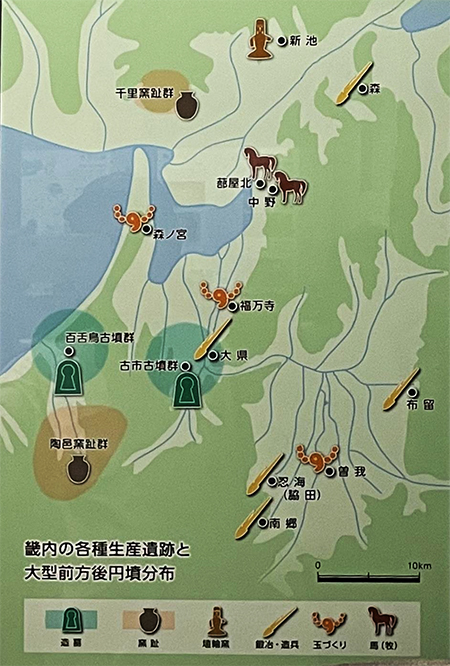
上の図は日本社会に導入されてきたいろいろな製造業痕跡。
畿内地域における鍛冶・道具や窯跡、労力としての馬産などの分布地図。
水田農耕には灌漑から水田土木まで多様な「土木」改変事業が必然化する。
そのときにまずは「鉄器」が最重要戦略物資であり、
次いでそういう土木工事を支える労力としてウマが活用された。
日本では馬産は畿内地域がいちばん古い時期からの導入地域。
水田農耕という「新技術社会」が瞬く間に日本列島を席巻したことがわかる。
権力機構は必然的にそれに随伴し結果したといえる。


今しも、そもそも中国発の感染症の巨大な猖獗がこの発症地域で勃発している。
昨日の日経新聞では中国総局長を永く努めた論説委員・中沢克二氏の記事。
●「北京コロナ感染70%」の深刻度、習政権に2つの司令部。
現在の状況について内情を知る関係者の興味深い説明の部分があって驚かされた。
「いかなる軍隊でも、情勢不利と判断した場合の撤退の際、全滅を避けるため、
追ってくる敵軍を防ぐいわゆる『しんがり』の部隊を最後尾に置いて逃げる。
ところが今、中国では、何の防御措置もとらないままゼロコロナ政策を放棄し、
全員が逃げる潰走が突然、始まった」
巨大人口国家の混乱は、いつの時代でも周辺国に影響を及ぼす。
そういえば日本の世論を動かそうとする「五毛党」などの活動も
最近、やや大人しくなっているように思う。混乱の根は深いのではないか。

English version⬇

Ancient History of International Exchange and Social Development 37,000 Years of the Japanese Archipelago – 49
Japan, which inherited intellectual assets from continental and peninsular societies and created a stable society, has a role to play in showing the wisdom of peace and stability in Asia. …

An intellectually exciting experience at the “Ancient History” exhibit zone of the National Museum of Japanese History.
What I am writing now is a re-learning of the history of the archipelago to accompany this experience.
Knowing the people of the past will give us the wisdom to live in the present.
In particular, Japanese society has been influenced by Chinese society in many ways.
Now, Japanese people are forced to think about their “relationship” with the continent and peninsula, which has continued since ancient times.
In terms of economics, the Japanese cannot respond in exactly the same way as the Americans.
However, in the past, major changes have repeatedly occurred on the Chinese mainland.
We must keep in mind that the “Yi Simei Revolution” will happen again in the future.
The surface of communism is just a surface, but the reality is the dictatorship of the Communist Party dynasty.
Whenever it will be revived, it will be the inevitability of history repeating itself.
Japanese society has been through many vicissitudes, but as a nation, it is a country of harmony.
It has continued to ensure unity and cohesion.
One of the wisdom of this is that Japanese kingship has no family name.
The wisdom of not having the basis for a family name revolution in the first place.
As a result of numerous political upheavals, many Asian intellectuals who defected to Japan
This is the result of the imprint of many Asian intellectuals who defected to Japan as a result of the many political upheavals in the region.
Japan has inherited many social assets from the Asian world.
Japan will be internationally called upon to demonstrate stability in the region as a whole.
Japan must fulfill its responsibility as the most stable society in a confusing Asian region.
Perhaps this is Japan’s major role in the world in the 21st century.
Perhaps such a perspective is the internal motivation for wanting to relearn history.

The figure above shows the traces of various manufacturing industries introduced into Japanese society.
It is a map of the distribution of blacksmithing, tools, kiln sites, and horse production as a form of labor in the Kinai region.
Paddy field agriculture necessitated various “civil engineering” projects ranging from irrigation to paddy field engineering.
At that time, iron tools were the most important strategic commodity.
Next, horses were used as labor to support such civil engineering projects.
In Japan, the Kinai region was the earliest area to introduce horse production.
It is evident that the “new technology society” of paddy field agriculture quickly swept over the Japanese archipelago.
The power structure inevitably followed suit.

Even now, a huge epidemic of infectious diseases originating in China is breaking out in this region.
In yesterday’s Nikkei Shimbun, editorialist Katsuji Nakazawa, who served as China’s general director for many years, wrote: ● “Beijing Corona Infection 70% Serious, Two Command Posts in Xi Administration.
The article was written by Mr. Katsuji Nakazawa, an editorial writer who had served as China’s General Director for many years.
I was surprised to find an interesting explanation of the current situation from a person with inside knowledge of the situation.
The official explained, “When any army withdraws from a situation it deems unfavorable, it must be prepared to defend itself against pursuing enemy forces in order to avoid total annihilation.
In order to avoid being annihilated, any army, when it withdraws from a situation it judges to be unfavorable, will leave a so-called “shingari” force in the rear to prevent enemy forces from pursuing it.
Now, however, China has abandoned its zero-corona policy without taking any defensive measures.
Suddenly, a crushing run in which everyone flees has begun.”
The turmoil in a megapopulation nation always affects neighboring countries.
Come to think of it, the activities of the “Five-Headed Party,” which tries to sway public opinion in Japan
seems to have become somewhat more mature recently. The roots of the confusion may be deep.

【古代史と地震噴火・天変地異 日本列島37,000年史-48】


わたしたち現代人も多くの天変地異によって社会変動を経験した。
阪神淡路大震災、東日本大震災などによって社会は深甚な打撃を受けた。
現実の被害を超えて人のこころ、社会そのものにも影響をもたらせた。
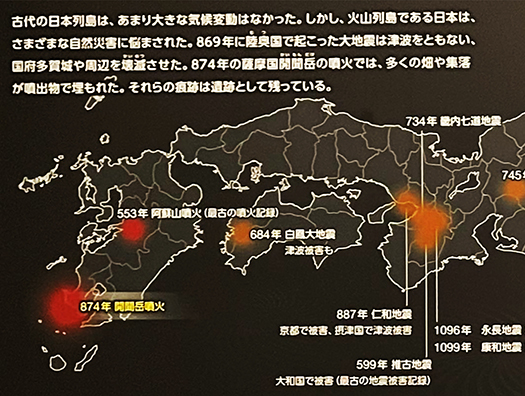
国立歴史民俗博物館展示パネルでも古代での災害記録が記されている。
〜古代の日本列島はあまり大きな気候変動はなかった。しかし火山列島である
日本はさまざまな自然災害に悩まされた。869年に陸奧国で起こった大地震は
大規模な津波を伴い国府多賀城や周辺を潰滅させた。
874年の薩摩開聞岳噴火では多くの畑や集落が噴出物で埋もれた。〜
以下にパネルに表記された主な古代の自然災害。
・553年 阿蘇山噴火(記録での最古の噴火)
・599年 推古地震(大和国被害〜最古の地震被害記録)
・684年 白鳳大地震(伊予南部・津波被害も)
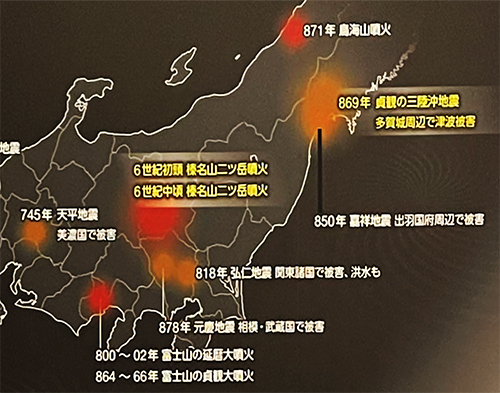
・6世紀初頭 榛名山二ツ岳噴火(古代豪族・上毛野氏本拠を直撃)
・6世紀中頃 榛名山二ツ岳噴火
・734年 畿内七道地震
・745年 天平地震(美濃国で被害)
・800~802年 富士山延暦大噴火
・818年 弘仁地震(関東諸国で被害、洪水も)
・864〜66年 富士山貞観大噴火
・869年 陸奧三陸沖・貞観地震と大津波(多賀城津波被害)
・871年 鳥海山噴火
・878年 元慶地震(相模・武蔵国で被害)
・887年 仁和地震(京都で被害、摂津で津波被害)
・・・国家機構として整備がされて以降の歴史年代でこうした記録。
それ以前の段階でも天変地異はもちろん多数発生していたことだろう。
そうした地震などが、祭政を司るヤマト王権にとってどのように影響したか、
現実に残された歴史経緯から想像力を巡らせるべきなのかもしれない。

6世紀初頭と中頃と記された榛名山噴火ではそれまでの古代勢力、
上毛野氏の本拠地域が壊滅的な打撃を受けたという。
古代中央軍事勢力・ヤマトタケル説話で名の残る地名
吾妻(あずま)としてはこの有力地域が眺望されたはず。
そういう吾妻中心地が潰滅したことで関東の歴史が大きく変動したと思える。
上毛野氏は古代の対外戦争でも中心的な軍事勢力として名が残るが
その後、政戦の記録からその名前が消滅し上野・下野の地名に
名前を留めるに過ぎなくなる。この榛名山二ツ岳噴火との強い関連が想像できる。
また古代の東日本大震災・貞観地震では王権の地方統治機構・多賀城が潰滅。
多賀城には関東を中心にした暴力装置・武装勢力が常駐しただろう。
その勢力の人命の多くが失われた可能性は高いと思われる。
中央政権のパワーが大きく削がれたことは疑いがない。
政治変動の基底要因としてもこうした天変地異が影響したと考えられる。
歴史年代として記録の残る時代でもこうした想像が可能だが
それ以前の社会でも自然災害はさらに大きな要因として働いたに違いない。

English version⬇

Ancient History and Earthquakes, Eruptions, and Natural Disasters: The 37,000-Year History of the Japanese Islands – 48
Numerous disasters have been recorded even after the age of historical records. Even before that, they occurred constantly and frequently. They must have had a strong influence on the mind and history. ・・・・.

We modern people have also experienced social changes due to many natural catastrophes.
The Great Hanshin-Awaji Earthquake, the Great East Japan Earthquake, and other disasters dealt a profound blow to society.
Beyond the actual damage, these disasters also had an impact on the human mind and society itself.
The National Museum of Japanese History exhibition panel also records disasters in ancient times.
〜The Japanese archipelago in ancient times did not experience major climatic changes. However, as a volcanic archipelago
In 869, a major earthquake occurred in Rikugunkoku, which was accompanied by a massive tsunami.
In 869, a major earthquake in Riku-Onkoku was accompanied by a massive tsunami that destroyed Tagajo, the national capital, and the surrounding area.
The eruption of Mt. Kaimondake in Satsuma in 874 buried many fields and villages in the eruption. ~.
The following are the major ancient natural disasters described in the panel.
Eruption of Mt. Aso in 553 (the earliest recorded eruption)
599 Suiko Earthquake (damage in Yamato Province – oldest record of earthquake damage)
684: Great Hakuho Earthquake (also caused tsunami damage in southern Iyo)
Early 6th century: Mt. Haruna Futatsudake eruption (hit the home of the ancient Kamimono clan)
Eruption of Mt. Haruna Futatsudake in the mid-6th century.
734 Kinai-Shichido Earthquake
745 Tenpyo Earthquake (damage in Mino Province)
800~802: Enryaku volcanic eruption of Mt.
818 Konin Earthquake (damage and flooding in Kanto region)
864-66: Great eruption of Mt.
869: Jogan earthquake and tsunami off the coast of Riku-On-Sanriku (damage from Tagajo tsunami)
871: Eruption of Mt.
878: Genkei Earthquake (damage in Sagami and Musashi Provinces)
887 Niwa Earthquake (Damage in Kyoto, Tsunami damage in Settsu)
These records are from the period after the establishment of the national organization.
Of course, there must have been many natural disasters even before that.
How such earthquakes affected the Yamato kingdom, which was in charge of ritual administration, is not clear.
Perhaps we should use our imagination to determine how such earthquakes and other events would have affected the Yamato royal government, which controlled the rituals.

The eruption of Mt. Haruna in the early and middle of the 6th century destroyed the ancient power that had been in power until then, the Kamimono clan.
The eruption of Mt. Haruna in the early to mid-6th century is said to have devastated the home region of the Kamomono clan, the ancient power that had been in power until that time.
Place names that remain in the legend of Yamatotakeru, the ancient central military force
This area must have been viewed as Azuma.
The destruction of the Azuma center is thought to have caused major changes in the history of the Kanto region.
The Kamimono clan’s name remained as a major military force in the ancient wars against Japan, but the records of political battles show that the Kamimono clan’s name did not change.
Later, their name disappeared from the records of political wars, and they were only mentioned in the names of places in Ueno and Shimono.
The name of the Jomono clan has remained only in the names of places in the Ueno and Shimono regions. It can be imagined that there is a strong connection with the eruption of Futatsudake on Mt.
In addition, the ancient Great East Japan Earthquake of Jogan destroyed Tagajo, the local seat of royal rule.
The Taga Castle would have been the permanent seat of a violent apparatus and armed forces centered in the Kanto region.
It is highly likely that many of the lives of those forces were lost.
There is no doubt that the power of the central regime was greatly reduced.
Such natural cataclysms are also thought to have been a fundamental factor in political change.
It is possible to imagine such an event even in the recorded historical period, but even in earlier societies
Natural disasters must have been an even more significant factor in earlier societies.