本文へジャンプ

【豊かなデザインの日本住宅開口部⑤ 四国住空間-43】


住宅には「開口部」が決定的な意味を持つ。
現代住宅はガラスという素材が窓やドアの決定的な因子になっている。
ガラス自体は日本でも相当古くから、
それこそ古代の時代から数多く存在しているけれど、
装身具やガラス玉のように装飾具として利用され
これを透明性を持った「建材」として外部建具に嵌め込む発想がなかった。
欧米社会では普遍化したことがどうして日本では起こらなかったのか、
よくわからないナゾなのではないかと思っています。
明治以降、欧米から建材としてのガラスが輸入されるようになって
それが対ロシア国防意識からの北海道開拓、開拓民の増加を国策として
推進されるようになって、日本家屋の決定的な弱点・寒冷対応での
気密性の欠如ということに気付かされた。そこで具体的対応として
ガラス建材が北海道が最前線として革新が起こり日本家屋に導入されていった。
日本の住宅性能が進化したのにはロシアの侵略への脅威が底流にあったといえる。
今日のウクライナにつながるような危機意識が日本社会にも強く存在した。
日本のガラス窓最初期からの建材屋さんにインタビューしてその状況の
リアリティを取材した記憶があります。

しかし、ガラス建材は導入されなかったけれど、
日本家屋に開口部の文化が乏しいというような言い方はできない。
日本人の生活スタイルとして開口部へのこだわりは多様に存在する。
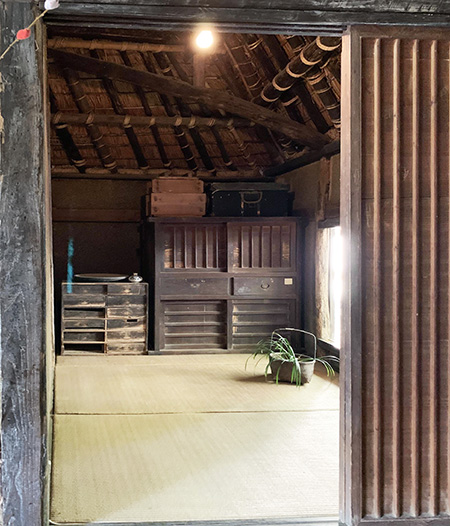
上の写真は上芳我家の床の間付きの座敷空間だけれど、
庭の景観を楽しむために大開口の障子建具や書院の開口部など、
景観と同時に障子の美しい光のコントロール、そのグラデーションを
感受性でフルに楽しんでいるのだと思う。
北海道人として温暖地域のこうした視覚優先の開口部構成にため息が出る。
いろいろなディテールの仕様、その丹念な造作を見るに付け、
そこに費やされる建築表現力の深さに驚かされる。
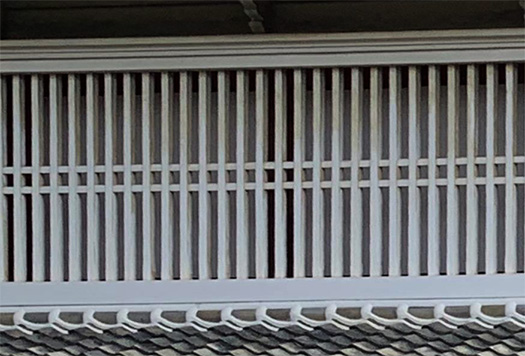
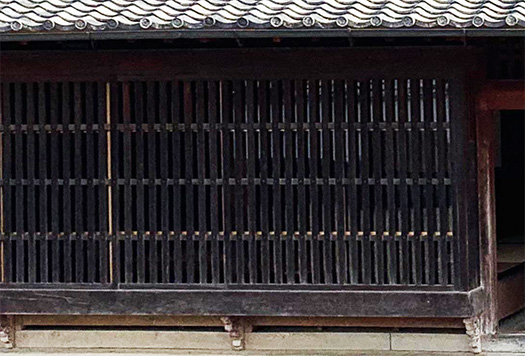

一方で、こちらの写真群は商家としての基本デザインを構成する外部建具。
京町家などで洗練されていった木格子による表現と
開口部のディテールにも、いかにも日本社会的な熟成感が漂っている。
こういった素材と格子組に対して白い障子が基底的なシンフォニーを見せる。
町家という都市住宅共通の建築デザイン要素を形成する
こういった開口部デザインは日本文化の重要なパート。
明治開国時期に日本の街並みを体感した多くの欧米の人たちは
その統一感の取れた街区デザインに対して感銘を語ってくれている。

現代日本の住宅地の街並みは、ガラス建材の窓が
基底的なデザインエレメントを形成しているけれど、
その機能性においては相当の進化は見られていると思うけれど、
このような繊細な美感を讃えている和の開口部文化に対して
どこまでのレベルに達しているか、疑問の余地があるのではないか。

English version⬇

[A richly designed Japanese house opening ⑤ Shikoku living space-43]
The maturity of the Japanese opening is high in terms of both the element of “cutting out the landscape” and participation in the block design. What about modern glass building materials?・ ・ ・

“Opening” has a decisive meaning in a house.
In modern houses, the material of glass is a decisive factor for windows and doors.
The glass itself is quite old in Japan,
It has existed a lot since ancient times,
Used as ornaments like jewelry and glass balls
There was no idea to fit this into external fittings as a transparent “building material”.
Why did the universalization in Western societies not happen in Japan?
I don’t know what it is.
Since the Meiji era, glass as a building material has been imported from Europe and the United States.
That is the national policy to cultivate Hokkaido from the consciousness of defense against Russia and increase the number of pioneers.
Being promoted, the decisive weakness of Japanese houses, in dealing with cold weather
It was noticed that there was a lack of airtightness. So as a concrete response
As for glass building materials, Hokkaido was at the forefront of innovation and was introduced into Japanese houses.
It can be said that the threat to Russia’s aggression was at the bottom of the evolution of Japanese housing performance.
There was a strong sense of crisis in Japanese society that would lead to Ukraine today.
Interviewing a building material store from the earliest days of Japanese glass windows
I remember covering reality.

However, although glass building materials were not introduced,
It cannot be said that Japanese houses lack the culture of openings.
There are various commitments to the opening as a Japanese lifestyle.
The photo above is a tatami room with a tokonoma in the Kamiyoshiga family.
To enjoy the scenery of the garden, such as shoji fittings with large openings and the opening of the Shoin, etc.
At the same time as the landscape, control the beautiful light of the shoji and its gradation
I think I’m sensitive and fully enjoying it.
As a Hokkaido citizen, I sigh at this visual priority opening structure in warm regions.
To see the specifications of various details and their elaborate construction,
I am amazed at the depth of architectural expressiveness spent there.

On the other hand, these photos are the external fittings that make up the basic design of a merchant house.
With the expression by the wooden lattice that was refined in Kyomachiya etc.
The details of the opening also have a sense of Japanese social maturity.
White shoji show a basic symphony for these materials and lattices.
Forming an architectural design element common to urban houses called machiya
This kind of opening design is an important part of Japanese culture.
Many Westerners who experienced the streets of Japan during the opening of the Meiji era
He is impressed with the unified design of the block.

The streets of modern Japanese residential areas have windows made of glass building materials.
Although it forms the basic design element,
I think that considerable evolution has been seen in its functionality,
For the Japanese meatus culture that praises such a delicate beauty
There may be doubts about how high it has reached.

【製造商工業者の古民家・オモテ空間④ 四国住空間-42】


江戸期からこの上芳我家は愛媛県・内子で木蝋生産で栄えてきた。
白蝋の大量生産・技術革新がこの家系によって確立したからとされる。
栃木県に芳賀という地名があるが、そもそもはその地から精蝋の技術をもって
この地に移住してきたという家系伝承。
栃木の芳賀出身者がどういうことでハゼノキ・木蝋とつながるのか、
この辺は探ってみても判然としない。
そして芳賀出身者が「芳我」と字が変化したことも不分明。
まぁ、文字変換自体はケースが散見されることではあるけれど・・・。
以前、考古的発見の現地説明会など栃木には愛媛県以上に訪問経験があり
「ハガって、そういえば栃木にあるよなぁ」と直感は持ってはいた。
それでガイドの方に「栃木と関連あるのですか?」と聞いた次第。
芳賀と芳我さんのルーツ、そして木蝋の関連について
機会を見てフィードバックして栃木県で深掘りしてみたい。
ハゼノキは九州が本場で神戸からの輸出最初期には九州産と混同されたという。
気候風土的に栃木よりも九州西岸地域との類縁性の方が高いだろう。

この上芳我家は、本家から分かれた13の分家の内の最大の成功者。
この住宅の創建はその木蝋生産の最盛期・明治38年頃とされている。
土佐から松山に抜ける街道・宿場町ではあるが、
深い山間の町でこういう輸出産業が出現したことになる。
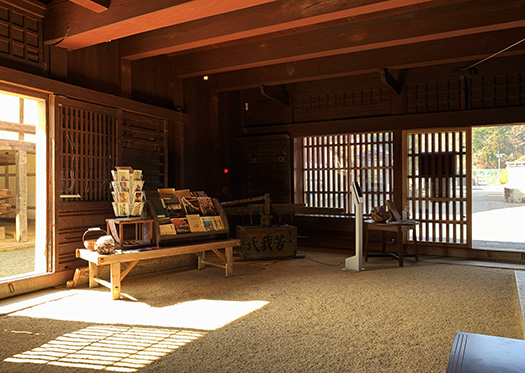
店舗機能としての玄関土間部分はそう広くはなく、
それよりも商談・応接的な空間が展開している。
ただ、基本的な建築構成としては「商家」の造作と言っていい。
訪問客は土間空間で番頭さん・手代といった人に応接されたに違いない。
土間は2方向に開口されていて、道路側と屋外天日干し中庭側につながる。
原材料の搬入、製品の搬出などの通路でチェック機能を果たしたか。
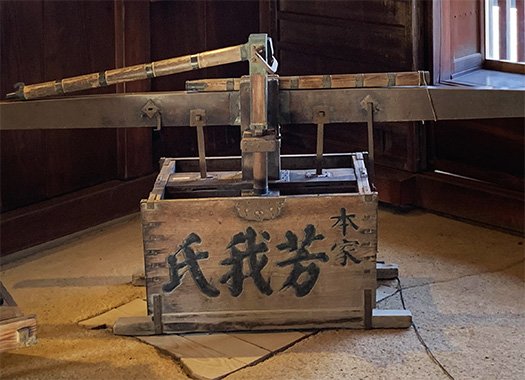
土間に置かれた「芳我」文字入りのものはどうも運搬具のように思える。
荷姿としてはそう大きくはないが、加工製造された木蝋製品は
コンパクトだけれど貴重品という商品特性だったのだろう。
内子は松山方面への街道筋宿場なので、陸路で今治か松山方面に運ばれ
そこから瀬戸内海海路で神戸の貿易拠点に運搬されたと想像できる。


このオモテ空間の奥には賓客を接遇したと思える座敷空間が広がっている。
床の間付きの主室からは中庭の眺めが見晴らせている。
家系の氏素性をあきらかにするかのように仏壇も置かれている。
商売としては信用第一、永くやってきているというアピールとも思える。
考えて見ると古民家をたくさん見て来ているけれど
商家の場合でも対面販売型の生業の家が多く、
この家のように工業生産・加工生産品型の製造業というケースはマレかも。
振り売りに近い店舗空間ではない、商工自営者という存在としての
あり方が建築の造作の随所に表れているのでしょうね。
あるいは同じ明治期の北海道の漁業生産施設「ニシン御殿」に近いのかも。

English version⬇

[Old folk house / front space of manufacturing commerce and industry ④ Shikoku living space-42]
The storefront of the high-priced processed product manufacturing industry in the Meiji era, which is neither a farmer nor a merchant for sale. A reception space for visitors.・ ・ ・

Since the Edo period, this Kamihoga family has prospered in the production of Japan wax in Uchiko, Ehime Prefecture.
It is said that the mass production and technological innovation of white wax was established by this family.
There is a place named Haga in Tochigi prefecture, but in the first place, with the technology of refined wax from that place
A family tradition that has emigrated to this area.
How do people from Haga in Tochigi connect with Hazenoki and Japan wax?
This area is not clear even if you explore it.
And it is unclear that the character of the person from Haga changed to “Hoga”.
Well, the character conversion itself has some cases, but …
Previously, Tochigi has more experience of visiting than Ehime prefecture, such as local information sessions on archaeological discoveries.
I had an intuition that “Haga is in Tochigi.”
So I asked the guide, “Is it related to Tochigi?”
About the roots of Haga and Haga, and the relationship between Japan wax
I would like to take the opportunity to give feedback and dig deeper in Tochigi Prefecture.
Hazenoki is said to have been confused with Kyushu products at the earliest stage of export from Kobe, where Kyushu is the home.
In terms of climate, it is more likely to be related to the west coast of Kyushu than Tochigi.

The Kamihoga family is the most successful of the 13 branch families separated from the head family.
The construction of this house is said to be around 1883, the peak of the production of Japan wax.
Although it is a highway / post town that runs from Tosa to Matsuyama,
This kind of export industry has emerged in a deep mountain town.
The entrance area as a store function is not so large,
Rather than that, a space for business negotiations and reception is developing.
However, as a basic architectural composition, it can be said that it is a “merchant” structure.
The visitor must have been treated by a person such as a clerk or a clerk in the dirt floor space.
The dirt floor is open in two directions and connects to the road side and the outdoor sun-dried courtyard side.
Did you perform the check function in the aisles such as carrying in raw materials and carrying out products?
The one with the “Hoga” character placed in the dirt seems to be a carrier.
Although it is not so big as a package, the processed and manufactured Japan wax products are
Although it is compact, it must have been a valuable product.
Uchiko is a post station on the highway to Matsuyama, so you can take it by land to Imabari or Matsuyama.
From there, it can be imagined that it was transported by the Seto Inland Sea Route to a trading base in Kobe.

In the back of this front space, there is a tatami room that seems to have treated guests.
The main room with an alcove overlooks the courtyard.
A Buddhist altar is also placed as if to reveal the identity of the family.
As a business, credit is first, and it seems to be an appeal that it has been coming for a long time.
When I think about it, I’ve seen a lot of old folk houses
Even in the case of merchant houses, there are many face-to-face sales type livelihood houses,
The case of industrial production / processed production type manufacturing industry like this house may be male.
As a self-employed business and industry, not a store space close to a fururiuri
Perhaps the way it should be appears everywhere in the architectural structure.
Or maybe it is close to the fishing production facility “Nishin Goten” in Hokkaido during the same Meiji era.

【明治有数の輸出産業を支えた食空間③ 四国住空間-41】


この上芳我家、現在価値にして45億円という明治の輸出産品製造業では
おおむね30人程度の雇用を生み出していたとされている。
蝋生産の職人やかれらをサポートする女中さんたちなど。
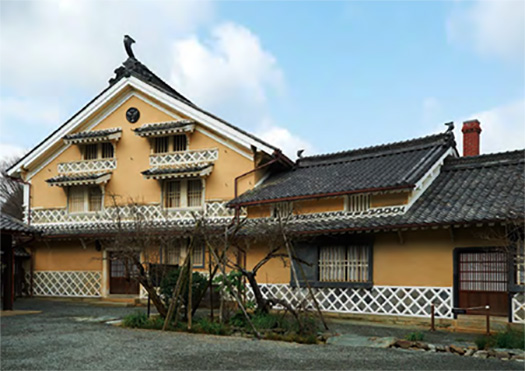
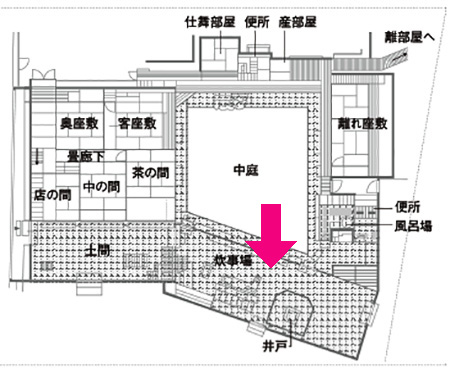
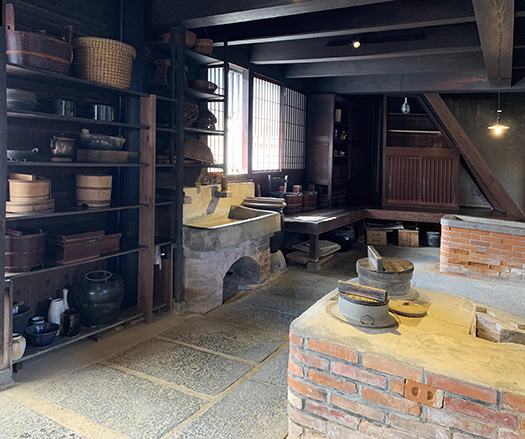
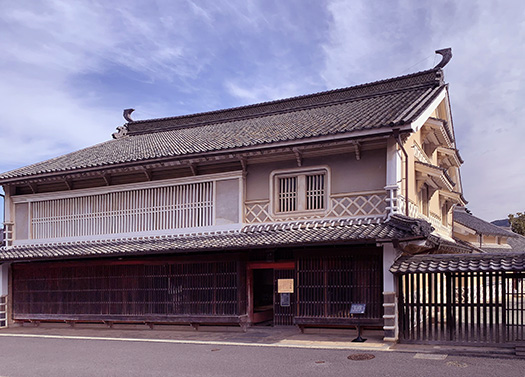
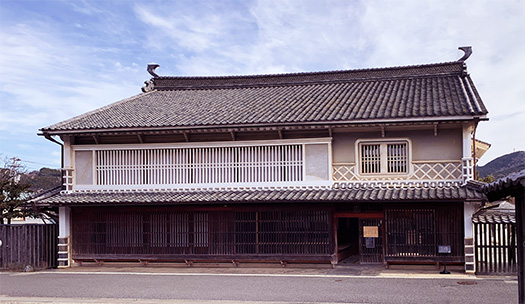
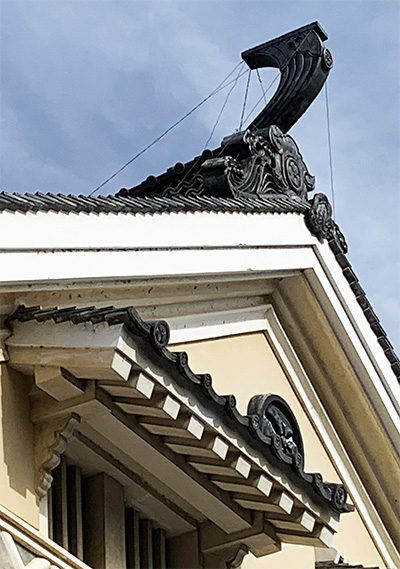
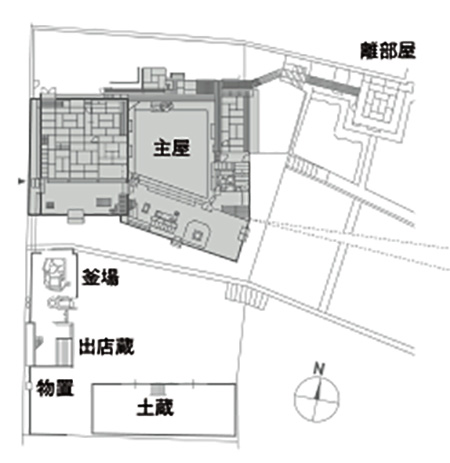
外観写真左側の主屋から右手に接続した棟がこちらの「炊事場」。
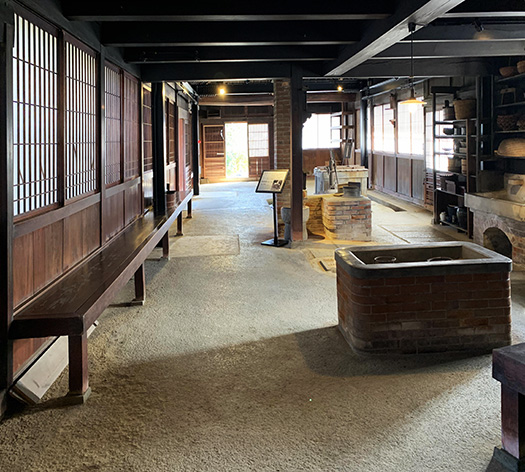
明治時代の内観の様子が非常によく保存されていて、
ひとびとの立ち働く様、活気に満ちた様子が空間に刻印されているかのよう。
日本が世界の市場経済に参加して最初期の活気が感じられる。
江戸期から藩財政を潤してきた木蝋生産があたらに欧米市場を開拓し
その坂の上の雲に向かって漕ぎ出していく日本社会の躍動感が薫る。
そういった人々の労働を癒し、活力を生み出す食空間・炊事場。
わたしにはそうした日本社会の「エンジン部分」のように思える。


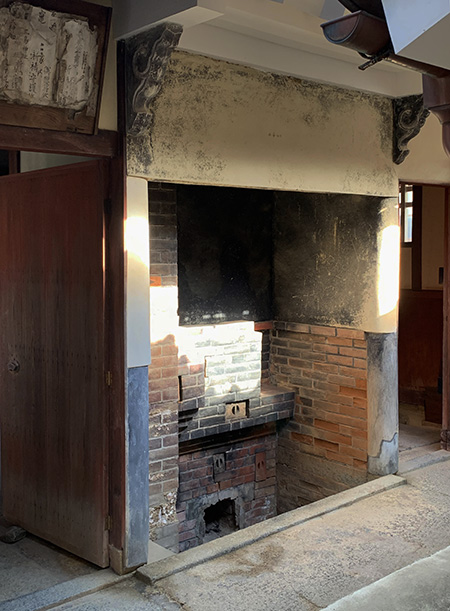
この木蝋生産では原材料のハゼノキに対して火力を加える工程が中心。
窯場のような設備が中核と言えるけれど、
そういった生産設備建築の延長線で、この炊事場でも
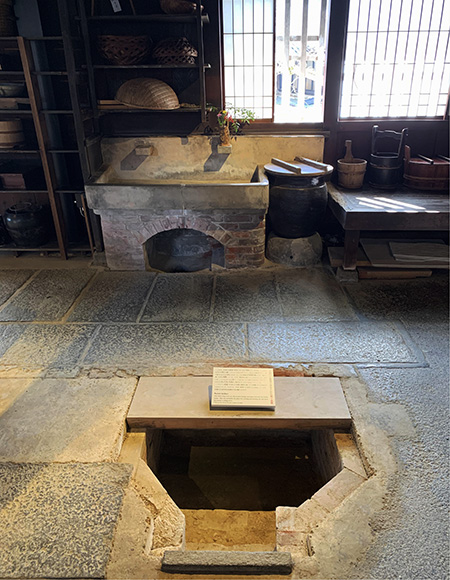
高温に耐えるレンガでの調理火力装置が多く見られる。
しっかりと叩き上げられた土間とそうしたレンガ装置が
たくましく労働者の営為を支えてくれたのでしょう。
約30坪という面積の空間が確保されているけれど、
ある意味、木蝋生産作業にとってセンター的な機能も果たしていたとみえる。
この炊事場棟の2階には女中部屋もあり、
朝早くから夕食作りまで、忙しく立ち働く場所だったことでしょう。
内子の町全体の中でも中枢的な活気に満ちた建築空間であり、
地域が生き延びていく経済活力そのものだったに違いない。
地域の人々にとっても、誇りを感じられる存在であり
そこで働くことが一種のステータスでもあったことが想像される。

それにしても蝋という日本独特の産品に対して
主には化粧品の展着素材としての活用価値があるという
気付き、着眼点はやはり欧米世界との交易が生み出した世界観。
その産業基盤は江戸期の地方各藩ごとの産業振興策が生み出したモノ。
そして欧米世界に対して万博などの機会を通して
貿易拡大に地道に努力してきた先人たちの営為には深く打たれる。
欧米による植民地支配にさらされたアジア圏のなかで
日本が独立を維持して、貿易立国のスタイルを確立できたことは大きい。
こうしたイギリスを中心とした海洋国家・貿易立国の側に立てたことは、
やはり日本にとって運命的だったのだと思う。
今日の自由貿易を基盤とした世界秩序の側にアジアで一番最初に加われたことは、
日本の生存戦略にとって大きなメリットある選択だったといえる。
暴力的な植民地主義を現代ですら振り回す愚かなロシアの現状を見れば
民族の先人たちの志向性の確かさを思わされる。昭和の一時期を除いて・・・。

English version⬇

[Food space that supported one of the leading export industries in the Meiji era ③ Shikoku living space-41]
Japan participates in the Western free trade society of clouds on the slopes and the value of affluence from Asia. A food space that creates labor vitality.・ ・ ・

In the Meiji export product manufacturing industry, the present value of the Kamihoga family is 4.5 billion yen.
It is said that it created about 30 jobs.
Wax-producing craftsmen and maids who support them.
The building connected to the right from the main building on the left side of the exterior photo is this “cooking place”.
The inside view of the Meiji era is very well preserved,
It seems that the space is engraved with a lively appearance, as if people were standing and working.
Japan’s participation in the world market economy makes us feel the earliest vibrancy.
The production of Japan wax, which has moistened the clan’s finances since the Edo period, pioneered the Western market.
The dynamic feeling of Japanese society rowing toward the clouds above the slope is fragrant.
A food space / kitchen that heals the labor of such people and creates vitality.
It seems to me that it is the “engine part” of Japanese society.

The main process of producing this wax is to add heat to the raw material Hazenoki.
It can be said that equipment like a kiln is the core,
As an extension of such production equipment construction, even in this kitchen
There are many cooking-fired appliances made of bricks that can withstand high temperatures.
The dirt floor that was struck up firmly and such a brick device
It must have supported the workers’ activities.
Although the space of about 30 tsubo is secured,
In a sense, it seems that it also played a central function for the wax production work.
There is also a maid’s room on the second floor of this kitchen building,
From early morning to supper making, it would have been a busy place to work.
It is a vibrant architectural space that is central to the entire town of Uchiko.
It must have been the economic vitality of the region to survive.
It ’s a pride for the people in the area.
It can be imagined that working there was also a kind of status.

Even so, for wax, a unique Japanese product
It is said that it is mainly useful as a cosmetics exhibition material.
I noticed that the point of view was the world view created by trade with the Western world.
The industrial base is the product created by the industrial promotion measures of each local clan during the Edo period.
And through opportunities such as the Expo for the Western world
The work of the ancestors who have made steady efforts to expand trade is deeply struck.
In Asia exposed to Western colonial rule
It is great that Japan was able to maintain its independence and establish a style of trading nation.
What we have set up on the side of a maritime nation and a trading nation centered on the United Kingdom is
I think it was fateful for Japan.
The first thing in Asia that joined the side of today’s free trade-based world order was
It can be said that it was a great choice for Japan’s survival strategy.
If you look at the current state of stupid Russia, which wields violent colonialism even today
It seems to be the certainty of the intentionality of the ancestors of the people. Except for one period in the Showa period …

【明治期輸出産品「木蝋」事業者の家② 四国住空間-40】


明治期の海外貿易において木蝋という産業の位置がどういったものであったか、
その概観を捉えることから、残された建築への理解は始まるでしょう。
現地では概要のおはなしは説明員の方から聞いたけれど、
いろいろと周辺事実を探っていくことでリアリティが高まります。
撮影写真と記録の掘り起こしでタイムスリップ型住宅取材が可能になる。
明治期以降の事跡については各種の資料が残っている。

以下、愛媛県史・社会経済3より要旨抜粋。
「木蝋の盛衰」
〜優秀な製品で知られた愛媛の木蝋は明治2年には白蝋100斤(60kg)30円以上、
生蝋100斤25円だったものが、暴落して10円と8-9円台になった。
が、その後海外輸出の途があることがわかり販路拡大に努めた結果、
価格も上昇し白蝋100斤15-6円、生蝋100斤12-3円となった。
愛媛県の木蝋は大阪・神戸の外国商人の手により九州の製品と混同して
中国上海に輸送され、さらに欧米各国へ再輸出された。
内子町の芳我弥三衛は明治26年アメリカ・イリノイ州シカゴ博覧会に出品し
褒賞を受けた。その当時の経営規模は使用者67人、年間産出額150万斤(900トン)、
価格225,000円と記録。また明治33年(1900)パリ博覧会でも銅メダルを受賞。
明治7年の『府県物産表』によると木蝋275,312貫余、115,343円余。
晒蝋36,050斤、3,271円、蝋燭167,294斤、17,171円余、
鬢付油68,419斤、995円36銭となっていた。
明治20年の『愛媛県農商工統計年報』では木蝋製造家が全県で369戸余。
喜多郡109、西宇和郡74、北宇和郡43、東宇和郡39、下浮穴郡34と続く。
喜多郡では生蝋が119,335貫(47.5トン)、晒蝋126,076六貫(472トン)、
代価260,298円と他郡を圧倒している。県全体では423,817円であった。
製造戸数は明治35年の生蝋332、晒蝋80、計412戸がピークで以後は漸減。
生蝋業者は櫨実の産に近い喜多郡と宇和四郡中心で晒蝋業者は内子町に集中。
明治28年に第一回全国木蝋業者大会が大洲町で、第二回が内子町で開かれた。〜


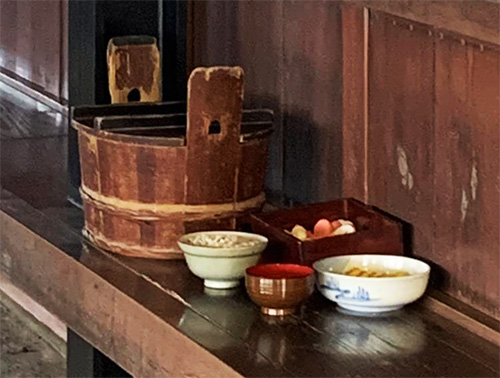
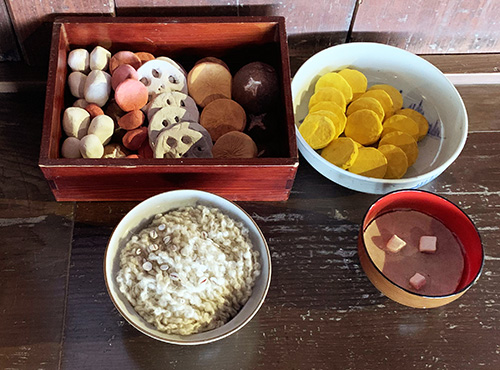
<写真は働いていた人たちの社員食堂献立見本>

ちなみに物価変動はあるが概算推計で明治時代の「1円」は現代の2万円。
明治30年頃、小学校の教員やお巡りさんの初任給は月に8~9円。
庶民にとって当時の1円は、現在の2万円ぐらいの重みがあったといわれる。
そのモノサシでこの家の主人・芳我弥三衛さんの事業規模を現在換算すれば、
明治26年段階で45億円程度と推計される。
海外市場を狙っての宣伝活動としてパリ万博などを利用するなど、
明治期のビジネスマンとして優秀な活動を行っていた。
「喜多郡出身の池田貫兵衛・河内寅二郎らは神戸に喜多組という貿易商社を設立」
と、上の要旨記録からも「臥龍山荘」オーナー河内寅二郎の名も出てくる。
愛媛県内での事業者たちの活動の実像がみえてくる。

English version⬇

[Meiji period export product “Japan wax” business operator’s house ② Shikoku living space-40]
Photographing at a visiting house and verification of records for interviews. Time-slip type housing coverage, today we are exploring the scale of business and money.・ ・ ・

What was the position of the industry of Japan wax in foreign trade during the Meiji era?
Understanding the remaining architecture will begin by capturing that overview.
I heard the outline of the story from the explanation staff at the site,
Reality will be enhanced by exploring the surrounding facts in various ways.
Time-slip type housing coverage will be possible by digging up photographs and records.
Various materials remain about the traces after the Meiji era.

The following is an excerpt from Ehime Prefecture History / Socio-Economy 3.
“The rise and fall of Japan wax”
~ Ehime Japan wax, known for its excellent products, was 100 loaves of white wax (60 kg) for 30 yen or more in the 2nd year of the Meiji era.
The price of 100 loaves of raw wax was 25 yen, but it plummeted to 10 yen and 8-9 yen.
However, as a result of trying to expand the sales channel after finding out that there was a way to export overseas,
The price also increased to 15-6 yen for 100 loaves of white wax and 12-3 yen for 100 loaves of raw wax.
Japan wax in Ehime prefecture is confused with Kyushu products by foreign merchants in Osaka and Kobe.
It was shipped to Shanghai, China, and then re-exported to Western countries.
Yasami Higa from Uchiko-cho, Kita-gun exhibited at the Chicago World’s Columbian Exposition in Illinois, USA in 1897.
He was rewarded. At that time, the management scale was 67 users, and the annual output was 1.5 million loaves (900 tons).
The price is recorded as 225,000 yen. He also won a bronze medal at the 1900 Paris Exposition.
According to the “Prefectural Product List” of the 7th year of the Meiji era, Japan wax is 275,312 pieces and 115,343 yen.
Sarashi wax 36,050 loaves, 3,271 yen, candles 167,294 loaves, over 17,171 yen,
It was 68,419 loaves of oil with sardines and 995.36 yen.
According to the “Ehime Prefecture Agricultural Commerce and Industry Statistics Annual Report” in 1890, there were more than 369 Japan wax manufacturers in all prefectures.
It is followed by Kita-gun 109, Nishiuwa-gun 74, Kitauwa-gun 43, Higashiuwa-gun 39, and Shimoukena-gun 34.
In Kita-gun, raw wax is 119,335 pieces (47.5 tons), bleached wax is 126,076 pieces (472 tons),
The price is 260,298 yen, which overwhelms other counties. It was 423,817 yen for the entire prefecture.
The number of units manufactured peaked at 332 raw wax and 80 bleached wax in 1902, and has been gradually decreasing since then.
The raw wax traders are mainly in Kita-gun and Uwa-shi-gun, which are close to the production of Hashimi, and the bleached wax traders are concentrated in Uchiko-cho, Kita-gun.
The first national wax trader competition was held in Ozu-cho in 1887, and the second was held in Uchiko-cho. ~

By the way, although there are price fluctuations, it is estimated that “1 yen” in the Meiji era is 20,000 yen in modern times.
Around 1890, the starting salary of elementary school teachers and policemen is 8-9 yen a month.
It is said that 1 yen at that time was about 20,000 yen for the common people.
If the business scale of the owner of this house, Yasami Haga, is currently converted with that monosashi,
It is estimated to be about 4.5 billion yen in the 26th year of the Meiji era.
For example, using the Paris Expo as a promotional activity targeting overseas markets, etc.
He was an excellent activity as a businessman in the Meiji era.
“Kita-gun Ikeda Nukibei, Kawauchi Torajiro and others established a trading company called Kita-gumi in Kobe.”
And, from the above summary record, the name of “Garyu Sanso” owner Torajiro Kawauchi also comes out.
You can see the real image of the activities of businesses in Ehime prefecture.

【江戸明治期の「木蝋」生産豪商の家① 四国住空間-39】


さて四国の住空間探訪ですが、わたし的にクライマックスの住宅がこちら。
内子という愛媛県内の山間の宿場町で江戸期には旧大洲藩領。
藩の殖産興業策としてローソクや化粧品原料となる「木蝋」生産に注力した。
先般紹介した「臥龍山荘」もこの産業貿易で財を成した人物の終の住み処。
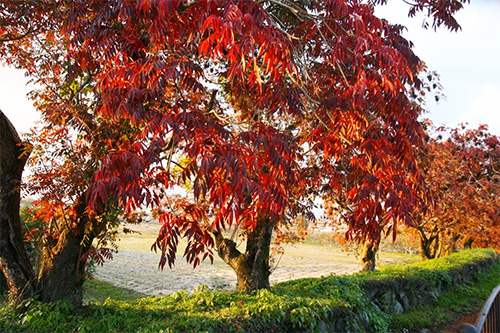
この木蝋の生産、原材料の樹種「ハゼの木」の地域最大の産地がこの内子。
そこに「上芳我家住宅」として生産工房と家系の豪邸が残されている。
公開住宅ですが、あまりにも興味深く説明の方をほぼ独占取材(笑)。
おかげで同行のカミさんとはぐれてしまった(泣)。
タイムスリップ型の住宅取材の醍醐味をたっぷりと堪能させてもらった。

そもそも「木蝋」という生産物自体、よくわからなかった(笑)。
Wikipediaなどの記述では以下のようになっています。
〜木蝋(もくろう・Japan wax)とは生蝋(きろう)とも呼ばれウルシ科の
ハゼノキ(Japanese wax tree)やウルシの果実を蒸してから、
果肉や種子に含まれる融点の高い脂肪を圧搾するなどして抽出した広義の蝋。
化学的には狭義の蝋であるワックスエステルではなく、
中性脂肪(パルミチン酸、ステアリン酸、オレイン酸)を主成分とする。
搾ってからそのまま冷却して固めたものを「生蝋」(きろう)と呼ぶ。
櫨(ハゼノキ)の種類により生蝋の緑色の程度や風合いが異なる。〜

●蝋燭、特に和ろうそく(Japanese candle)の仕上げには生蝋をさらに
天日漂白した白蝋を用いる。かつては蝋燭だけでなく、びんつけ、艶出し剤、
膏薬などの医薬品や化粧品の原料として幅広く使われた。
このため商品作物として明治時代まで西日本各地で盛んに栽培されていた。
●愛媛県南予の内子では木蝋生産が盛んで江戸期・大洲藩6万石の経済を支える
大きな柱の一つであった。明治期には海外にも盛んに輸出された。
第二次世界大戦以前は日本国外にも通用する輸出品としても重要視され、
1940年には重要輸出品取締法に基づく重要輸出品目に加えられている。
●お相撲さんの髷を結う鬢付け油には木蝋が欠かせない。激しいぶつかり合いで、
その他の油では髪がバラバラになってしまう。木蝋はジャパンワックスと呼ばれ
ヨーロッパ、アメリカにずっと輸出が続いている。
ポマード、チック整髪料、クレヨン、色鉛筆、食品、医薬品、口紅など化粧品。
トナー、インクリボン、CDなどOA機器にも使わる。また天然材料であることから
シックハウス症候群対策としても良いコーティング剤が開発されている。〜

こちらの上芳我家住宅はこうした木蝋産業の記念碑的遺構。
北海道の住宅関係人としては、さまざまな意味で引き込まれる。
ということで、何回かに分けて住宅探訪ブログであります。

English version⬇

[House of a wealthy merchant who produced “Japan wax” in the Edo period ① Shikoku living space-39]
Japanese original raw materials for cosmetics such as candle raw materials and shaving oil. It was in the limelight in Europe and the United States. Architectural exploration that is the afterglow of the industry.・ ・ ・

Now, let’s explore the living space of Shikoku, but here is the climax house for me.
Uchiko is a mountain post town in Ehime prefecture, and was the territory of the former Ozu domain during the Edo period.
As a measure to promote the clan’s breeding industry, we focused on the production of candles and “Japan wax,” which is a raw material for cosmetics.
The recently introduced “Garyu Sanso” is also the final residence of the person who made a fortune in this industrial trade.
This Uchiko is the largest producer of this wax and the raw material “Haze no Ki”.
The production workshop and the mansion of the family are left there as the “Kamihoga family residence”.
It’s a public house, but it’s so interesting that the explanation is almost exclusive (laughs).
Thanks to that, I got separated from Kami-san who accompanied me (crying).
I was able to fully enjoy the real thrill of time-slip type housing coverage.

In the first place, I didn’t really understand the product itself called “Japan wax” (laughs).
In the description such as Wikipedia, it is as follows.
~ Japan wax is also called raw wax and belongs to the family of lacquer tree.
After steaming Hazenoki (Japanese wax tree) and lacquer fruit
Wax in a broad sense extracted by squeezing fat with a high melting point contained in pulp and seeds.
It is not a wax ester, which is a wax in a narrow sense chemically.
The main component is triglyceride (palmitic acid, stearic acid, oleic acid).
The wax that has been squeezed and then cooled and hardened is called “raw wax”.
The degree and texture of the green color of raw wax varies depending on the type of hazenoki. ~
● Add more wax to finish candles, especially Japanese candles.
Use white wax bleached in the sun. In the past, not only candles, but also bottles, polishes,
Widely used as a raw material for pharmaceuticals such as plasters and cosmetics.
For this reason, it was actively cultivated in various parts of western Japan until the Meiji era as a commercial crop.
● In Uchiko, Nanyo, Ehime Prefecture, Japan wax production is flourishing and supports the economy of 60,000 stones of the Ozu clan during the Edo period.
It was one of the big pillars. During the Meiji era, it was actively exported overseas.
Before World War II, it was regarded as important as an export product that can be used outside Japan.
In 1940, it was added to the important export items under the Important Export Control Law.
● Japan wax is indispensable for the bintsuke oil that connects sumo wrestlers. In a fierce collision,
Other oils will cause your hair to fall apart. Japan wax is called Japan wax
Exports continue to Europe and the United States.
Cosmetics such as pomade, tic hair styling products, crayons, colored pencils, foods, medicines, and lipsticks.
It is also used for OA equipment such as toner, ink ribbons, and CDs. Also, because it is a natural material
A good coating agent has been developed as a countermeasure against sick building syndrome. ~

This Kamihoga family house is a monumental remains of the Japan wax industry.
As a person involved in housing in Hokkaido, I am drawn in many ways.
So, it is a housing exploration blog divided into several times.

【ヒグマと人間社会の平和な距離感確保】


わたしどもの住所は札幌市西区山の手なのですが、
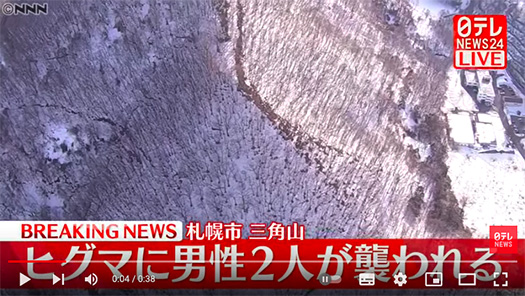
同じ住所名でヒグマの巣穴が発見されて男性2人が被害を受けた。
報道ではこの巣穴には体長40cmレベルの子熊が2頭残され
人に危害を加えた母熊は、周辺山林に逃亡中だという。
母性本能を考えれば子熊のところに戻るべく帰巣を狙っているでしょう。
いまは監視体制が取られているので母熊がどう判断するか、
非常にきわどい段階なのだということ。
すっかりその名前も知られたのですが、場所は「三角山」の上の方。
わが家からだいたい1.5km程度の距離であります。
昨年から札幌市内でヒグマの出没が相次いで、
市民生活もいろいろに影響を受けていたのですが、
ことしは雪融けとともにさっそく非常事態的な状況です。
昨日朝、散歩に外に出た途端に上空を数台のヘリが爆音をとどろかせ
三角山方向から緊急的な車両移動の様子がビンビン伝わってくる。
一種異様な状況に包まれておりました。
そういった事実はWEB、SNSなどで情報を得ていたので
散歩コースは山側を避けて行動しておりましたが、
小1時間経過後、帰宅しても三角山方向からの騒音は一向に止みませんでした。

昨年来、予防的なヒグマ駆除の社会的決定が一向になかったことで、
ことしの春以降、ヒグマ危機が常態化する悪い予感がありましたが
どうもこういう予感は現実化してきたと思います。
人間を守れない社会システムならば自己矛盾ではないか。
ヒグマ個体数の増加とともに札幌市内で同様な巣穴は多数あるのでしょう。
「ヒグマとの共生」というのはコトバは美しいかも知れないけれど、
普通の日本人社会とは異なる危険の受容を強制されるに等しい。
この地域に住んでいる人間は、つねにビクビクして生きることになる。
人間社会では交通事故もたしかに危険因子ではあるけれど、
その対価としては移動交通の利便性ということがある。
ヒグマとの共生という危険因子受容の対価はなにかと考えると
動物愛護の自己満足感ということになるだろうか。
しかしこの動物はかなり危険で遭遇すれば被害確率はマックス。
誰が考えても、ヒグマ生息圏と人間社会をしっかり分離させ距離を保つしかない。
オオカミは北海道でかつて自然に生息していたけれど、
この距離確保がムリで絶滅させるしかなかったのでしょう。
ヒグマとはその個体数を人間側でコントロールするべく駆除し
人間社会との安全距離を確保するしかないと思われるのですが、さて・・・。

English version⬇

[Securing a peaceful sense of distance between brown bears and human society]
At the same time as Russia’s invasion of neighboring areas, Hokkaido is in the midst of a brown bear distress crisis in Sapporo. Property tax is taken and it is in danger of being left unattended.・ ・ ・

Our address is in Yamanote, Nishi-ku, Sapporo.
A brown bear burrow was found with the same address and two men were damaged.
According to media reports, two cubs with a body length of 40 cm are left in this burrow.
The mother bear, which has harmed humans, is said to be fleeing to the surrounding forests.
Given her maternal instinct, she would be aiming to return home to return to the bear.
Now that the monitoring system is in place, how does the mother bear judge?
It’s a very critical stage.
The name was well known, but the place is above “Sankakuyama”.
It is about 1.5km from my house.
Since last year, brown bears have been appearing one after another in Sapporo city.
Citizen’s life was also influenced in various ways,
This is an emergency situation as the snow melts.
As soon as I went out for a walk yesterday morning, several helicopters roared over the sky.
From the direction of Mt. Sankaku, you can see the urgent movement of the vehicle.
I was surrounded by a strange situation.
I got information about such facts on the WEB, SNS, etc.
The walk course was acting avoiding the mountain side,
Even after returning home after a small hour, the noise from the direction of Mt. Sankaku did not stop at all.

Since last year, there has been no social decision to prevent brown bears.
After this spring, I had a bad feeling that the brown bear crisis would become normal.
I think this kind of premonition has come true.
Isn’t it self-contradiction if it is a social system that cannot protect humans?
As the number of brown bears increases, there may be many similar burrows in Sapporo.
“Coexistence with brown bears” may be beautiful, but
It is equivalent to being forced to accept a danger different from that of ordinary Japanese society.
Humans living in this area will always be thrilled to live.
Traffic accidents are certainly a risk factor in human society,
The price is the convenience of mobile transportation.
Considering what the price of accepting the risk factor of coexistence with brown bears is
Is it a sense of self-satisfaction for animal welfare?
However, this animal is quite dangerous and if encountered, the damage probability is max.
No matter who thinks, there is no choice but to keep the brown bear habitat and human society apart.
Wolves used to live naturally in Hokkaido,
This distance securing would have been the only way to extinct it.
Brown bears are exterminated to control their population on the human side.
It seems that there is no choice but to secure a safe distance from human society, but …

【東讃岐山村農家に見る原風景の暮らし④ 四国住空間-38】


日本人と住宅、という関わりについて
その原型のようなものを深く気付かされるような典型例。
床面積11坪、「ウサギ小屋」と欧米社会から言われるような家だけれど、
だからこそ見えてくる日本人家族意識の原風景。
写真上は家族の寝室空間だけれど夫婦と子どもたちが1室で
重なり合うように、お互いの肌身のぬくもりを感じながら
温め合って生き抜いてきた様子が立ち上っている。
江戸期までの日本社会は権力の争闘によって庶民の暮らしが規定された。
四国の平野部はがんじがらめの利権関係で固められ、
庶民は徐々に山間の土地に新開地を目指していたのでしょう。
次男3男の層には必然的な生き方選択だっただろう。
傾斜地をすこしづつ開墾して日々努力し続ける日常。
時間を惜しんで農作業に勤しむ暮らし。
日中の傾斜地開墾作業・少ない農地での農作業に忙殺され続け
仕上げの脱穀作業などは夜間に土間で続けられていた。
そういう暮らしの中ではたしかに「個人の時間」などは考えられなかった。
住宅を考えるときにそういった「余暇」時間の過ごし方を考慮する
寸分の余地もなかったということなのでしょう。
正直な構造の素地あらわしは、日々のメンテナンスも可能にする。
いかにも「人間の暮らし」という実相が伝わってくる。

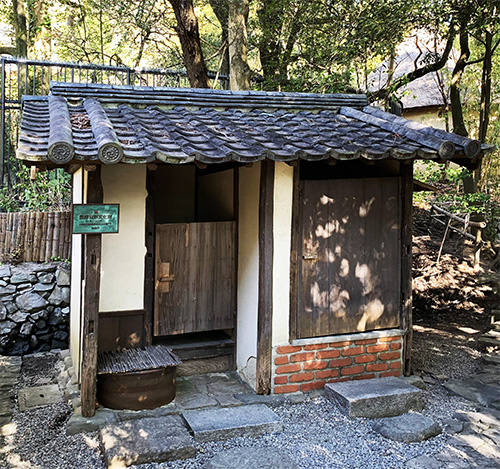
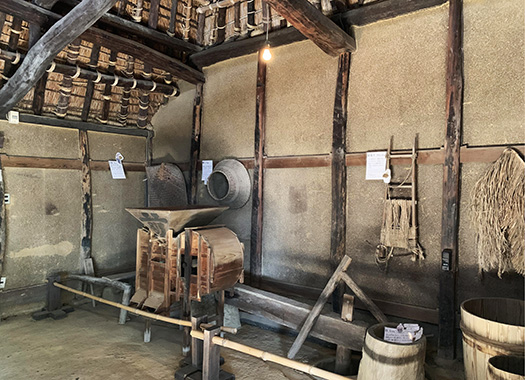
この居住棟とは別に隣接してトイレ・湯殿とおぼしき棟がある。


この棟の説明は現地でも示されていなかったし、
その後WEBなどで確認してもなかなか発見することができません。
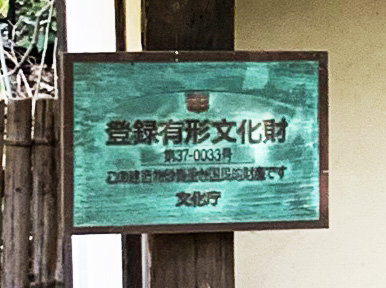
しかし間違いなく「登録有形文化財 第37-0033」という表示はある。
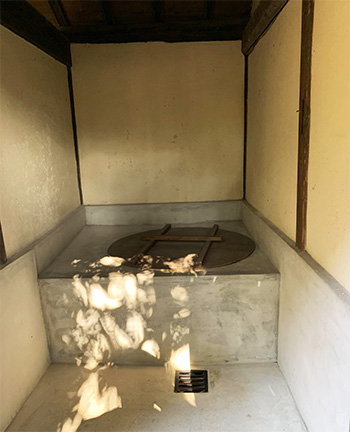
内部の写真を見ると浴槽が作られている。
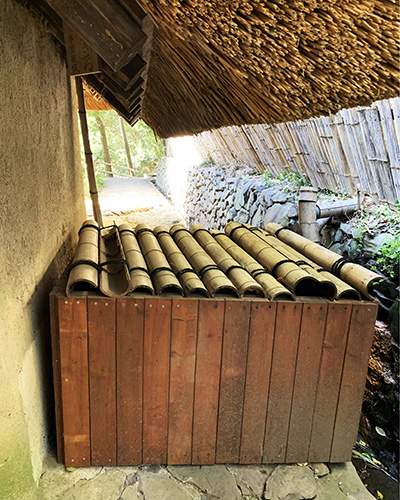
居住棟の台所隣には水場のごらんのようにあるので、
家風呂を造作していたのだろうと思われます。
山間住宅なのでバイオマス、薪の採取は容易だっただろうから
自給自足型の暮らしとしては必要性の高い生活必需装置だったのでしょう。
モルタルでの仕上げのようなので明治期以降に造作されたようです。

現代住宅はこのような生活必需装置のすべてを屋内に入れていますが
その前の時代までは屋外空間に置く方が一般的。
むしろ、山村農家の場合などでは室内空間というのが
建物周辺の野外空間も含まれた考え方だったように思われる。
緑の「塀」があり、隣居との距離が十分すぎるほどあれば、
こういった拡張された「家空間認識」のほうが常識的感覚。
むしろ現代住宅はそういうスペースもすべて室内に仕舞い込むしかない、
きわめて閉鎖的な生活感覚なのだとも気付かされる。
たいへん多くの理解を得られた住宅でした、ありがとう。

English version⬇

[Living in the original scenery seen by farmers in Higashi Sanukiyama Village ④ Shikoku Living Space-38]
Although it can be said that it is open, there was also an external living function that modern houses take into the room. Uchi and Soto, a fusion home.・ ・ ・

About the relationship between Japanese people and housing
A typical example that makes you deeply aware of something like that prototype.
It has a floor area of ​​11 tsubo and is said to be a “rabbit hut” by Western societies.
That is why the original scenery of Japanese family consciousness can be seen.
The photo shows the family bedroom space, but the couple and children are in one room.
Feeling the warmth of each other’s skin so that they overlap
It seems that they have survived by warming each other.
Until the Edo period, the lives of ordinary people were regulated by the struggle for power in Japanese society.
The plains of Shikoku were consolidated by a stubborn concession.
The common people would have been gradually aiming for new land in the mountainous land.
It would have been an inevitable way of life choice for the second son and the third son.
Everyday we continue to work hard every day by clearing slopes little by little.
Living to spare time and work in farming.
Continued to be overwhelmed by daytime slope clearing work and farm work on a small amount of farmland
Finishing threshing work was continued in the soil at night.
In such a life, I couldn’t think of “individual time”.
Consider how to spend such “leisure” time when thinking about housing
Perhaps there was no room for it.
The honest structure of the foundation makes daily maintenance possible.
The reality of “human life” is really transmitted.

In addition to this residential building, there is a toilet / Yuden and a building that seems to be adjacent.

The explanation of this building was not shown in the field,
After that, even if you check it on the WEB etc., you can not find it easily.
However, there is definitely a display saying “Registered Tangible Cultural Property No. 37-0033”.
Looking at the photo inside, a bathtub is made.
Next to the kitchen in the residence building, it looks like a water place, so
It seems that he was building a home bath.
Because it is a mountainous house, it would have been easy to collect biomass and firewood.
It must have been a daily necessities device that is highly necessary for a self-sufficient lifestyle.
It seems to have been made after the Meiji era because it seems to be finished with mortar.

Modern homes have all of these necessities indoors,
Until the time before that, it was more common to put it in an outdoor space.
Rather, in the case of mountain village farmers, the indoor space is
It seems that the idea included the outdoor space around the building.
If you have a green “fence” and the distance to your neighbor is more than enough,
This kind of expanded “house space recognition” is a more common sense.
Rather, modern houses have no choice but to store all such spaces indoors.
It is also noticed that it is a very closed sense of life.
It was a house that got a lot of understanding, thank you.

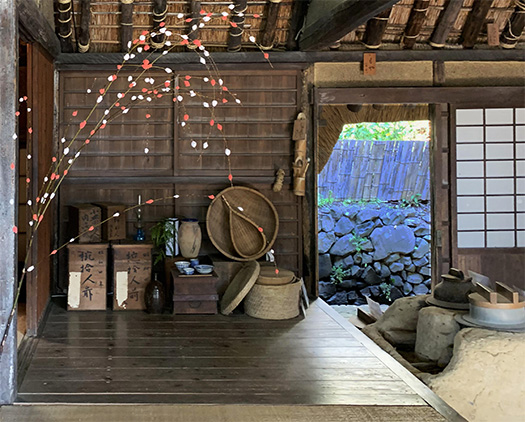
【いのちを繋ぐおくどさん・東讃岐山村農家③ 四国住空間-37】


「最小限住宅」というコンセプトは戦後の復興期に
東大の建築工学をリードした池辺陽氏が打ち出したコンセプト。
今日では難波和彦氏の「箱の家」シリーズがその志向を継承していると思う。
復興期の家づくりにあたって指針を示していた。
この東讃岐の山村農家を見ていると、そのコンセプトが明瞭に感じられる。
時代相を考えれば床面積5−6坪で家族7−8人程度という
食べる・寝るという人間の最小限必要床面積はむしろ清々しい。
折からの世界的な建材コストアップのなかでコンパクトハウス志向が
好むと好まざるとに関わらず進行するだろうという状況の中で
示唆的だとも思えてならない。

床面積は「豊かさ」を表現するモノサシではあるだろう。
しかしこと「家族の情愛」という意味合いでは狭い床面積は
必然的に家族の「距離感」を狭め愛を強めていたことも事実だろうと思う。
どうしても個人的に過ごしたい時間は、この農家にとってイエ意識の
延長空間である周辺緑地や茅葺きが降り落ちている軒下空間などが
その「用」を足していただろうと思われる。

ある住宅人から「家にはさめざめと泣ける空間も必要」と聞いたことがある。
自分の住体験に重ねて激しく同意した記憶がある。
そういった空間は必ずしも各個人の「個室」である必要はない。
それこそ少雨気候のこの讃岐ならば、茅葺きの軒下から星空を見上げる空間で
そういう個人の情念が必要とする空間性は確保されていただろう。
そんなふうに考えて行くと、自然環境との相関の人間環境として
決して不足ばかりの住空間とは思えないのです。

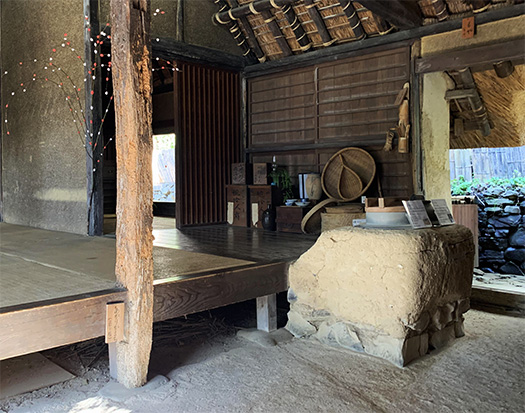
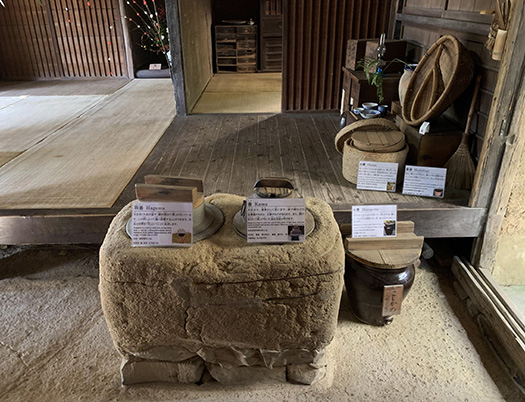
そういう家の中で、いかにも威厳に満ちたたたずまいを見せる「おくどさん」。
家の土間と板敷き空間との接点でいのちを支える食の火力装置。


その横には調理用のザルや水場、水甕などのワンセットも装置されている。
食器類も引き戸付きの収納に納められている。
最小限ではあっても、必要性要件は十分に満たしている。
火力の位置としても土間と板の間の接点というのは合理的。
よくみるとおくどさんの足下など高さ調整も考えられているし、
床下空間も開放されていて、そこは収納装置としても機能していただろう。
「おくどさん」とさん付けで火力装置のことを呼ぶ深層心理には
いのちへの尊崇、感謝の念が込められているように思われる。
ファッション性としては不格好な形であり素材もいかにも土着的。
しかし、だからこそ「さん」と言いたくなるのだろう。
火力が付けられると家中が煙に包まれた。
ゴホゴホと咳き込みながら、また煙で目が痛くなっただろうけれど、
力強くいのちを繋いでいく繰り返される営為として、
イエへの愛着を重ねていく日常の時間だったに違いない。
床面積11坪の最小限住宅へのリスペクトの念が湧き上がってくる。

English version⬇

[Okudo-san connecting life, farmhouse in Higashi Sanuki Yamamura ③ Shikoku living space-37]
When I lit it, the whole house was covered with smoke. Gohogoho Coughing smoke hurts my eyes, but the reverence that calls for firepower with “san”.・ ・ ・

The concept of “minimal housing” was introduced during the postwar reconstruction period.
A concept launched by Mr. Kiyoshi Ikebe, who led the architectural engineering of the University of Tokyo.
Today, I think Kazuhiko Namba’s “Hako no Ie” series inherits that orientation.
He provided guidelines for building a house during the reconstruction period.
Looking at this mountain village farmhouse in Higashi Sanuki, the concept is clearly felt.
Considering the times, the floor area is 5-6 tsubo and the family is about 7-8 people.
The minimum floor space required for humans to eat and sleep is rather refreshing.
Amid rising global building material costs from time to time, the trend toward compact houses
In a situation where it will progress whether you like it or not
It shouldn’t seem suggestive.

The floor area will be a monosashi that expresses “richness”.
However, in the sense of “family affection”, the small floor area is
I think it is also true that the family’s “sense of distance” was inevitably narrowed and their love was strengthened.
The time I really want to spend personally is a consciousness for this farmer
The surrounding green space, which is an extension space, and the space under the eaves where thatched roofs are falling down, etc.
It seems that he would have added that “use”.
I was once told by a housekeeper that “a house needs a space where you can wake up and cry.”
I have a strong memory of agreeing with my own living experience.
Such a space does not necessarily have to be an individual “private room”.
In this Sanuki, which has a light rain climate, you can look up at the starry sky from under the thatched eaves.
The spatiality required by such individual feelings would have been secured.
Thinking like that, as a human environment that correlates with the natural environment.
I don’t think it’s a living space that is just lacking.

“Okudo-san” shows a dignified appearance in such a house.
A food-fired power device that supports life at the point of contact between the dirt floor of a house and the wooden space.

Next to it, there is also a set of colanders for cooking, a water place, and a water bowl.
Tableware is also stored in a storage with sliding doors.
The requirements are fully met, albeit at a minimum.
As for the position of the thermal power, the point of contact between the soil and the board is rational.
If you look closely, you can adjust the height of Okudo’s feet, etc.
The underfloor space was also open, and it would have functioned as a storage device.
For the deep psychology of calling a thermal power device with “Okudo-san”
It seems to be filled with respect and gratitude for life.
The shape is awkward for fashion and the material is very indigenous.
However, that is why I want to say “san”.
When the firepower was turned on, the whole house was covered with smoke.
While coughing and coughing, the smoke would have hurt my eyes again,
As a repetitive activity that connects life powerfully
It must have been a daily time for me to continue to attach myself to Ye.
There is a sense of respect for a minimalist house with a floor area of ​​11 tsubo.

【日本的イエ意識・東讃岐山村農家② 四国住空間探訪-36】


今日では住宅の床面積はかなり拡大確保されてきている。
「ウサギ小屋」と対欧米社会との比較で言われていた日本家屋だけれど
経済発展の結果、家屋数と床面積は飛躍的に増え、
また「核家族」化と資本主義的な経済活動拠点の都市集中、
大都市や首都圏などの近郊に「郊外型」住宅専用地域が作られ社会が一変した。
きっとそれ以前の社会とは、縄文と弥生くらいの時代差があるのかも。
それ以前の社会のきわめて一般的な住空間。
十一坪の屋内空間。
半分は農作業用の土間に取られてしまう。
生産活動は昼間だけではなく、この土間空間で可能な時間の限り続き、
5-6坪の共有の床上空間で家族全員の束の間の休息がある。
生産関与可能の年齢範囲の家族は全員、農事に関わる。
家族は通常3世代同居するのが一般的なので、
最低でも5-6人の共同生活。子どもの数によっては2ケタであったかも。
それこそ夫婦生活も不自由そのものだったに違いない。
現代の暮らしようから類推することは難しいけれど、
ほんの百数十年前にはこういう暮らしようが一般的だった。
現代住宅とは「床面積」概念自体に大きな相違があったように思える。
たぶん田畑や家周辺の外部空間も含めてイエ空間であり
住居というのは壁の有る無しを問わない拡大された概念だったのだろう。

だから家に帰ってもそのまま農事をこなす土間空間が主体であって
常にその生産活動と連携するような動線になっていたのだと思う。
当然、人間の寿命も短く、世代更新も繰り返されてきた。
そういう極少空間でありながら、正月には精一杯の飾り付けをして
ハレの空間演出も凝らして暮らしに結節点を作っていた。
その根拠は先祖との意識距離が極めて近いものであり
イエ空間に先祖が居続けるという認識が社会共有のものだったのだろう。
現代人は個人主義と資本主義の発展によって
このようなイエ空間からはかなり乖離してきたのだけれど、
わたしたちの共有のルーツとしてこのようなイエ意識が強く存在する。
朝星夕星を、茅葺き屋根の上に見上げて束の間の休息を得る。

個人主義のスペースはほぼない住空間だけれど、
しかしこういった住宅構造では必然的に家族同士の情愛は細やかであり
強固なイエ意識は人間社会の共有基盤として厳然と存在した。
家族仲が良くない、互いに争うということはもっとも恥とされたという。
人間の「倫理規範」のようなものは、たぶんタイムラグが存在する。
暮らし方が大転換しても、意識の基底には暮らし方の常識は根強く残る。
日本人的な根底的規範の家族意識はさて永続するだろうか?

English version⬇

[Japanese-style consciousness, Higashi Sanuki Yamamura farmhouse ② Shikoku living space exploration-36]
Is the transition from Edo to the present age a major shift from Jomon to Yayoi? Life ethics and morals, however, do not move easily. What’s the future?・ ・ ・

Today, the floor area of ​​houses has been considerably expanded and secured.
It’s a Japanese house that was said to be a comparison between “rabbit hut” and Western society.
As a result of economic development, the number of houses and floor area have increased dramatically.
In addition, the “nuclear family” and the concentration of capitalist economic activity bases in cities,
A “suburban” residential area was created in the suburbs of big cities and metropolitan areas, and society changed completely.
Perhaps there is a time difference between Jomon and Yayoi with the society before that.
A very common living space in the society before that.
An indoor space of 11 tsubo.
Half of it is taken up in the soil for agricultural work.
Production activities continue not only in the daytime, but as long as possible in this soil space,
There is a brief rest for the whole family in the shared floor space of 5-6 tsubo.
All families in the age range that can be involved in production are involved in farming.
Family members usually live together for three generations, so
A minimum of 5-6 people living together. It may have been double digits depending on the number of children.
That must have been the inconvenience of married couple life.
It’s difficult to infer from the modern way of life,
Only a hundred and several decades ago, it was common to live like this.
It seems that there was a big difference in the concept of “floor area” itself from modern houses.
Maybe it’s a ye space including the fields and the exterior space around the house.
Dwelling would have been an expanded concept with or without walls.

Therefore, even if you go home, the main space is the soil space where you can do farming as it is.
I think that the flow line was always linked to the production activities.
Naturally, human life is short, and generational updates have been repeated.
Even though it is such a tiny space, I will do my best to decorate it on New Year’s Day.
The space production of Halle was also elaborately made into a nodal point in daily life.
The rationale is that the distance of consciousness with the ancestors is extremely close.
The recognition that ancestors will continue to live in the Ye space may have been shared by society.
Modern people are by the development of individualism and capitalism
It’s been quite different from this kind of space,
There is a strong sense of yea as our shared roots.
Look up at Asahi and Yusei on the thatched roof for a brief rest.

It’s a living space with almost no individualistic space,
However, in such a housing structure, the affection between families is inevitably delicate.
A strong sense of yea existed strictly as a shared foundation of human society.
It was said that it was the most shameful to have a bad family relationship and to fight each other.
Something like human “ethical norms” probably has a time lag.
Even if the way of life changes drastically, the common sense of the way of life remains at the base of consciousness.
Will the family consciousness of the underlying Japanese norms be permanent?

【東讃岐「ぐるり八間」山村民家① 四国住空間探訪-35】


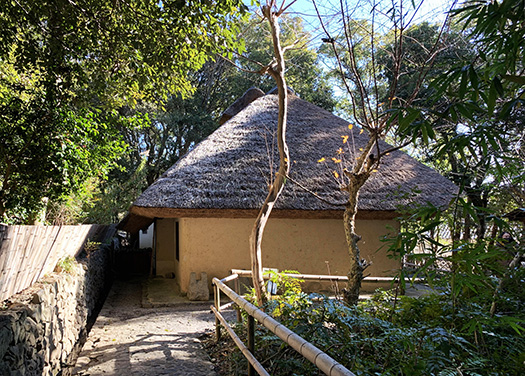
いまから200年以上前の東讃岐の平均的な山村農家。
寄棟造・茅葺きの11坪というコンパクト住宅です。
「周囲〜ぐるり〜八間」と一般的に呼ばれた庶民の家という。
一般呼称の「ぐるり八間」というのはやや自虐的な愛称のように響く。
「ウチは〜ほどのちっちゃな家だから(笑)」みたいな名付けか。
3間四方の基本骨格9坪に下屋で2坪分取り込んだ建て方か。
多少の平面的凹凸があって11坪という面積だけれど
いかにも日本的な合理主義の所産のような間取り。
必要最小限の床面積の空間にくらしのすべての要素を満たす住宅。
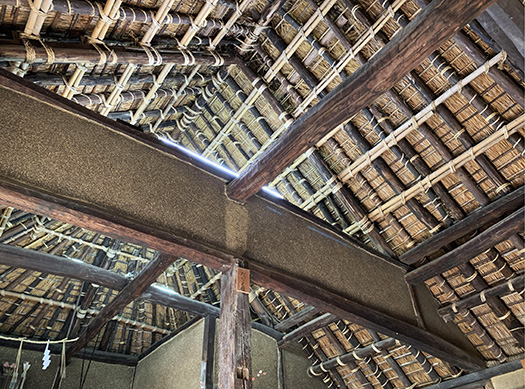
下屋部分にまで茅葺き屋根が葺き下ろされている。
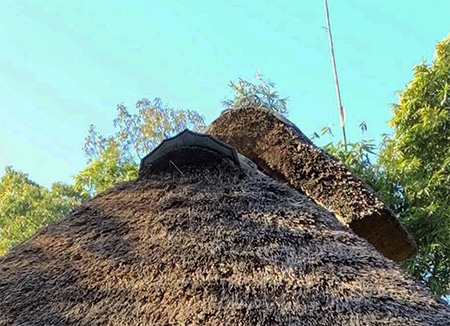
屋根の棟部分に「抑え」として雁ぶり〜がんぶり〜瓦。
また棟中央には同じ茅葺きの「煙出し」が設けてある。
香川県指定有形文化財として四国村に移築保存されているけれど、
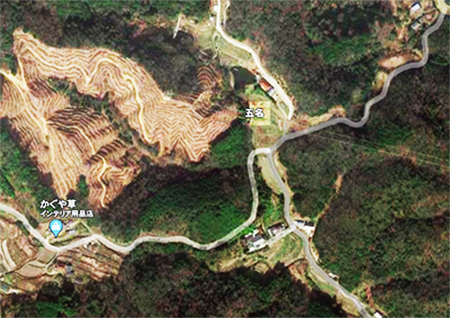
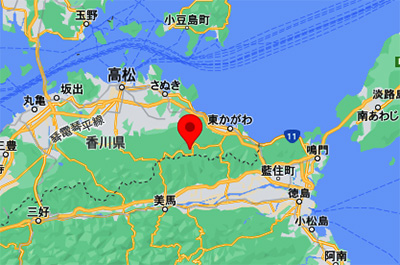
移築前は、香川県大川郡白鳥町五名1840という地番で
(現在は東かがわ市)写真のようなGoogle Map。


四国は平野部が少なく、山林を切り開いて農地化させた地形が多い。
地形写真を見るとそのような典型的山村の農家のようです。
屋根の形状がその暮らし方を表現しているかのようで、
つつましく勤勉に生活する価値感が匂い立っている。
いかにも日本人の原風景的な住まいのありようではないかと思われた。
こういう住宅をしっかり保存されている四国村の生活文化記録者に
たしかな住宅選択眼を感じさせられた。
歴史的に名を残した人物の住宅も貴重な「消息」を伝えてくれるけれど
一方で名も無い庶民の家々には民俗そのものが凝縮される。
古民家でも庄屋階層などの上農の家ばかりではなく庶民の家は
その明瞭な暮らしの証言性で胸に迫ってくるものがある。


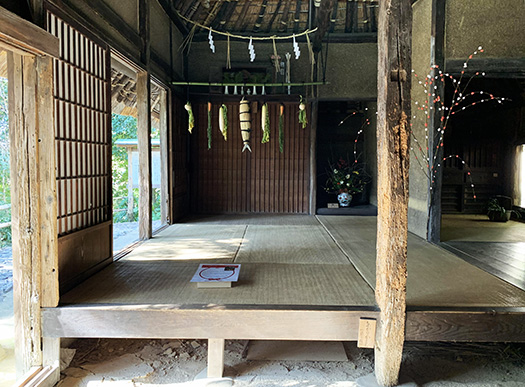
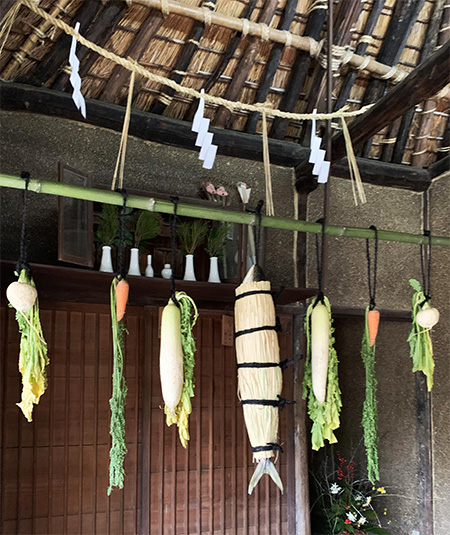
こちらの写真は「懸け魚」といわれる地域の正月飾り。
まんなかの魚は「アラ」とおぼしいのだけれど、
大事に衣装を着させられていてなんともかわいらしい。
左右には大根、ニンジン、カブが整然と吊り下げられている。
山村での暮らしで、魚は非日常的な「ご馳走」として
振り売りの手で各戸に訪問販売されて、このように特別な正月縁起ものに
昇格して飾り立てられたものでしょう。
このように吊しておいて正月期間の経過後、
これらを鍋料理に仕立てて一家で食べたように思えます。
正月の間は家の先祖霊や神さまに供えて、その後
家族がそれらを囲んで食事するという風景が見えてくる。
日常と非日常、ハレとケの暮らしぶりが
日本人としての生活規範そのものを証言しているのでしょう。

English version⬇

[Higashi Sanuki “Gururi Hachima” mountain village Minka ① Shikoku Living Space Exploration-35]
A compact house in the Edo period desperate to live. Did you open up slopes in the mountains and steadily farm, and did you inspire “hanging fish” during the New Year?・ ・ ・

The average mountain village farmer in Higashi Sanuki more than 200 years ago.
It is a compact house with a hipped roof and thatched roof of 11 tsubo.
It is called the house of the common people, which is generally called “Around-Gururi-Hachima”.
The general name “Gururi Hachima” sounds like a self-deprecating nickname.
Is it a name like “I’m such a small house (laughs)”?
Is it a construction method that incorporates 2 tsubo in a lower house with a basic skeleton of 9 tsubo on all sides of 3 ken?
There are some flat irregularities and the area is 11 tsubo.
The floor plan is like the product of Japanese rationalism.
A house that meets all the elements of living in a space with the minimum floor area required.
A thatched roof is laid down to the lower part.
Goose-buri-ganburi-roof tiles as a “suppression” on the roof ridge.
In addition, the same thatched “smoke” is installed in the center of the building.
Although it was relocated and preserved in Shikoku Village as a tangible cultural property designated by Kagawa Prefecture,
Before the relocation, the lot number was 1840, Gomyo, Shirotori-cho, Okawa-gun, Kagawa Prefecture.
(Currently Higashikagawa City) Google Map like the picture.

Shikoku has few plains, and there are many terrains that have been carved out of forests and turned into agricultural land.
Looking at the topographical photographs, it looks like a typical mountain village farmhouse.
The shape of the roof seems to express the way of life,
The value of living humble and diligent is scented.
It seemed like the original Japanese dwelling.
To the life culture recorder of Shikoku village where such a house is well preserved
It made me feel a certain eye for choosing a house.
The house of a person who has left a name in history also conveys a valuable “news”.
On the other hand, the folklore itself is condensed in the houses of the unnamed ordinary people.
Even in old folk houses, not only the upper farming houses such as the Shoya level but also the common people’s houses
There is something that comes to my heart with the clear testimony of life.

This picture is a New Year’s decoration in the area called “hanging fish”.
The fish in the middle seems to be “ara”, but
It’s so cute that she’s dressed carefully.
Radishes, carrots and turnips are neatly hung on the left and right.
Living in a mountain village, fish is an extraordinary “feast”
Door-to-door sales are made to each house by hand, making it a special New Year’s lucky charm.
It must have been promoted and decorated.
After hanging like this and after the New Year period has passed,
It seems that these were made into hot pot dishes and ate at home.
Offer to the ancestral spirits and gods of the house during the New Year, and then
You can see the scenery of the family surrounding them and eating.
Everyday and extraordinary, the way of life of hare and ke
Perhaps it is a testimony of the norms of life as a Japanese.