本文へジャンプ

【北海道らしい夏の味覚「漬物メロン」にメロメロ】


 北海道もこのところ、まるで盛夏の気候が続いております。連日ほぼ30度ほどの気温でさすがに日中は屋外での散歩を避け、早朝時間に済ませるようになってきているので、さらに早起きに。
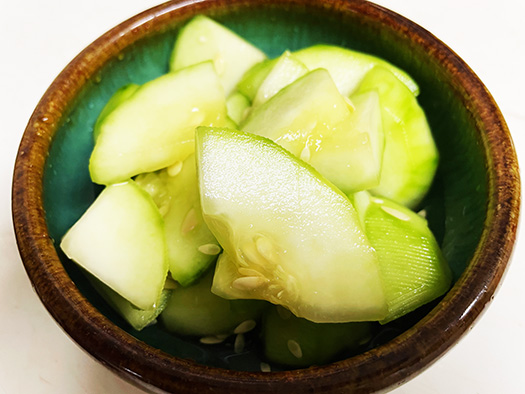
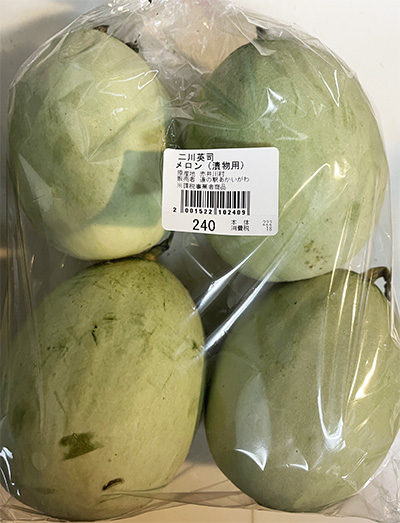
 で、食品では写真のような「漬物用メロン」が店頭に並ぶようになって来た。これは「ウリ」という方が正しいのではないかと思うのですが、最近ではメロンが一般名化しているので、こういった呼び名になっている。本当はウリの一種でしょう。これが甘くなる品種だと「カンロ」とされたりする。わたしは、この「漬物メロン」を適当に1口大に切ってジッパー袋に入れて、軽く塩振りした上で浅漬けのモトで漬け込む。
 この出来上がりの浅漬けが無上の好物。
 どんな主食とも合うのですが、なかなかなのが蕎麦や冷や麦との食べ合わせ。
 暑い日の夕方、麺類のつけ麺を食べながら、この浅漬けを食べる快感は、まことに「夏」を感じさせてくれる。単純な性格をしているので、昨晩など、このまま涅槃に到達しているかと思えてくる(笑)。
 値段もタテの長さで12-3cmのヤツが4個入っていて240円でした。200円くらいの場合もある。写真のできあがり漬物だと1個の1/8程度なので、この盛り付けで原材料費は7-8円程度ということになる。最近はなんでも値上がり傾向が続いていますが、こういうウレシイ夏野菜も出回り始めてきていて、まことに救世主。
 たのしく夏を乗り切っていく頼もしい助っ人が大登場であります。

●お知らせ
拙書「作家と住空間」幻冬舎から電子書籍で発刊
お求めはAmazonで。
https://amzn.asia/d/eUiv9yO
English version⬇

[Pickled melon, a typical Hokkaido summer delicacy]
A reliable savior for the common people appeared with the arrival of summer. The raw material cost is 7-8 yen for this picture. It’s truly a no-brainer! ……

 Hokkaido has recently been experiencing the weather as if it were midsummer. The temperature has been almost 30 degrees Celsius every day, and as expected, people are avoiding outdoor walks during the daytime and getting up even earlier to finish them in the early morning hours.
 In the food industry, “pickle melons” like the one in the photo have started to appear on store shelves. I think it would be more correct to call them “cucumbers,” but since melon has become a common name these days, this is what they are called. In truth, it is probably a type of cucumber. If this is a variety that is sweeter, it is sometimes called “kanro. I cut the melons into bite-sized pieces, put them in a zipper bag, sprinkle them lightly with salt, and pickle them using the “asazuke” method.
 The resulting pickled melon is my favorite.
 It goes well with any staple food, but what is not so easy is to eat it with soba noodles or cold barley.
 On a hot evening, the pleasure of eating this asazuke while eating tsukemen (noodles) really makes me feel “summer”. Being of a simple nature, last night I felt as if I had reached nirvana (laugh).
 The price was 240 yen for 4 pieces of 12-3 cm in length, sometimes 200 yen. The finished pickles in the photo are about 1/8 of one piece, so the cost of raw materials for this serving would be about 7-8 yen. Recently, the price of everything has been on the rise, but these summer vegetables are starting to appear on the market, and they are a real lifesaver.
 We have a reliable helper who will help us get through the summer happily.

I have published my book “Writers and Living Space” in e-book format from Gentosha at
.
Please visit Amazon to purchase the e-book.

【神魂(かもす)神社参観で出雲古代史に惑溺・・・】


 神話の里、という印象がどんどん加速されてくる山陰の旅のブログシリーズですが、自分で体感したままに撮影した写真群を整理整頓して行くことが、そのまま探究の開始になってしまいます。そういうなかで出会った水木しげるの「古代出雲」を読み進めることで、古事記・日本書紀についての山陰の側・出雲の系統からの独自の解釈が見えてきて、深い整合性を感じさせられています。
 同書の奥書に「古代出雲歴史博物館専門学芸員」の岡宏三氏の文章があって、いかにも水木しげるのこの地に寄せていた「思い」が深く伝わってくる。以下要旨。〜(水木の生家は境水道に面して建てられているけれど)幼少年期を過ごした境港は文字通り鳥取と島根の境界に位置する港で、境水道を挟んで向かいの東西に山(島根半島)の裏側に当たる諸喰という「のんのんばあ」の故郷の小さな集落に連れて行かれたとき、水木少年ははじめて訪れたにも関わらず、前世にも訪れていたとしか考えられない思いを抱いたという。とすれば、島根とははるか生まれる以前からの故郷なのだろう。〜
 「前世にも訪れていたとしか考えられない」という思いはわかりやすく伝わってくる。兵庫県福崎出身の日本民俗学の祖・柳田國男の茨城県での神秘体験の事例でもわかるように、感受性の鋭いタイプの人にとっては、こうした神秘体験と従来語られてきた事柄が、実は最先端的な「量子科学」的な領域であると解明されてきているのだと思う。
 そしてそこから、不整合な古事記・日本書紀を再度、読み込んでみれば別の解釈体系も生まれてくるように思える。「国譲り」という古代最大の政争について、それを「神話」として扱いたいヤマト王権側の思惑。そしてさらにそれを「国史」として中国の中華思想国家に対して「なるべく深遠なるもの」として表現して提出したという経緯もまた察せられてくる。
 そんなテーマ性が浮かび上がってきて、古代の列島で繰り広げられたであろうドラマに、さまざまな思いが去来してなりません。他でもない北海道神宮にも、祭神としてこのような古代由来の神々が鎮座されているのですから、絵空事でも済まされない。

●お知らせ
拙書「作家と住空間」幻冬舎から電子書籍で発刊
お求めはAmazonで。
https://amzn.asia/d/eUiv9yO

English version⬇

Kamosu Shrine visit to Izumo’s ancient history is a dazzling experience…]
The appearance and atmosphere of this truly ancient shrine is still in the veins of the young territory of Hokkaido. …

 The impression of the San’in as a mythical village is becoming more and more accelerated in this blog series on my travels in the San’in region, and organizing the group of photos I took as I experienced it myself became the beginning of my exploration. In reading “Ancient Izumo” by Shigeru Mizuki, I found a unique interpretation of the Kojiki and Nihonshoki from the San’in side and the Izumo lineage, and I am deeply impressed by the consistency of the book.
 In the back of the same book, there is a text by Mr. Kozo Oka, “Specialized Curator of the Museum of Ancient Izumo History,” which conveys how deeply Mizuki Shigeru’s “feelings” toward this place were. The following is a summary. 〜When Mizuki was taken to Morokure, a small village on the back side of the mountain (Shimane Peninsula) across the Sakai Waterway, he was told that it was the first time he had ever visited there. Although this was his first visit to the village, he felt as if he had visited there in a previous life. If so, Shimane must have been his hometown long before he was born. ~
The thought “I can only think that I had visited there in a previous life” is easily understood. As the case of mystical experiences in Ibaraki Prefecture by Kunio Yanagida, the founder of Japanese folklore who was born in Fukuzaki, Hyogo Prefecture, shows, I believe that for those with keen sensitivities, what has traditionally been described as mystical experiences are in fact being clarified as cutting edge “quantum science.
 And from there, if we re-read the inconsistent Kojiki and Nihonshoki, a different system of interpretation seems to emerge. The Yamato kingdom wants to treat the greatest ancient political conflict, the “handing over of the kingdom,” as a “myth. Furthermore, the history of the Yamato kingdom’s submission of the “national history” to the Chinese nation of Chinese thought, expressed as “something as profound as possible,” can also be inferred.
 Such themes emerge, and one cannot help but be filled with various thoughts about the drama that must have unfolded in the ancient archipelago. It cannot be a mere pictorial story, since the Hokkaido Jingu Shrine, of all places, also has gods of ancient origin as its deities of worship.

●Notice
My book “The Writer and the Living Space” is published by Gentosha as an e-book.
Please visit Amazon for more information.

【古代出雲はアジア大陸との移動交流最前線か?】


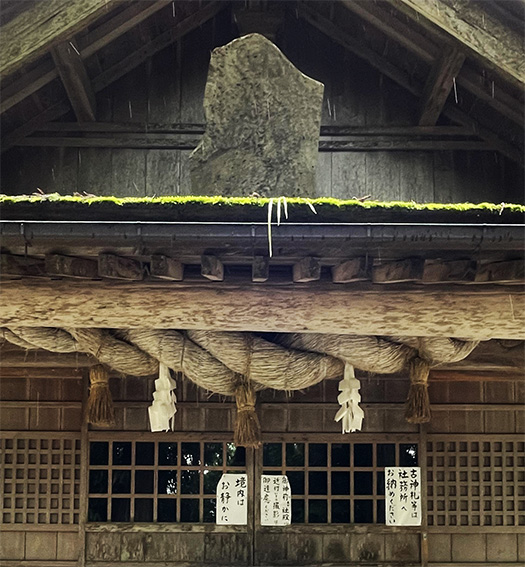
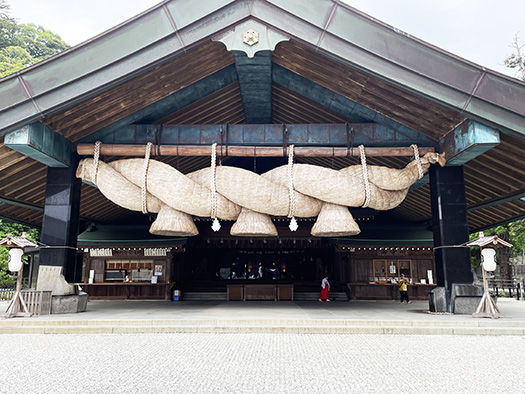
 昨日は神魂(かもす)神社での人的な情報交流について書きましたが、やはり古格な大社造り建築の本殿を見ていても、この出雲を中心とする山陰日本海側地域の歴史層の深さを叩き付けられる思い。写真は拝殿正面からのショットですが、注連縄を見ていると、やはり「出雲大社系」のように思える。って言ってもわたしには注連縄文化の解析は不分明なのですが、下の出雲大社・神楽殿の「大注連縄」と基本的なデザインは共通していると見定められる。なので神魂神社は出雲大社系ではないかと思っていたのですが、拝礼の仕方などは基本的に伊勢神宮系。このあたりは神々の世界のことなので不明。
 そういう出雲周辺、山陰地域の文化現象について、現代世界でいちばんの「語り部」として水木しげるの活動があったように思います。だんだんわたしのなかで、今回の山陰の旅経験が熟成してきている。こういう「楽しみ」は奥深くてどんどんのめり込んできますね(笑)。ということで水木しげるの作品を当たっていたら「古代出雲」という2012年刊行の角川書店からのマンガ作品と出会った。
 さすがにこの地域の文化伝統を体現したかれらしく、素晴らしい探究成果がわかりやすく展開されていた。そのなかに非常に強い印象を受けさせられたのが以下の記述。(要旨抜粋)
 〜紀元前5世紀頃にはすでに満州・北朝鮮東岸から南下して隠岐の島➡出雲という海上ルートがあった。一方、対馬を経て北九州に至る海上ルートは、当時はまだその速い流れに対馬海流を乗りきれるだけの舟がなく、従って出雲は日本列島の「正面玄関」であり、もっとも早く大陸文化とつながっていた。〜
 というのですね。どうも古代史にとってかなり重要なポイントについて、地元人らしい探究姿勢の発露のように感銘を受けた。邪馬台国論争のように北九州地域と畿内地域が古代史の中心と思い込んでいたわたしのような人間には強く響いてきた。
 どうしても距離的な遠近差で、北九州地域を「日本の玄関口」と刷り込まれてきたけれど、そこに「海流」という要素を提示されて、日本海を舞台とした船での移動交流の歴史解明、という視点には深く納得感をもたらされた次第。深く直撃された気分でありました。

●お知らせ
拙書「作家と住空間」幻冬舎から電子書籍で発刊
お求めはAmazonで。
https://amzn.asia/d/eUiv9yO

English version⬇

Is Ancient Izumo the Frontline of Migratory Exchange with the Asian Continent?
Searching through the ancient history of the San’in region and considering the influence of ocean currents, there is some validity to the theory that Izumo was a gateway for the acceptance of continental cultures. A shock to stereotypes. …….

 Yesterday, I wrote about human information exchange at Kamosu Shrine, but looking at the main shrine, which is still an old-style Taisha-zukuri architecture, I was struck by the depth of the historical layers of this San’in Sea of Japan side region centering on Izumo. The photo is a shot from the front of the worship hall, and the shimenawa (sacred straw ropes) seem to be of the Izumo-taisha type. Although I am not well versed in the analysis of shimenawa culture, I can conclude that the basic design of the shimenawa is the same as that of the “Dai-shimenawa” in the Kaguraden (Kaguraden) of Izumo-taisha Shrine, below. Therefore, I had thought that the Kamikami Shrine was of the Izumo-taisha type, but the way of worship is basically of the Ise Shrine type. This area is unknown because it is the world of the gods.
 I think that Shigeru Mizuki was the best “storyteller” in the modern world about the cultural phenomena of the Izumo and San’in regions. My experience of this trip to the San’in region is gradually maturing in my mind. This kind of “fun” is profound and I am getting more and more absorbed in it (laughs). While browsing through Shigeru Mizuki’s works, I came across a manga work titled “Ancient Izumo,” published in 2012 by Kadokawa Shoten.
 As one would expect from someone who embodies the cultural traditions of this region, the manga is a wonderful exploration of the region, and the results are easy to understand. Among them, the following description made a very strong impression on me. (Abstract excerpt)
~There was already a maritime route from Manchuria and the east coast of North Korea to Oki Island and Izumo in the 5th century BC. On the other hand, the maritime route via Tsushima to Kitakyushu did not yet have enough boats to ride the Tsushima Current with its fast current at that time, and thus Izumo was the “front door” of the Japanese archipelago and the earliest connection to continental culture. ~ I was impressed by the local people’s attitude of inquiry on this point, which is quite important for ancient history. It strongly resonated with people like me, who had assumed that the Kitakyushu and Kinai regions were the center of ancient history, as in the “Yamataikoku” controversy.
 I have always been under the impression that the Kitakyushu area was the “gateway to Japan” due to the distance between the two areas, but the presentation of the “ocean current” as a factor in this was deeply satisfying from the perspective of clarifying the history of exchange by boat movement on the Sea of Japan. I felt like I was deeply struck by this.

Notice
My book “Writers and Residential Space” is published by Gentosha as an e-book.
Please visit Amazon for more information.

【最古の国宝大社造 「神魂(かもす)神社」と結縁譚】


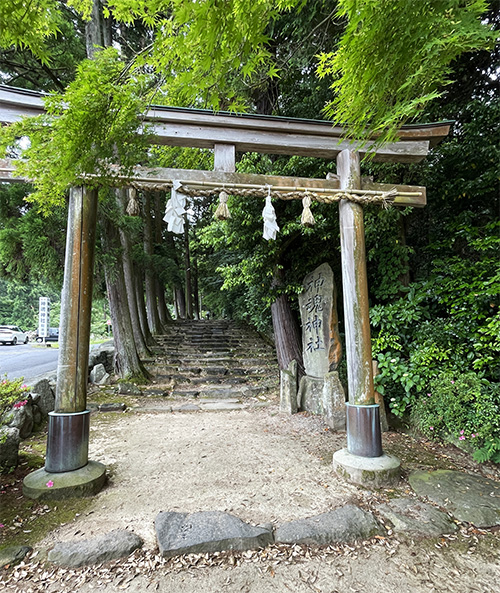
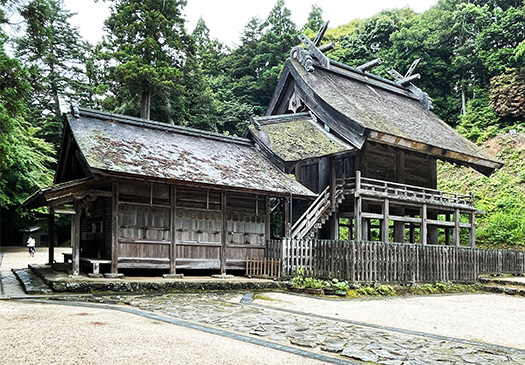
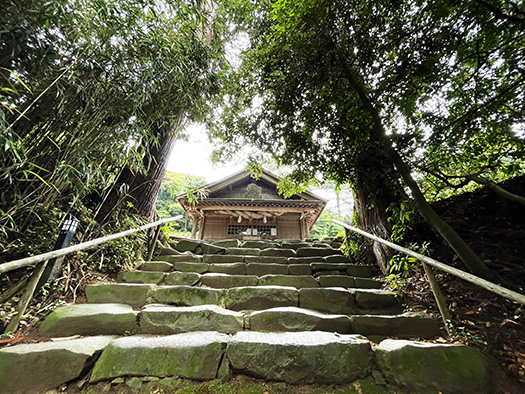
奈良県橿原在住の知人の日本画家から、山陰への旅に当たってかれの出身地の古社として紹介されていたのがこの神社。出雲大社の殿舎はなんども火災にあっているけれど、この神魂神社の殿舎は古格の出雲大社建築の工法を最古のカタチで伝承してきている。心御柱古材に「正平元年丙戌十一月日」の墨書銘があり柱古材は1346年当時の柱と考えられる。現存建築としては築679年経過ということになりたしかに最古級。そうしたことから建築として日本最古の大社造りであり国宝に指定。また、石段には自然石が使われていて「男坂」として結構な急勾配。なんとか登り切った。
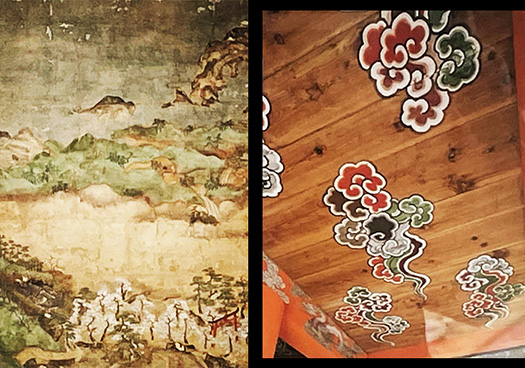
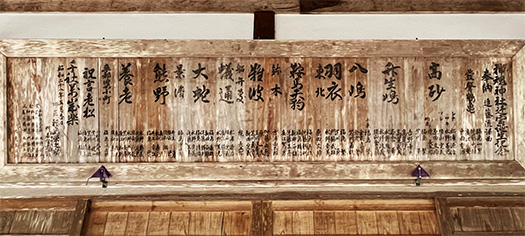
 出雲国造府が立地していたことが推定されその鎮守として存在してきた。祭神は伊弉諾・伊弉冉。神社の「案内」には以下記述(要約)。〜当社は出雲国造の太祖「天穂日命(アメノホヒノミコト)」がこの地で創建。以来その子孫が出雲国造として奉仕された。本殿は3間四方で高さ4丈。床が高く柱が太く宇豆柱が壁から著しく張り出しているなど大社造の古式に則っていて昭和27年3月に国宝指定された。本殿内には狩野派の画家・土佐光起(江戸期1617-1691年)の壁画9面と天井画に五色の瑞雲が彩られている。〜
 さらに、天穂日命が高天原から天下る際に乗って来られたと伝わる古い「鉄窯」も祀られていることも興味深い。山陰地域はその山並みに豊かな鉱物資源が存在し、古代において鉄の生産が国産ではできなかったためにさかんに朝鮮半島国家との政戦があったけれど、そうした戦いが停止したことの裏側にはこの地で本格的に国内生産がはじまったことが大きい。神話と鉄器のクロスは刺激的。

 ここでは神前結婚式のあと「神楽」まで奉納される。という古格ぶりに敬虔に参拝していたらこの神社で50年前に結婚式を挙げたご夫婦と出会って談笑。この古格な神社での結婚費用を50年前、若気の至りで極少金額(あえて金額は公表しません)の奉納で済ませていたという白状。おお、そんだけかよ、と釣られて大爆笑。しかしそういうご縁に感謝し続け、現在お住まいの滋賀県からクルマで足繁く通われているのだそう。神縁・ご加護か。

●お知らせ
拙書「作家と住空間」幻冬舎から電子書籍で発刊
お求めはAmazonで。
https://amzn.asia/d/eUiv9yO

English version⬇

Kamosu Shrine, the oldest national treasure and a tale of marriage.
An ancient shrine where kagura (traditional Shinto music and dance) is dedicated. A couple got married with a very small amount of money and have been worshipping at the shrine for more than 50 years out of gratitude. A true divine favor. The shrine is a Shinto shrine.

A Japanese-style painter acquaintance of mine who lives in Kashihara, Nara Prefecture, introduced this shrine to me as an ancient shrine in his hometown on a trip to the San-in region. Although the Izumo-taisha Shrine building has been damaged by fire many times, this Kamikami Shrine has inherited the oldest construction method of the ancient Izumo-taisha building. The old wood of the central pillar has an inscription in ink, “Shohei-gen-nen hei inu juichigatsu” (11th day of the 11th month of the 1st year of the Shohei-gen era), and it is thought that the old pillar was built in 1346. This means that the oldest surviving building in Japan is indeed 679 years old. The oldest existing building in Japan, the Taisha-zukuri is designated as a National Treasure. The stone steps are made of natural stone and are quite steep as a “men’s slope. I managed to climb it.
 It is estimated that the Izumo Provincial Government was once located here, and the shrine has existed as a Shinto shrine. The deities are Izanagi and Izanami. The shrine’s “Guide” describes the shrine as follows (in summary) 〜The shrine was founded here by Amenohohinomikoto, the founder of the Izumo-no-kunizo clan. Since then, his descendants have served as Izumo kokuzo. The main hall is 3 ken (3 ken) square and 4 meters high. It was designated as a National Treasure in March 1952 because of its high floor, thick pillars, and Uzumabashira, which protrudes significantly from the wall, in accordance with the ancient Taisha-zukuri style. The main hall is decorated with nine mural paintings by Tosa Mitsuki (Edo period, 1617-1691), a painter of the Kano school, and the ceiling paintings are decorated with five-colored auspicious clouds. ~
It is also interesting to note that an old “iron kiln” is also enshrined here, which is said to have been ridden by Amahoninomikoto on his descent from the high heaven. The San’in region has abundant mineral resources in its mountain ranges, and in ancient times, because iron could not be produced domestically, there were many political battles with the Korean peninsula, but the cessation of such battles was largely due to the start of full-scale domestic production here. The cross between mythology and ironware is exciting.

 The shrine even dedicates a kagura (traditional Japanese music and dance) performance after the wedding ceremony. While I was respectfully worshipping at this ancient shrine, I met a couple who had married 50 years ago at this shrine and had a chat with them. They confessed that they had paid for their wedding at this ancient shrine with a very small amount of money (we dare not disclose the amount) in a youthful indiscretion 50 years ago. Oh, that’s all there is to it? But he continues to be grateful for that kind of connection, and he commutes to the shrine frequently by car from Shiga Prefecture, where he currently lives. A divine fate or blessing?

Notice
My book “The Writer and the Living Space” is published as an e-book by Gentosha.
Please visit Amazon for more information.

【あとの祭りの「ベタ踏み坂」〜鳥取県・江島大橋】


 わたしの年代、1940-50年代生まれの人間は、いわゆる「戦後世代」でクルマ革命・テレビ革命のただ中で生きてきた最初期年代に属します。とくにわたしの場合、自転車乗り練習を始めた時期には札幌有数の大動脈幹線道路に面した家だったので、練習のときに猛速のクルマに危うく轢かれ死ぬ寸前の体験をした。その様子を目撃した父親が、わたしに「自転車乗り練習の厳禁」を厳命することになった。
 親の言いつけをよく守る素直な幼少年は厳しい言いつけをよく順守した。命令撤回は結局、父の死までなかった。
 で、移動手段としての自転車利用が叶わなかったので、逆に18歳の免許取得可能年齢到達の途端に免許を取得した。そうすると今度は仕返しで「移動の自由」を最高レベルで享受する人生に向かった。
 社会人になる直前、入社決定していた広告会社の入社研修を兼ねて当時の創業家社長からのご指名で、四国一周ドライバーとして活躍したりした(笑)。まぁ誰でも運転は出来る時代なのですが自分でも運転には自信もあった。社長が乗り込むと同時に、ぴしゃりと「安全運転最優先で行きます(キッパリ)」とやや逆に命令調で宣言していた。
 社長は「おお、その考えに完全同意だ(笑)」と言ってくれていた。
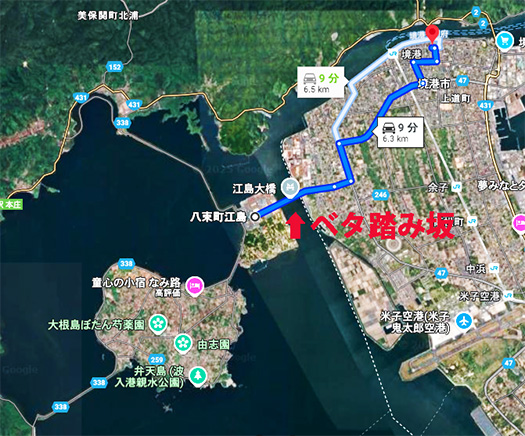
 まぁそんなクルマ運転人生を送ってきて、いまでも東京〜兵庫県姫路往復などのロングドライブも平気でこなしているような人生行脚。そんなわたしなので、今回の関西〜山陰の旅も当然レンタカーでの自由ドライブ。で、カミさんと話していて興味深かったスポットがこの「ベタ踏み坂」〜鳥取県・江島大橋。
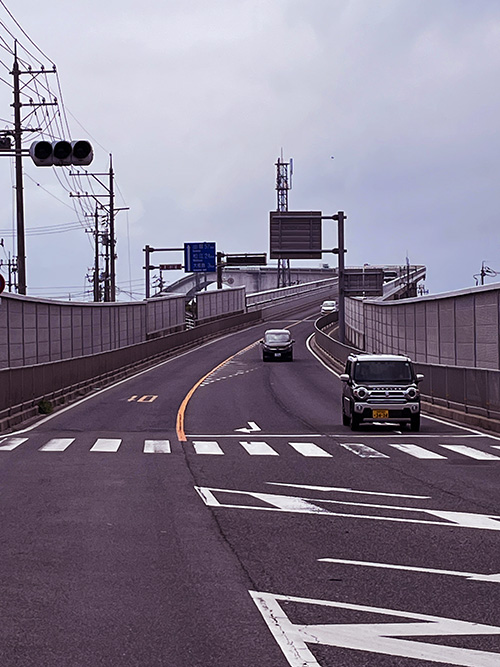
 まぁアクセルをずっと踏み続ける過酷な坂道橋、という意味と理解。ぜひ「映え」の写真でも撮影できたら、と考えて出発。しかしいかんせん勝手のわからないカーナビ頼みのドライブ。「あ、ここがそうか」と気付いたときは、順調に後続車が連なる1本道の橋の直前。助手席のカミさんに「急いでiPhoneで写真撮って」と言ったが、間に合わず。
 やむなく橋を下りて駐車場所に止めてから「あとの祭り」写真を撮影していた(泣)。写真は2枚目が鳥取県HPの観光用写真と3枚目がわたしが撮った「あとの祭り」写真。
 っていう失敗写真ではありますが、それもまた楽しい「移動人生」のひとこま。人生での未踏の県、鳥取県最初の貴重な体験でありました。

●お知らせ
拙書「作家と住空間」幻冬舎から電子書籍で発刊
お求めはAmazonで。
https://amzn.asia/d/eUiv9yO

English version⬇

The “Sticky Slope” of the Aftermath – Eshima Bridge, Tottori Prefecture, Japan]
This is the image of a harsh slope bridge where you have to keep stepping on the accelerator pedal. However, the latest cars cleared the slope with ease (laugh). The photo was not taken. Well, it had to be done. The photo was not taken.

 Those of my generation, born in the 1940s and 1950s, belong to the so-called “postwar generation,” the first generation to live in the midst of the car and television revolutions. Especially in my case, when I started practicing bicycle riding, my house faced one of the major arterial highways in Sapporo, and I was almost run over by a fast-moving car while practicing and nearly died. My father, who witnessed the incident, strictly ordered me not to practice riding my bicycle.
 As an obedient youngster, I obeyed my parents’ strict orders very well. The order was not rescinded until my father’s death.
 And since I could not use a bicycle as a means of transportation, I obtained a driver’s license as soon as I reached the age of 18, which was the age at which I could obtain a driver’s license. In doing so, I was now headed for a life in which I would enjoy the highest level of “freedom of movement” as a form of payback.
 Just before I entered the workforce, I was assigned by the president of the founding family at the time to drive around Shikoku as part of the induction training for an advertising company I had decided to join (laugh). Well, this was an era when anyone could drive, but I was also confident in my driving skills. As soon as the president got in the car, he declared in a somewhat contrary commanding tone, “I will go with the highest priority on safe driving (crisp).
 The president said, “Oh, I completely agree with that idea (laugh).
 Well, I have lived such a life of driving, and even now I can make a long drive from Tokyo to Himeji in Hyogo Prefecture and back without a hitch. Since I am such a person, this trip from Kansai to San’in was naturally a free drive in a rented car. I was talking with my wife about this interesting spot, the “Sticky Slope” – Eshima Ohashi Bridge in Tottori Prefecture.
 We understood that it means a severe slope bridge where you have to keep stepping on the gas pedal all the time. We set off, hoping to take some “eiyoe” photos of the bridge. However, we had to rely on the car navigation system, which we didn’t know how to use. When I realized, “Oh, this is it,” I was right before the bridge on a straight road with a steady stream of following cars. I told my wife in the passenger seat to hurry up and take a picture with her iPhone, but she couldn’t get there in time.
 I had no choice but to exit the bridge and park in a parking lot before taking the “after the fact” photos (tears). The second photo is a tourist photo from the Tottori Prefecture website, and the third is the “After Festival” photo I took.
 I know it is a failure, but it is also a fun part of my “life on the move”. It was my first precious experience in Tottori, a prefecture I had not yet explored in my life.

I would like to inform you that my book “The Writer and the Living Space” is now available as an e-book from Gentosha .
 

【鳥取の「巨大な砂場」アチチ体験/鳥取砂丘】


 鳥取砂丘に行ってみたいというカミさんの希望で、今回の旅では足を伸ばしてみた。まぁそれが大きな目的地というワケではなく、わたしの旅人生でようやくの全県制覇という目的達成の「動機」という位置付け。
 特定の作家の住宅とかの探求目的などもなかったので、事前の調査などもまったくしないでの観光。ただ、やはり鳥取といえば砂丘という刷り込みがながく脳裏にあった。どんなものさ?
 砂丘というので日本にはない「砂漠」みたいなイメージがあって、なんとなくラクダ観光みたいな広大さイメージがあったのですが、現地に着いたら完全に「観光地」のひとつという印象。きのう紹介した隈研吾ランドマーク建築もある、自然観光スポット的な光景が広がっている。
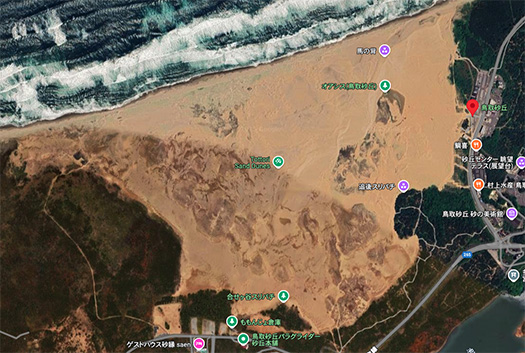
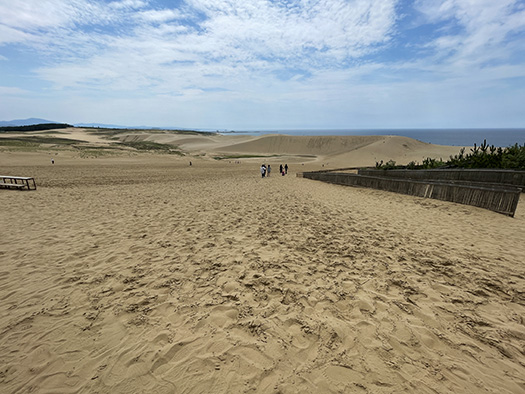
 広さはおおむね東西南北2kmほどのスパンで、まさに広大な「砂場」。写真のようにまことに「広大な砂漠」というイメージ。さすがにビジターセンターの出発点から海岸線に沿った段丘スポットまでを一望して、高年齢者としては、これはそこそこの往復運動量とは思われた。でもいまのところ毎日10,000歩程度はウォーキングしているので、軽々と出発。途中で素足で歩きたくなって靴を脱いでおりました。さて「熱さ」はどうかと体感したくなったのですね。現地では7月以降の真夏には裸足はオススメできません、という案内。体感では往復おおむね2kmで足裏にはそこそこの熱さが溜まって、最後は「アチチ」状態となりました。ただ、砂の表面を少し2-3cm足で掘ってみるとそれなりの低温感も得られていた。しかし真夏時期には確かにアチチの猛威は燃えさかりそうだと実感できた。最後はそのほてりを抑えるべく、ベンチで足についた砂を払いながらしばし冷却させていました。
 ビジターセンターを中心にして広がった地域自然ミニツアーゾーンという感じでしょうか。ラクダ観光もあって1回1600円という料金で記念撮影などもあるという「観光」ぶり。子ども時代からの空想イメージに対しての現実解が得られたことでそこそこの充足感。けっして「ガッカリ」感はありませんでしたよ。

●お知らせ
拙書「作家と住空間」幻冬舎から電子書籍で発刊
お求めはAmazonで。
https://amzn.asia/d/eUiv9yO

English version⬇

[Tottori’s “Giant Sandbox” Achichi Experience / Tottori Sand Dunes]
A sightseeing spot that offers a completely different experience from the Sapporo Clock Tower and Kochi Harimaya Bridge. I was so excited that I was able to cheerfully traverse the 2 km round trip. Tottori Sand Dunes

 My wife wanted to visit the Tottori Sand Dunes, so we extended our trip this time. Well, it was not a major destination, but rather a “motive” for achieving my goal of conquering all the prefectures in my life as a traveler.
 Since there was no specific artist’s residence to explore, I did no prior research at all. However, I still had an imprint in my mind that Tottori is famous for its sand dunes. What kind of dunes?
 I had an image of the dunes as a “desert” that does not exist in Japan, and I had an image of vastness like camel sightseeing, but when I arrived there, I had the impression that it was completely a “sightseeing spot. I had the impression that it was a natural tourist spot, with the Kengo Kuma landmark architecture I introduced yesterday.
 The area spans approximately 2 km from east to west, north to south, and south to north, and is truly a vast “sandbox. As you can see in the photo, it is truly a “vast desert. As an older person, I thought it would be a good amount of exercise to make a round trip from the starting point of the visitor center to the terraced spot along the coastline. But since I am currently walking about 10,000 steps every day, I set off lightly. On the way there, I took off my shoes because I wanted to walk barefoot. So you wanted to experience the “heat. The local guide said that barefoot is not recommended in midsummer after July. The heat was so intense that I felt a “hot” sensation on my soles after walking about 2 km round-trip. However, when I dug my feet 2-3 cm into the sand surface, I also felt a reasonable low-temperature sensation. However, I could feel that the fury of the achichi was certainly going to flare up in the midsummer period. At the end of the day, I had to cool down by brushing the sand off my feet on a bench in order to keep that hot flare-up at bay.
 I guess you could call it a regional nature mini-tour zone spread out around the visitor center. There is also a camel tour for a fee of 1,600 yen per visit, which includes a commemorative photo. I felt a sense of satisfaction in having found a real-life solution to my childhood fantasy image. I was not disappointed at all.

Notice
My book “Writers and Living Space” is published as an e-book from Gentosha.
Please visit Amazon to purchase it.


【鳥取砂丘周辺・隈研吾「タカハマカフェ」】


 さて鳥取県に来たので敬意を込めて「鳥取砂丘」を訪問。あ、一応こちらが地元の総理のお菓子も先般紹介もさせていただいた。支持はあんまり・・・ですが(笑)。
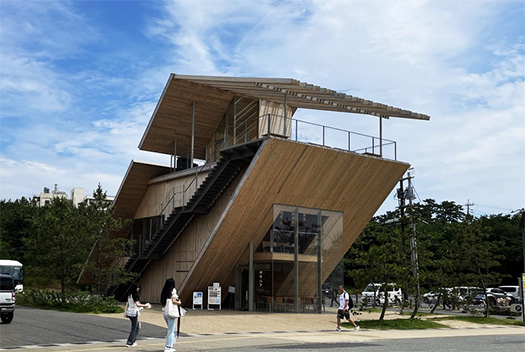
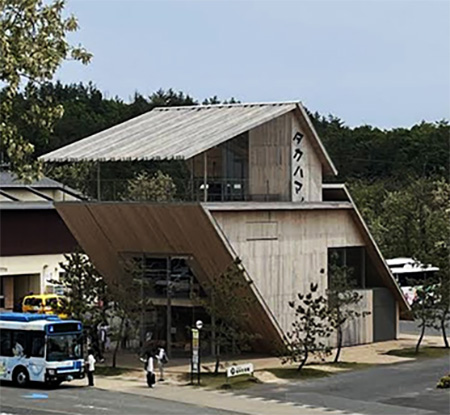
 砂丘では靴を脱いで裸足になって往復2km以上、子ども時代以来の「砂場遊び」。砂場があるので石破もいるのかなぁ(笑)。やや足はホットになって清潔になったような気分。で、なにげにビジターセンター向かいの変わった建築に惹かれてしまった。まったく予備知識なく「なにこれ」と目が驚いていた。
 ちょっとググったら案の定、設計は隈研吾氏の「タカハマカフェ」とのこと。足のほてりもあったので、しばしアイスコーヒーでもということで中でひと休み。
 以下はWEBでの紹介要旨引用。〜構造はRCですが、壁材や天井材に木質CLTが使われて中は完全に木質空間。このCLT、仕上げに鳥取県産の杉のラミナ材が貼ってある。また家具類は同じく鳥取県産材がたくさん使われオリジナル照明に貼られた和紙も鳥取県の和紙が使われている。〜
 というようないかにも観光客向けの「これでどうだ」的な建物。訪問時はとにかく足のほてりを癒すために休息したかった一択。店内に入って1階に喫茶飲み物注文カウンターがあってそこで注文して飲み物を受け取って、自由に店内の好きな場所に移動するシステム。最初は3階のオープンテラスに向かったけれど、こちらには残念ながら、飲み物を置くテーブルがなかったので2階に移動。
 こちらでは砂丘側に向かって眺望が広がっている椅子席が1ボックスだけ。その「特等席」はすでに先客がいてその他の席は、眺望のない場所でだれもいない。視線を外部に向けるとするとどうしてもその特等席を「見つめ」なければならないので、他の場所の客は眺望を遠慮せざるを得ない。このあたり、大胆な外観形状のオシャレさ最優先で、室内からの外部眺望の極端な有利不利を感じさせられた。
 
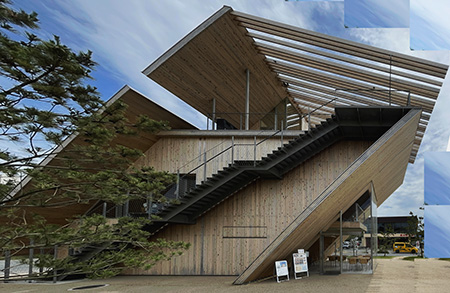
 これは真横から外観形状を狙った写真でしたが、後退距離が取れず広角ではどうしても画角変形。しかたなく画像修正して外観「見え」復元をこころみた画像。う〜む、オシャレだけど活用利便はどうも・・・という印象。まぁ滅多に来ない観光地のランドマークということでしょうか?

●お知らせ
拙書「作家と住空間」幻冬舎から電子書籍で発刊
お求めはAmazonで。
https://amzn.asia/d/eUiv9yO

English version⬇

[Around Tottori Sand Dunes, Kengo Kuma’s “Takahama Cafe”]
A big discrepancy between the eye surprise of the architectural exterior and the usability of the interior. Well, I wonder if it aims to be a landmark of a rarely visited tourist spot? …

 Now that we are in Tottori Prefecture, we pay our respects and visit the “Tottori Sand Dunes”. Oh, and in case you are wondering, we also recently introduced the local prime minister’s snacks here. I don’t really support him… (laughs).
 At the dunes, I took off my shoes and went barefoot for a round trip of more than 2 km, playing in the sandbox for the first time since my childhood. I wonder if there are stone breakers because of the sandbox (laugh). My feet felt somewhat hot and clean. Then, I was attracted by the unusual architecture across the street from the Visitor Center. Without any prior knowledge of the place, my eyes were surprised to see it.
 I googled a bit and sure enough, it was the “Takahama Cafe” designed by Kengo Kuma. My feet were burning, so I decided to take a break inside for a cup of iced coffee.
 The following is a quote from the introduction on the web. 〜The structure is RC, but the walls and ceiling are made of wood CLT, making it a completely woody space inside. This CLT is finished with lamina wood of Japanese cedar produced in Tottori Prefecture. The furniture is also made of Tottori Prefecture’s lumber, and the Japanese paper used for the original lighting is also made of Tottori Prefecture’s paper. 〜 The building is a tourist-oriented building, with a “how’s this for you? When I visited, I just wanted to take a rest to heal my burning feet. After entering the restaurant, there is a coffee and beverage ordering counter on the first floor, where you place your order, receive your beverage, and then move freely to your favorite spot in the restaurant. We first headed for the open terrace on the third floor, but unfortunately, there were no tables for drinks there, so we moved to the second floor.
 Here, there is only one box of chair seats with a view toward the dune side. The “special seat” had already been occupied by a guest, and the other seats were empty without a view. If one’s gaze is directed to the outside, one must “gaze” at the “special seat,” so the guests in other places must refrain from looking at the view. In this area, the fashionable bold exterior shape is given top priority, and we were made to feel the extreme advantageous disadvantage of the exterior view from the interior.

 This photo was taken to capture the shape of the exterior from the side, but the angle of view was inevitably deformed at wide angle because of the lack of backward distance. I had no choice but to modify the image to try to restore the “look” of the exterior. Well, it is fashionable, but I have the impression that it is not very useful. I guess it is a landmark of a sightseeing spot rarely visited by tourists.

Notice
My book “Writers and Residential Space” is published by Gentosha as an e-book.
Please visit Amazon for more information.

【日本庭園の美感追究 足立美術館の印象】


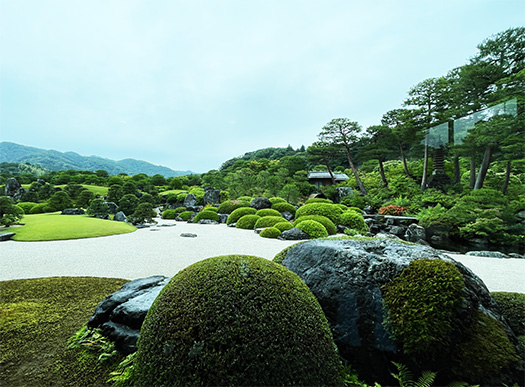
 近年、欧米の「庭園専門誌」の年度ごとの表彰制度で、島根県の足立美術館の庭園が連年、最優秀賞として顕彰され続けている、というNHK番組での紹介が続いている。
 日本庭園というのはたしかにオモシロい文化現象であり、和の文化の精緻であることも理解できる。わかりやすいところでは京都の伝統文化施設では、その背景あるいは主役として日本的な庭園美が追究されている。住宅と庭という関係性では長い歴史積層からこの列島の気候風土の中でのオリジナルな植生を生かした庭園美が追究されてきた。その積層はすごいことだと思っている。
 しかし一方で、北海道人としてはそういう日本的な植生とはやや違う樹種の自然条件と、なんといっても冬期の積雪のすさまじさ〜札幌で年間積雪6m超という自然環境の中では、そのままの庭園文化は成立しない地域にわたしたちは住み続けている。勢い、その「エッセンス」を受け取って「北国らしい」庭園美を探求するという立場に立たざるを得ない。そういう現実の中では、より気候条件に共通性がある欧米的なスタイルに惹かれるようになるのも、自然だと思っている。
 現実的に冬期間約4ヶ月以上の積雪環境では、いかにも和風庭園的な構成は望めない。
 そうではあるけれど、わたしたち北海道人も日本文化圏のなかの一員であることは事実。できるだけ、こうした和の庭園美の世界に親しみたいという潜在的な願望はある。
 そんな気分で、この足立美術館の庭園美に浸って見た次第です。
 ・・・心理的な受け止め方としては、すばらしい。けれど、やはり距離感がある、といったところ。
 この庭園美を維持し続ける庭師さんたちの努力は本当に頭が下がる思い。そして、借景となっている後背の自然環境にも配慮して、日本的庭園美を維持し続けている努力にはほんとうに脱帽であります。こういった和の伝統的な環境・素材とは違った道具立てで、北海道らしい「拡張された花鳥風月」への探究が実際的なんだろうと再確認させられた次第。

●お知らせ
拙書「作家と住空間」幻冬舎から電子書籍で発刊
お求めはAmazonで。
https://amzn.asia/d/eUiv9yO

English version⬇

Japanese Garden Aesthetic Pursuit: Impressions of the Adachi Museum of Art]
Japanese garden beauty that interacts with Japanese-style vegetation. The snow-covered environment of the north that nullifies such efforts and covers everything. How can we create “Kacho Fu Fugetsu” (flowers, birds, winds, and the moon) that is uniquely Hokkaido? …

 In recent years, NHK has been reporting that the Adachi Museum of Art in Shimane Prefecture has been awarded the top prize in the annual awards program of a Western “garden magazine” for many years in a row.
 Japanese gardens are indeed an interesting cultural phenomenon, and it is understandable that they are an exquisite example of Japanese culture. In Kyoto, for example, traditional cultural facilities are pursuing the beauty of Japanese-style gardens, either as a backdrop or as a mainstay. In the relationship between houses and gardens, the beauty of gardens that take advantage of the original vegetation in the archipelago’s climate has been pursued for a long time. I think this layering is a wonderful thing.
 On the other hand, as Hokkaido residents, we continue to live in an area where the natural conditions of tree species are somewhat different from those of Japanese vegetation, and where the snowfall in winter is so great that the annual snowfall in Sapporo exceeds 6 meters, that garden culture as it is cannot be established. We have no choice but to take the “essence” of the snowfall and seek the beauty of “northern-style” gardens. In such a reality, I think it is natural to be attracted to the Western style, which has more in common with the climatic conditions.
 In reality, we cannot hope to create a Japanese-style garden in an environment where snow accumulates for more than four months during the winter.
 Nevertheless, it is a fact that we Hokkaido people are a part of the Japanese cultural sphere. We have a latent desire to become familiar with this world of Japanese garden beauty as much as possible.
 It was with this in mind that I immersed myself in the garden beauty of the Adachi Museum of Art.
 The psychological reception was wonderful, but there was still a sense of distance. However, there is still a sense of distance.
 I really admire the efforts of the gardeners to maintain the beauty of the garden. I also take my hat off to the gardeners for their efforts to maintain the Japanese-style beauty of the garden while also taking into consideration the natural environment of the hinterland from which the garden borrows its scenery. I was reminded that it is practical to explore the “extended beauty of flowers, birds, winds, and the moon” that is typical of Hokkaido, using tools different from those used in traditional Japanese environments and materials.

Notice
My book “Writers and Residential Space” is published by Gentosha as an e-book.
Please visit Amazon for more information.

【戦争が奪った片腕とネジ式の腕血管切断 水木しげる館-5】


 きのう、本来シリーズ的に「水木しげる」館探訪記を記していたのに、思わずわたし自身の「こころの原風景」のシンボルに遭遇して、詠嘆的にスピンアウトしてしまった。
 自分自身の「ふり返り」の時間、日々生存活動に没頭して無念無想で走り続けていた自分自身の足許を再探索し始めた2年近い時間経過。そうしたいとなみから「中心軸」を再度見定める時間が巡ってきた感。友人から「つげ義春のネジ式は、深い」というつぶやきにも似た印象があったけれど、あの同時代に青春期を過ごしていた人間としては、強く同意させられていた。「え、もう一回あの空気に身をさらすのか・・・」と。
 それもこれも、山陰鳥取県の西端・境港市の町のにぎわい復興の担い手として多くの日本人に共感を呼び起こしている「水木しげる」記念館の大きな「戦果」なのだと思う。わたし自身「作家と住空間」というテーマ設定でセカンドの行脚を旅し始めてきて、どうも自分自身の内臓探索にも似た気分を感じ続けている。
 やはり自分の決定的な「こころの場所」に帰ってこざるを得ない、という印象だろうか。
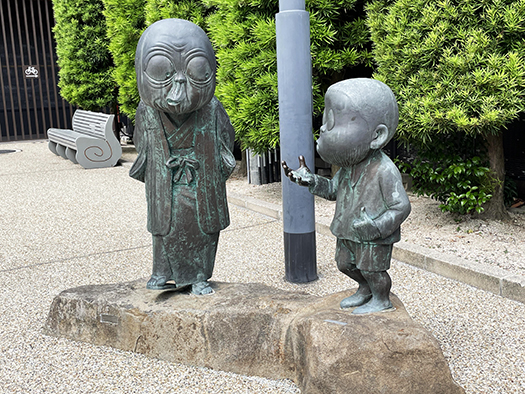
 写真は水木しげる記念館のフロントに置かれた「のんのんばあと水木しげる少年」の像。水木しげるはわたしの父母の年代に近い存在だけれど、かれも遭遇し活躍した戦後マンガの大嵐のなかから、わたし自身はその子ども世代として文化的に揺籃されてきたことに再度正対させられている。
 つげ義春は、15歳年上ということで、年代的にはわたしには歳の近い叔父か、年の離れた長兄のような年代層に位置している。なので「こころの時代感」としては父母よりも身近で、近接した同一時代的な存在。
 ネジ式には、水木しげる的などっぷりとした土着民俗性とは離陸した感覚がある。最初のイラスト画面、メメクラゲに攻撃されて血管が破断した腕を押さえながら、海から上陸してくる場面の上空にはB29とおぼしき爆撃機が描かれているような画面から「始まった」人生世代なのかも知れない。
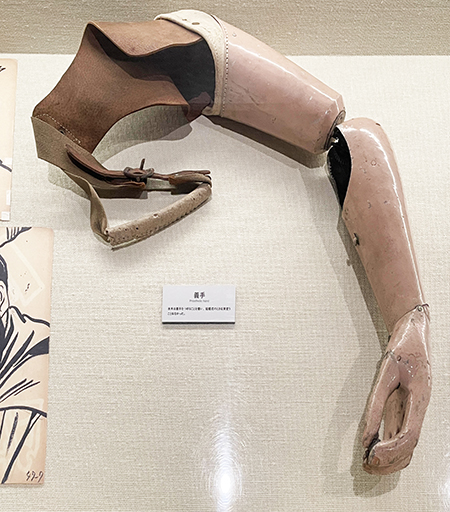
 水木しげるは片手を戦争で失っている。
 夢ドラマとしての「ネジ式」では最後、モーターボートに乗った主人公が、血管をネジ式に改造した様子で海上を疾走するシーンで締めくくられている。このことが、水木とつげの「ミッシングリンク」の表現だったように、いまは強く思えている。さてどうだろうか?

●お知らせ
拙書「作家と住空間」幻冬舎から電子書籍で発刊
お求めはAmazonで。
https://amzn.asia/d/eUiv9yO

English version⬇

[One Arm Taken Away by War and Screwed Arm Vasectomy: Shigeru Mizuki – 5]
The war trace of Shigeru Mizuki’s “one arm” overlaps with the difficult “screwed” major story. The traces of the “heart” of postwar Japanese. …

 Yesterday, I had originally intended to write a series of articles on my visit to the “Shigeru Mizuki” museum, but I unexpectedly came across a symbol of my own “original landscape of the heart” and spun out into a poem.
 It has been nearly two years since I began to “reflect” on myself, and to re-explore my own footsteps, which I had been running without thought, immersed in daily survival activities. I feel as if time has come for me to re-focus on the “central axis” of my life. A friend of mine had the impression that “Yoshiharu Tsuge’s screw formula is deep,” and as someone who spent my adolescence in that same period, I was compelled to agree. But as someone who had lived through that period of adolescence, I strongly agreed with him.
 I believe that this is the great “war result” of the Shigeru Mizuki Memorial Museum, which has aroused the sympathy of many Japanese people as a leader in the reconstruction of the bustling town of Sakaiminato, located on the western edge of Tottori Prefecture in the San-in region. As I have begun my second journey on the theme of “the artist and his/her living space,” I continue to feel as if I am searching for my own internal organs.
 I guess I feel that I have to come back to my definitive “place of the heart.
 The photo is a statue of “Nonnonbato Mizuki Shigeru Boy” placed in front of the Shigeru Mizuki Memorial Museum. Although Shigeru Mizuki is close to the age of my parents, I am confronted once again with the fact that I, as a child of Shigeru Mizuki, have been culturally cradled in the midst of the postwar manga storm that he also encountered and was active in.
 Yoshiharu Tsuge is 15 years older than me, which puts him in the same age bracket as my uncle or eldest brother. Therefore, in my “sense of the age of the heart,” he is closer to me than my parents, and he is in the same age group as them.
 In Nejishiki, there is a sense of detachment from the Mizuki Shigeru style of indigenous folklore. Perhaps it is the generation of life that “began” with the first illustration screen, a screen that seems to depict a B-29 and a dim bomber in the sky above a scene of a man coming ashore from the sea while holding his arm with a broken blood vessel after being attacked by a meme jellyfish.
 Shigeru Mizuki lost one hand in the war.
 In “Nejishiki” as a dream drama, the film ends with a scene in which the main character, in a motorboat, is speeding through the sea with his blood vessels seemingly converted to a screw type. I now strongly feel that this was an expression of the “missing link” between Mizuki and Tsuge. What do you think?

●Notice
My book “The Writer and the Living Space” is published by Gentosha as an e-book.
Please visit Amazon for more information.


【水木しげるからいっとき、スピンアウト・・・つげ義春へ】


 旅をするとそこで出会う情報の「宝庫」に刺激されて、どんどんとその領域が拡大してしまう。いまは、鳥取県境港市が市を挙げて観光活性化の起爆剤にしている水木しげるをめぐっての情報世界に耽溺しているのですが、その探索の過程でふと「つげ義春が、水木しげるの水木プロダクションというマンガ制作集団に一時期所属していた」という事実に突き当たって、あまりの懐かしさに、ついスピンアウトしてしまった・・・。
 まぁわたし自身の「人生まとめ」的なふり返りとしても、これからの自分自身の旅は機能していく予定なので、まったく目的的には合致する流れだなぁとひとりで腑に落ちている。
 そうなのです、1968-70年当時、戦後学生運動高揚期が青春期であったわたしは、やがて司馬遼太郎の日本人的な歴史文学世界に耽溺していく直前期、巨大な「日本マンガ文化大革命」のただ中でこころが燃え上がっていた。その最絶頂期に雑誌「ガロ」に突然掲載された、つげ義春「ネジ式」に強い衝撃を受けていた。
 「え、水木しげるは、つげ義春をスタッフとして使っていたんだ・・・」という驚き。
 これは、あの時代の空気感覚から「おい、オマエ、この世界のことを忘れたままにしておくのかよ?」と、激しい情熱で呼び戻される衝撃を感じさせられた次第。当然「参りました、いさぎよくその内奥からの叫び声に、身を任せることにいたします」と降参してきてしまっている。
 ・・・ということで、何年も仕舞い込まれていた写真の記念碑的な「記録本」を眺め始めていた。
 はじめて読んだ「ガロ」は、当然、いま手許にはない。というか、そういったマンガ本の類いはその後の人生流転に付随する住居移転の結果として「もののあはれ」となってしまっている。写真の本は新潮社から2014年に発刊された本。ふと気付いて買い求めていた。ただ、その購入動機はすぐに読みたい、ではなくそのうち「ふりかえる」ときのため、と思って購入していたモノ。
 今回の水木しげるとつげ義春の「線」のつながりの発見は、だんだんラストのライフテーマとも重なってくるように思われてきております。
 
●お知らせ
拙書「作家と住空間」幻冬舎から電子書籍で発刊
お求めはAmazonで。
https://amzn.asia/d/eUiv9yO

English version⬇

[From Shigeru Mizuki to Iki, Spinning Out… to Yoshiharu Tsuge]
conflict between life and the culture of expression. Japan’s world-class “Manga Cultural Revolution” was exploding at the same time. I thought it was time to confront it once again. …

 When I travel, I am stimulated by the “treasure trove” of information I encounter there, and the realm of information expands more and more. In the process of my search, I suddenly came across the fact that “Yoshiharu Tsuge belonged for a time to a manga production group called Mizuki Productions,” which is owned by Shigeru Mizuki, and I was so nostalgic that I spun out. I was so nostalgic that I spun out of the page….
 Well, my own journey will also function as a “summary” of my own life, so I am convinced that this is exactly the right course of action for my purpose.
 I was in my youth from 1968 to 1970, when the postwar student movement was in full swing, and just before I became absorbed in the Japanese historical literature of Ryotaro Shiba, my heart was burning in the midst of the huge “Japanese Manga Cultural Revolution”. At the height of the revolution, Yoshiharu Tsuge’s “Nejishiki,” which suddenly appeared in the magazine “Garo,” had a strong impact on him.
 I was surprised that Shigeru Mizuki was using Yoshiharu Tsuge as a staff member.
 This was a callback from the atmosphere of that era, “Hey, omae, are you going to leave this world behind you?” I felt the shock of being called back to the world with intense passion. Naturally, I have surrendered, saying, “I am here, and I am going to let myself be overcome by the cry from deep within.
 So I began to look at the monumental “record book” of photographs that had been stowed away for years.
 Naturally, I don’t have the “Garo” that I read for the first time. Or, rather, those kinds of manga books have become a thing of the past as a result of my subsequent life changes and residential relocations. The book in the photo was published by Shinchosha in 2014. I suddenly realized that I had to buy it. However, my motive for purchasing the book was not that I wanted to read it right away, but rather that I wanted to have it for when I “look back” on my life in the future.
 The discovery of the connection between Shigeru Mizuki and Yoshiharu Tsuge’s “lines” seems to gradually overlap with the last theme of my life.
 
●Notice
My book “Writers and Residential Space” is published by Gentosha as an e-book.
Please visit Amazon to purchase it.